
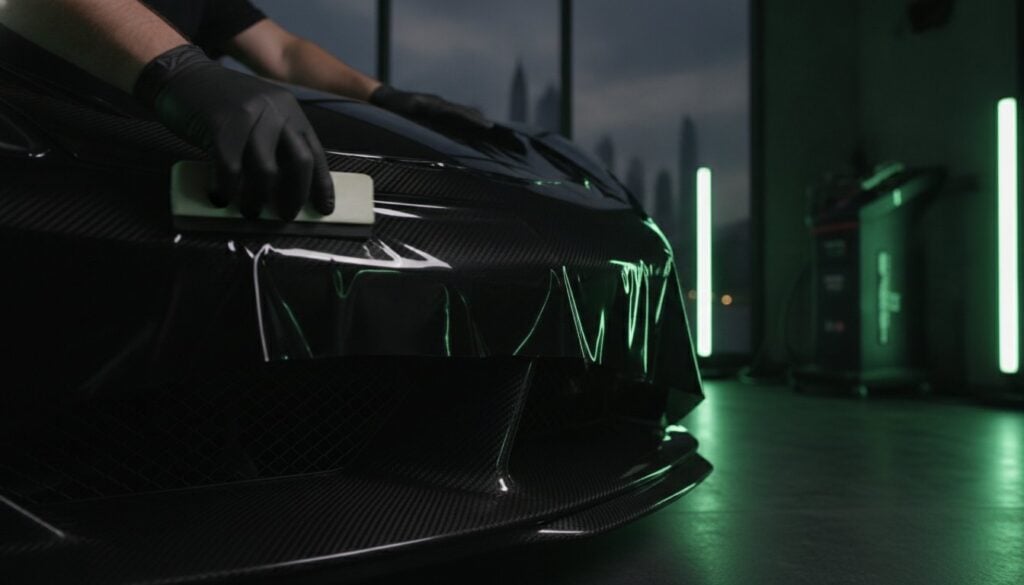
A flawless finish on a flat hood is expected, but the true test of an elite installer lies in the aggressive recesses of a Brabus front fascia or the sharp angles of a Mansory wing. Mastering the art of wrapping complex bumpers and spoilers is a test of tension management and material memory that only elite precision can pass. You likely understand the frustration of seeing “fingers” or lifting edges on a fresh wrap after just one week in the intense sun. The fear of visible seams or, worse, blade marks on your factory paint is a valid concern for any high-end vehicle owner.
This 2026 professional guide reveals the elite techniques and material science required to achieve a seamless, factory-quality finish on the most challenging automotive contours. Discover how to achieve a paint-like result while ensuring long-term durability in high-heat environments. We will break down the critical differences between amateur applications and elite installations, providing you with the confidence to choose the right shop for your next kit conversion. From managing film stretch to understanding post-heating requirements, we explore the meticulous care required to transform your vehicle into a masterpiece of aerodynamic art.
Key Takeaways
- Understand the physics of material memory to prevent vinyl from lifting in deep recesses and sharp aerodynamic angles.
- Master advanced manipulation techniques like the “Inlay” strategy to manage tension on the most extreme automotive contours.
- Identify why premium cast films are the only viable choice for wrapping complex bumpers and spoilers in high-heat environments.
- Implement a rigorous precision workflow, from clean-room decontamination to essential post-heating protocols that lock the finish in place.
- Learn how to maintain the design integrity of aggressive carbon fiber lines during bespoke body kit conversions.
Mastering the Geometry: Why Complex Bumpers and Spoilers Challenge the Pros
Modern automotive aesthetics in 2026 have pushed the boundaries of traditional installation. We’re seeing deep air intakes, razor-sharp splitters, and multi-tiered wings that demand more than just basic skill. Successful wrapping complex bumpers and spoilers requires a technical understanding of how film behaves under extreme stress. Every aggressive curve introduces a battle between the installer’s vision and the vinyl’s physical properties. On high-end supercars, where every millimeter is scrutinized, there is no room for error or compromise.
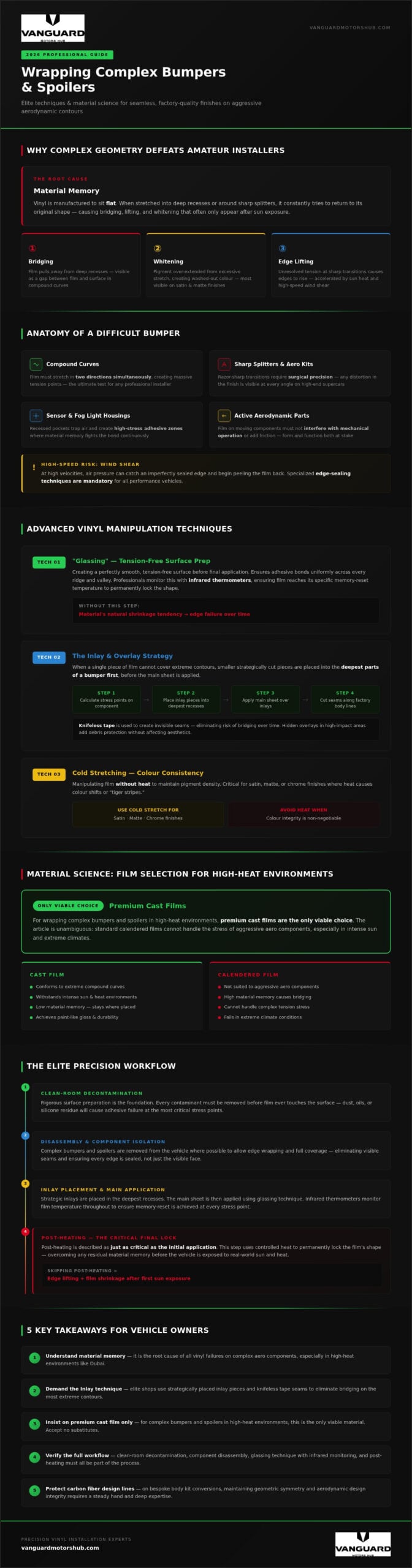
The primary challenge is material memory. Most vinyl wrap materials and applications involve a film manufactured to sit flat. When you stretch that film into a deep license plate well or around a sharp carbon fiber splitter, the material naturally wants to return to its original shape. If tension isn’t managed with precision, you’ll see “bridging” where the film pulls away, or “whitening” where the pigment is over-extended. These failure points often don’t appear until the car sits in the sun, making the post-heating process just as critical as the initial application.
The Anatomy of a Difficult Bumper
Compound curves are the ultimate test for any professional. Unlike a simple fender, a complex front bumper requires the film to stretch in two directions simultaneously. This creates massive tension points that lead to edge lifting if not handled correctly. Recessed areas around sensor housings and fog light surrounds also present hurdles. These pockets trap air and create high-stress zones where the adhesive must fight the film’s memory. Sharp transitions on aggressive kits require surgical precision to ensure the film follows every contour perfectly without distorting the final finish.
Aerodynamics and Spoilers: High-Speed Considerations
Spoilers present unique challenges that go beyond simple aesthetics. At high velocities, wind shear becomes a significant factor. If an edge isn’t perfectly sealed, air pressure can catch the film and begin to peel it back. This is why specialized edge-sealing techniques are mandatory for performance vehicles. Active aerodynamics add another layer of difficulty. When wrapping complex bumpers and spoilers with moving parts, the film must not interfere with mechanical operation or add friction. For those pursuing a Vanguard transformation, precision is the only standard to maintain both form and function.
Advanced Vinyl Manipulation: Techniques for Seamless Coverage
Achieving a paint-like finish on intricate aero parts requires more than just heat and a squeegee. It’s about “glassing” the film, a technique where the installer creates a perfectly smooth, tension-free surface before the final application. This stage is critical when wrapping complex bumpers and spoilers, as it ensures the adhesive bonds uniformly across every ridge and valley. Professionals monitor this process with infrared thermometers, ensuring the film reaches its specific memory-reset temperature to lock the shape permanently. Adhering to professional automotive surface material standards ensures the longevity of the install in extreme climates. Without this precise heat management, the material’s natural tendency to shrink will eventually lead to failure at the edges.
The Art of the Inlay and Overlay
When a single piece of film isn’t enough for wrapping complex bumpers and spoilers, we must calculate the exact stress points of the component. The “Inlay” strategy involves placing small, strategically cut pieces of film into the deepest parts of a bumper before applying the main sheet. By using knifeless tape, our technicians at Vanguard create invisible seams along factory body lines. This method eliminates the risk of the film pulling back or “bridging” over time. Hidden overlays are also used in high-impact areas to provide extra protection against road debris without compromising the aesthetic. It’s a meticulous process that requires a steady hand and an eye for geometric symmetry.
Cold Stretching for Color Consistency
Cold stretching is the technique of manipulating film without heat to maintain pigment density. This approach is vital for satin, matte, or chrome finishes where heat can cause unsightly color shifts or “tiger stripes.” By working the material cold, the installer preserves the uniform look of the wrap. This precision is especially important when dealing with parking sensors. A skilled technician wraps around these sensors with such accuracy that they remain fully functional while looking like a factory-painted component. This level of craftsmanship ensures that even the most complex aero kits maintain their visual impact from every angle. If you’re ready to elevate your vehicle’s appearance, consult with our precision wrapping team.
Material Science: Selecting the Right Film for High-Tension Curves
The success of wrapping complex bumpers and spoilers hinges on the molecular structure of the chosen film. While calendered vinyl is suitable for flat surfaces, it lacks the stability required for deep channels and aggressive aero. Premium cast vinyl is the only viable option for elite components. These films are manufactured in a relaxed state, meaning they don’t possess the “shrink-back” tendencies found in cheaper materials. High-end cast films offer the conformability needed to follow the aggressive lines of a Brabus or Mansory conversion without internal stress or pigment distortion.
Modern adhesive technology has revolutionized how we handle intricate surfaces. Advanced air-release channels allow trapped air to escape during the squeegee pass, preventing the micro-bubbles that plague amateur installs. We look for a balance between low initial tack, which allows for precise repositioning, and a powerful long-term bond. This ensures the wrap remains secure against the wind shear forces encountered at high speeds. Research from the U.S. Department of Energy Vehicle Technologies office highlights the importance of advanced surface coatings in maintaining vehicle integrity under thermal stress. In our national climate, UV resistance and heat stability are non-negotiable requirements for any professional installation at Vanguard.
Vinyl vs. Color PPF for Complex Parts
When choosing between traditional vinyl and color Paint Protection Film (PPF), thickness is the primary differentiator. Standard vinyl is roughly 3-mil thick, providing maximum flexibility for tight corners. Conversely, 8-mil PPF offers superior impact resistance and self-healing properties. For a daily-driven supercar, PPF is the superior choice for front bumpers to guard against road debris. However, for show cars with hyper-complex splitters, the thinner profile of vinyl may be necessary to achieve a seamless look. We often recommend a hybrid approach to maximize both protection and aesthetics on high-end kit conversions.
The Rise of Peelable Paint for Intricate Aero
Certain components, like honeycomb grilles and mesh intakes, are nearly impossible to cover with traditional film. This is where peelable paint applications excel. It provides a 100% paint-like finish with zero seams, even on the most intricate patterns. By combining film on large body panels with peelable paint on complex aero accents, we achieve a level of finish that was previously impossible. This hybrid protection strategy ensures every millimeter of your vehicle is shielded and visually perfect, regardless of how challenging the geometry may be. It’s the ultimate solution for those demanding a factory-quality finish on the most aggressive aftermarket parts.
The Precision Workflow: From Disassembly to Post-Heating Excellence
Elite quality begins in a controlled atmosphere where air filtration is non-negotiable. A successful installation of wrapping complex bumpers and spoilers is as much about the environment as it is about the technician’s hand. Microscopic dust particles can ruin a high-gloss finish, creating visible imperfections that compromise the factory-quality look. Surface preparation goes far beyond a standard car wash. We utilize a multi-stage decontamination process involving mechanical clay bar treatment and specialized chemical solvents. This ensures every ridge of an aggressive air intake is free of waxes, oils, and road contaminants that could hinder adhesive performance.
The debate over disassembly often separates enthusiasts from experts. While some shops prefer on-car application to save time, true precision requires a deeper approach. Removing the bumper or spoiler allows for a more comprehensive wrap that extends behind the panels. This technique eliminates visible seams and provides a level of durability that surface-level wrapping cannot match. When wrapping complex bumpers and spoilers on a supercar, the margin for error is zero, and the workflow must reflect that standard of care.
Disassembly and Hardware Removal
Achieving a seamless look requires the meticulous removal of badges, parking sensors, and cameras. By wrapping the component in its disassembled state, we ensure the film follows the natural lines of the hardware housings. For multi-tiered spoilers, we wrap around fasteners and mounting points with surgical accuracy. This prevents the film from bunching or lifting at high-stress connection zones. Our technicians follow factory torque specifications during reassembly, ensuring that every electronic sensor and active aerodynamic system remains fully calibrated and functional.
Post-Heating and Quality Control
Post-heating serves as the final seal of excellence. We use thermal imaging to verify that the film has reached its specific memory-reset temperature across every complex curve. This process locks the vinyl into its new shape, preventing it from trying to return to its original flat state. Every vehicle undergoes a 24-hour settling period in a climate-controlled bay. This time allows the adhesive to reach its maximum bond strength before the car faces the elements. We apply specialized edge sealers and primers to high-risk tension areas, guaranteeing a finish that withstands extreme national climates. Schedule your professional precision wrap consultation today.
Bespoke Finishing at Vanguard: Protecting Elite Body Kits
Elite automotive transformation is a multi-disciplinary challenge. It demands a seamless blend of mechanical expertise and aesthetic precision. When performing a Brabus body kit installation, our technicians don’t just bolt on components; we analyze the kit’s specific geometry to determine the optimal approach for wrapping complex bumpers and spoilers. This master-level understanding ensures the film complements the aggressive lines of Mansory and Jetour kits without compromising their aerodynamic function. In cases where components have sustained minor damage during transport or previous use, we integrate carbon fibre car parts repair to restore structural integrity before the aesthetic transformation begins. This holistic approach guarantees that the final finish is as durable as it is visually striking.
Wrapping Aggressive Aftermarket Aero
Aggressive widebody fender flares and multi-tiered wings present unique challenges that standard wrapping techniques cannot solve. Managing these sharp angles requires the specialized manipulation methods discussed earlier, such as strategic inlays and tension-free glassing. Achieving a factory look on carbon fiber diffusers and splitters is the ultimate test of an installer’s skill, especially when maintaining the weave’s visual continuity. We specialize in customizing Jetour kits to provide a unique national presence on the road. Every edge is tucked with surgical precision, ensuring the aggressive aero parts look like they were finished in a dedicated factory paint booth. This meticulous attention to detail is why elite kit conversions at Vanguard are recognized for their flawless execution and long-term stability.
The Vanguard Premium Package Approach
The Vanguard Premium Package offers more than just a color change; it’s a comprehensive preservation strategy. We combine the technical art of wrapping complex bumpers and spoilers with world-class supercar detailing to preserve the vehicle’s long-term value and aesthetic brilliance. Maintaining wrapped complex parts in high-heat environments requires specific chemical care and periodic inspections. We provide our clients with professional maintenance protocols to ensure the film remains vibrant and secure against the intense national sun. This proactive care prevents edge lifting and pigment degradation, ensuring your vehicle remains a masterpiece of form and function for years to come. Consult with our master installers at Vanguard Motors Hub to begin your bespoke conversion journey and experience the pinnacle of automotive customization.
Redefining the Standard for Elite Automotive Customization
Achieving a factory-grade finish on high-performance aero parts isn’t just a service; it’s a technical discipline. We’ve explored how mastering material memory and employing advanced inlay strategies are essential for wrapping complex bumpers and spoilers. From selecting premium cast films to executing a meticulous disassembly workflow, every step ensures your vehicle withstands the intense national climate while maintaining its visual impact. Precision is the only acceptable standard when dealing with the aggressive geometries of modern supercars.
Vanguard Motors Hub stands as a visionary leader in the automotive sector. Our master-level installers specialize in Brabus and Mansory conversions, providing the meticulous care required for supercars and luxury SUVs. We offer a comprehensive approach that bridges the gap between aesthetic wraps and professional mechanical upgrades. This ensures your vehicle’s form and function remain perfectly aligned under one roof. Whether you’re pursuing a bold color transformation or a full kit conversion, our expertise guarantees an elite result.
Ready to transform your vehicle with elite precision? Request a Precision Consultation at Vanguard Motors Hub. Your journey toward a flawless finish starts with a commitment to excellence.
Frequently Asked Questions
Can a car wrap cover deep scratches on a bumper?
A vinyl wrap doesn’t hide deep scratches; it often accentuates them because the film conforms to the surface texture. For a factory-quality result, we recommend performing a cosmetic repair or smart repair to level the surface before application. If the damage is structural, our team integrates car damage repair into the workflow. Ensuring a smooth substrate is the only way to achieve a paint-like finish on high-end vehicles.
How long does it take to wrap a complex front bumper?
Wrapping complex bumpers and spoilers typically requires one to two full days of dedicated labor. This timeline accounts for meticulous disassembly, multi-stage decontamination, and the essential 24-hour settling period. Aggressive aero kits from Brabus or Mansory demand even more time due to their intricate recesses and sharp angles. Rushing this process compromises the film’s longevity, especially in the intense national heat where precision post-heating is mandatory.
Will wrapping my spoiler affect its aerodynamic performance?
A professionally installed wrap won’t negatively impact your spoiler’s aerodynamic performance. Premium vinyl films are approximately 3-mil thick, which is negligible for wind resistance. However, for active aero systems, the installation must ensure zero mechanical interference. We focus on precise edge-sealing to prevent wind shear from catching the film at high velocities. This technical approach maintains the aerodynamic integrity of your vehicle while providing a bespoke aesthetic transformation.
Why do wraps sometimes peel in the corners of a bumper?
Peeling usually occurs due to excessive material tension or inadequate post-heating. When wrapping complex bumpers and spoilers, the film’s natural memory wants to pull it back to a flat state. If the installer doesn’t reach the specific memory-reset temperature, the adhesive eventually fails. Contaminants left in the deep recesses during poor surface preparation also cause premature lifting. We use specialized edge primers and infrared thermal imaging to prevent these failure points.
Is it better to wrap or use peelable paint for intricate grilles?
Peelable paint applications are the superior solution for intricate grilles and mesh patterns where traditional vinyl cannot reach. While wraps are excellent for large, smooth panels, the liquid nature of peelable paint ensures 100% coverage with zero seams in complex honeycombs. This hybrid approach allows us to match the color of your main body wrap perfectly. It provides robust protection while maintaining a factory-quality look that vinyl simply cannot replicate on mesh.
Do I need to remove my bumper to get a perfect wrap?
Full disassembly is the only way to achieve a truly seamless, factory-quality finish. Removing the bumper allows our technicians to tuck the film behind the panels, eliminating visible edges and preventing lifting. This deeper wrap provides better protection against the elements and road debris. While on-car wrapping is possible for simple designs, high-end kit conversions demand the precision that only a disassembled workflow can provide. It’s a hallmark of elite automotive care.
How do you handle parking sensors when wrapping a complex bumper?
We wrap parking sensors individually to ensure they maintain full functionality while matching the vehicle’s new aesthetic. Each sensor is treated as a separate component, requiring surgical precision to avoid blocking the ultrasonic signals. This prevents the sensor error messages common with amateur installations. By using cold-stretching techniques, we maintain uniform pigment density across the sensor face. This meticulous attention to detail ensures your safety systems work perfectly alongside your bespoke finish.
Can you wrap carbon fiber spoilers and splitters?
You can absolutely wrap carbon fiber spoilers and splitters. Many owners choose this to protect the expensive resin from UV degradation or to achieve a color-matched look. If the carbon fiber has existing cracks or yellowing, we offer carbon fibre installation and repair to restore the part before applying the film. This combination of structural restoration and aesthetic protection is ideal for maintaining the value of aggressive aftermarket aero components from Mansory or Brabus.