
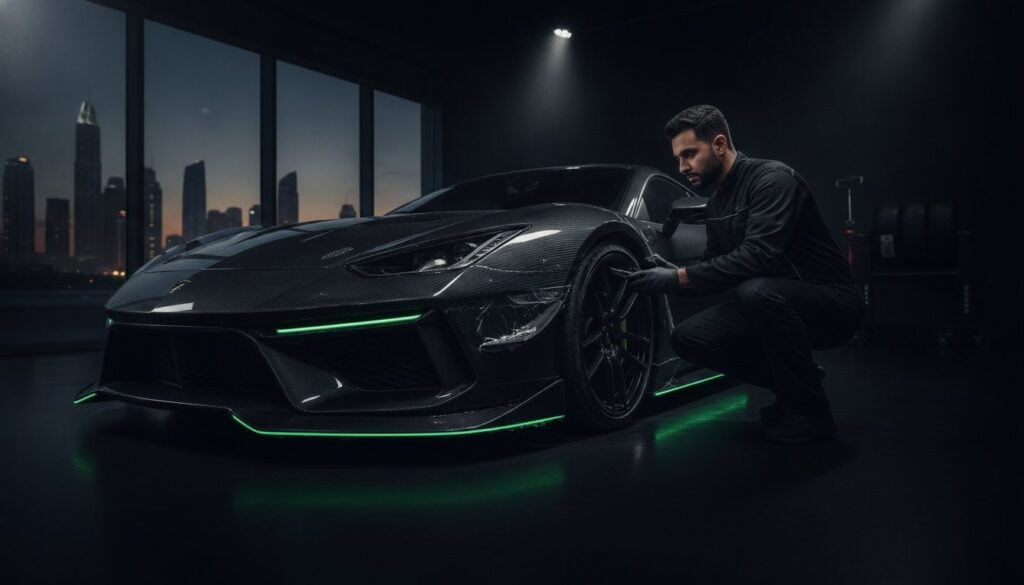
What if the stunning wide-body conversion you’re eyeing is actually a structural liability hidden beneath a layer of fresh paint? It’s a valid fear for any serious collector. You know that a modification is only as valuable as the precision of its execution. When you’re assessing quality of car modifications on a high-performance machine, the line between a masterpiece and a mistake is razor thin. You deserve the confidence that comes with knowing every bolt, seam, and carbon fiber weave meets a global standard of excellence.
This guide delivers the definitive 2026 professional checklist to help you master the art of inspecting modified luxury vehicles. You’ll learn how to identify high-caliber automotive craftsmanship that enhances resale value instead of compromising it. We’ll examine the critical inspection points for elite kit conversions, the technical standards for premium PPF, and the structural benchmarks for bespoke carbon fiber work. It’s time to transform your hesitation into technical authority and ensure your next investment is as sound as it is striking.
Key Takeaways
- Define “Factory-Plus” as the benchmark for 2026 modifications, ensuring enhancements integrate seamlessly with OEM standards.
- Learn the expert techniques for assessing quality of car modifications, including how to spot “silvering” in PPF and the superior finish of peelable paint.
- Inspect the structural mounting of Brabus or Mansory kits to confirm they use mechanical fasteners rather than just adhesive.
- Follow a rigorous pre-purchase inspection checklist that prioritizes visual symmetry and tactile edge precision for all carbon fiber and film applications.
- Discover how a consolidated service approach maintains vehicle warranty and ensures every modification meets a professional, high-performance standard.
Defining the “Factory-Plus” Standard for 2026 Car Modifications
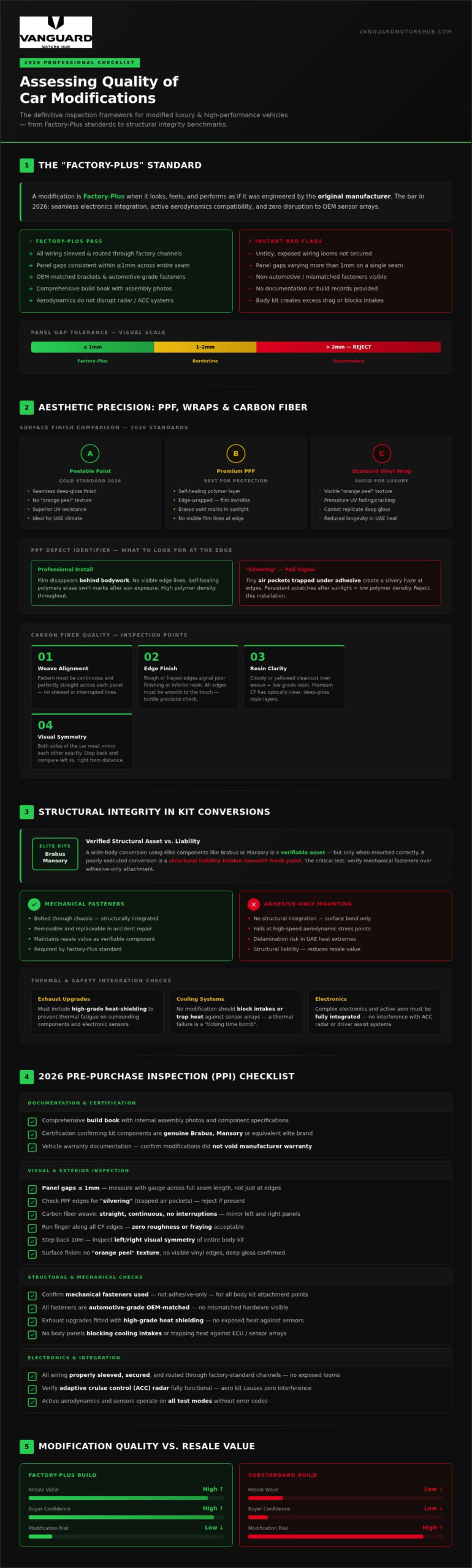
The “Factory-Plus” standard represents the pinnacle of automotive evolution in 2026. It’s the philosophy that aftermarket enhancements should look, feel, and perform as if they were engineered by the original manufacturer. When you’re assessing quality of car modifications on a high-performance machine, you’re searching for a synergy between new components and the legacy chassis. Vanguard Motors Dubai sets this benchmark, ensuring every modification refines the vehicle rather than just changing it. True craftsmanship doesn’t just alter a car; it elevates it.
In the current market, 2026 standards demand more than just aesthetic flair. They require seamless integration of complex electronics, active aerodynamics, and sophisticated sensor arrays. If a body kit creates excessive drag or disrupts the radar systems used for adaptive cruise control, it’s a technical failure regardless of how good it looks. High-caliber work maintains the vehicle’s functional integrity while pushing its boundaries. There’s a direct correlation between this level of precision and long-term resale value. A poorly executed modification is a liability that scares off future buyers, whereas a conversion using elite components like a Brabus or Mansory kit is a verifiable asset.
Initial red flags are often easy to spot if you know where to look. Keep an eye out for these common indicators of subpar work:
- Visible, untidy wiring looms that aren’t properly sleeved or secured.
- Mismatched or non-automotive fasteners that look out of place against factory hardware.
- Uneven panel gaps that vary by more than a millimeter across a single seam.
- Rough edges on carbon fiber components that suggest poor finishing or inferior resin.
The Psychology of Quality in Customization
The hallmark of a master technician is often invisible. While a novice might focus on the “bolt-on” look, a professional creates a bespoke conversion that respects the original design language. This means every bracket is finished to match the chassis and every wire is routed through factory-standard channels. You shouldn’t be able to tell where the original car ends and the modification begins. Documentation and certification play a massive role here too. A comprehensive build book with detailed photos of the internal assembly proves that no corners were cut behind the scenes, providing the transparency required for high-end automotive investments.
Reliability vs. Performance: The 2026 Balance
True performance isn’t just about speed; it’s about endurance. When assessing quality of car modifications, check if the upgrades support or hinder the vehicle’s core cooling and safety systems. For example, high-performance exhaust upgrades must include high-grade heat-shielding to protect surrounding components from thermal fatigue. If a modification blocks an intake or traps heat against a sensitive electronic sensor, it’s a ticking time bomb. Factory-Plus is the integration of aftermarket parts with original engineering precision. This balance ensures your vehicle remains as safe on the track as it is refined on the road.
Aesthetic Precision: Assessing PPF, Wraps, and Carbon Fiber
Visual impact is the first benchmark of any world-class build. When you’re assessing quality of car modifications, the surface finish tells the most honest story about the technician’s skill. In extreme climates like the UAE, material quality is your first line of defense. High-end peelable paint applications have become the gold standard for 2026, offering a seamless, deep-gloss finish that standard vinyl wraps simply cannot replicate. Unlike traditional wraps, peelable paint eliminates the “orange peel” texture and provides a level of UV resistance that prevents the premature fading or cracking common in lower-tier sticker applications.
Surface Protection Integrity
True mastery in paint protection film installation is found where the panel ends. Professional installers use edge-wrapping techniques to ensure the film disappears behind the bodywork. If you see visible film lines or “silvering” (tiny air pockets trapped under the adhesive), it’s a sign of a compromised installation. High-performance films in 2026 feature advanced self-healing properties that react to ambient heat to erase swirl marks. If a film remains scarred after exposure to sunlight, it lacks the polymer density required for long-term protection.
Carbon Fiber and Composite Standards
Carbon fiber should be a technical masterpiece, not just a cosmetic addition. Inspect the weave alignment across large panels like hoods or diffusers. A high-quality installation features a perfect “V” pattern symmetry along the centerline. If the weave looks distorted or “wavy,” you’re likely looking at a cheap cosmetic overlay rather than a structural component. Resin clarity is also vital. Premium carbon fiber uses high-solid clear coats that resist the yellowing effect of intense sun exposure. Whether you choose traditional twill or the marbled look of forged carbon, the finish must be smooth and free of pinholes or resin pooling.
Achieving this level of aesthetic perfection requires a meticulous eye and specialized tools. Assessing quality of car modifications is a technical skill that ensures your investment stays protected and visually stunning. If you’re unsure about the finish on your vehicle, consult our detailing specialists for a professional surface audit.
Structural Integrity in 2026 Kit Conversions
The true character of a bespoke conversion is revealed at high speeds, where aerodynamic forces test the limits of every fastener and seam. While aesthetics capture the initial gaze, structural integrity is what preserves the vehicle’s safety and performance. When assessing quality of car modifications, you must look beyond the visible panels to understand how the components are anchored to the chassis. A premium conversion should feel as rigid and silent as the day it left the factory, regardless of how aggressive the wide-body profile appears.
Fitment tolerances are the most immediate indicator of professional assembly. In 2026, high-end kits from Brabus or Mansory are engineered to mirror OEM specifications, meaning panel gaps should be uniform across the entire vehicle. If you find gaps that vary by more than a millimeter or parts that overlap awkwardly, it suggests a hurried installation. Furthermore, professional builders prioritize mechanical fasteners over simple adhesives. While high-strength bonding agents have their place, critical aerodynamic components like spoilers and front splitters must be secured with bolts and brackets to ensure they don’t detach under the immense downforce generated at triple-digit speeds.
The Elite Kit Checklist: Brabus and Mansory
Verifying the authenticity of a Brabus body kit installation requires a deep dive into the hardware. Genuine components feature specific hardware stamps and serial numbers that confirm their origin. Beyond the parts themselves, check for vibration dampening materials in wide-body conversions. Subpar installations often skip these internal liners, leading to annoying rattles and road noise. Finally, assess the paint match under various lighting conditions. Factory-grade color blending is non-negotiable; the new kit must be indistinguishable from the original bodywork in both hue and orange-peel texture.
Exhaust and Mechanical Integration
A sophisticated build integrates mechanical upgrades with the same precision as the bodywork. When inspecting supercar exhaust upgrades, prioritize thermal clearance. High-performance systems generate intense heat that can melt nearby plastic trim or damage wiring looms if not properly shielded. Test the electronic integration of active valve systems to ensure they respond instantly to the car’s drive modes without throwing error codes. Assessing quality of car modifications in the exhaust system also involves listening for “drone” or resonance. This unwanted acoustic interference is usually the result of poor weld quality or a lack of precision in the pipe geometry, signaling an inferior product.
The 2026 Pre-Purchase Inspection (PPI) Checklist
A rigorous pre-purchase inspection is your final line of defense when acquiring a modified masterpiece. While a car might look flawless in a showroom, a professional PPI uncovers the technical reality beneath the surface. When assessing quality of car modifications, you need a systematic approach that moves from broad visual sweeps to granular mechanical audits. This process ensures that the “Factory-Plus” standard has been maintained throughout the vehicle’s life cycle.
- Step 1: Visual Symmetry Scan. Position the vehicle under bright, natural light. Observe the panel alignment from multiple angles to ensure that aftermarket kits follow the original body lines without deviation.
- Step 2: Tactile Edge Audit. Run your fingers along the edges of the PPF, wraps, and carbon fiber trim. You’re feeling for lifting, rough cuts, or “stepping” where the film should be tucked seamlessly.
- Step 3: Under-Carriage Review. Inspect the mounting points for exhaust systems and body kit reinforcements. High-quality builds use bespoke brackets rather than universal hangers or zip ties.
- Step 4: Electronic Systems Test. Cycle through every modified component. Check that active exhaust valves, integrated LED lighting, and recalibrated parking cameras function without latency or dashboard errors.
- Step 5: Modification Log Review. Request the full service history and installation logs. A master-tier build will have a documented trail of every component’s origin and the technician who installed it.
Interior and Leather Restoration Checks
The cabin should reflect the same level of precision as the exterior. Examine the stitch consistency in any bespoke leather restoration work; uneven spacing or frayed threads are immediate indicators of low-tier craftsmanship. You should also verify the material authenticity. Genuine Alcantara has a specific weight and directional nap that synthetic imitations cannot match. Finally, test all electronic seat functions and integrated sensors. In modern luxury vehicles, improper upholstery work can often interfere with seat-occupancy sensors or heating elements.
The National Climate Stress Test
In a national climate where temperatures frequently soar, modifications face extreme thermal stress. Check window tints and wraps for any signs of heat-related bubbling or adhesive failure at the corners. High-quality mods must withstand 50°C+ ambient temperatures without degradation. This environmental resilience is also a key factor in the longevity of cosmetic car repair. If a filler or paint blend isn’t rated for high UV exposure, it will begin to shrink or discolor within months. Assessing quality of car modifications requires confirming that every material used is engineered for this specific environment.
Don’t leave your investment to chance. If you’re considering a modified luxury vehicle, book a professional pre-purchase inspection with our technical team today.
The Vanguard Standard: Why Professional Execution is the Best Inspection
The ultimate assurance of modification quality begins long before the first bolt is turned. While a checklist is essential for evaluating existing builds, the most effective way of assessing quality of car modifications is choosing a partner that operates at a specialist engineering level. Vanguard Motors Dubai provides a centralized environment where protection, aesthetics, and mechanical upgrades are executed under a single standard of excellence. This eliminates the technical gaps that occur when a vehicle is moved between disconnected shops, each with varying quality benchmarks.
The premium packages at Vanguard Motors Dubai consolidate quality control by treating the vehicle as a unified system. Instead of isolated upgrades, every component is cross-referenced for compatibility and structural synergy. This holistic approach is supported by a mobile detailing van, which brings professional-grade maintenance to your doorstep. As we discussed regarding PPF and wraps, these modifications require specific chemical care. The mobile units from Vanguard Motors Dubai ensure that your investment remains in peak condition without the risks associated with generic car washes.
Comprehensive Care Solutions
Preservation is as critical as the initial transformation. By integrating supercar detailing with long-term protection strategies, Vanguard Motors Dubai ensures that every surface remains resilient against environmental degradation. This expertise extends to carbon fiber repair, which is essential for maintaining the structural integrity of elite kits that might suffer from stone chips or minor impacts. Vanguard Motors Dubai also specializes in “Smart Repairs” for minor cosmetic imperfections, providing surgical-level corrections that restore a vehicle to its “Factory-Plus” state without requiring a full respray.
Your Next Steps for Quality Assurance
The path to a world-class build starts with an expert consultation. If you’re considering a Brabus or Mansory conversion, speaking with a specialist at Vanguard Motors Dubai ensures that your vision aligns with technical reality and resale value. For those looking to acquire a pre-modified vehicle, booking a professional pre-purchase inspection is the only way to verify the hidden details of the build. Assessing quality of car modifications requires more than a visual scan; it requires the trained eye of a master technician. Visit Vanguard Motors Dubai for a professional assessment of your vehicle’s potential and take the first step toward automotive excellence.
Elevate Your Automotive Standards for 2026
The transition from a standard vehicle to a bespoke masterpiece is a journey of technical precision. As we have explored, the “Factory-Plus” standard for 2026 is defined by seamless integration and structural resilience. Whether you are inspecting the weave of a carbon fiber spoiler or the tucked edges of a paint protection film, your approach to assessing quality of car modifications determines the longevity and value of your investment. You don’t just want a car that looks the part; you want one engineered to perform under pressure.
Vanguard Motors Dubai stands as the authoritative benchmark for this elite level of craftsmanship. As authorized installers of Brabus, Mansory, and Jetour kits, we ensure that every conversion meets global standards of excellence. Our UAE-wide mobile detailing units and professional inspection teams specialize in high-heat resilient solutions, protecting your vehicle against the intense local climate. We bridge the gap between aspirational design and mechanical reliability.
Don’t leave the integrity of your high-performance vehicle to chance. Secure your investment with a professional modification assessment at Vanguard Motors Dubai today. It’s time to drive with the confidence that only expert precision can provide.
Frequently Asked Questions
How do I check if a car wrap is high quality?
You should inspect the edges and deep recesses of every panel. A high-quality wrap must be tucked behind the bodywork with no visible film lines or “silvering” air pockets. Look for a smooth finish that is free from “orange peel” texture. If you notice lifting around door handles or mirrors, the adhesive has likely failed due to poor surface preparation or inferior material choice.
Do car modifications void the manufacturer warranty in 2026?
Modifications typically only impact the warranty for the specific systems you’ve altered. For example, upgrading your exhaust won’t void the warranty on your infotainment system. However, using authorized installers for elite conversions like Brabus or Mansory is vital. These professionals maintain the “Factory-Plus” standard, ensuring that your upgrades integrate with original engineering without compromising the vehicle’s underlying mechanical or electronic reliability.
What are the signs of a poorly installed body kit?
Uneven panel gaps and a reliance on adhesives instead of mechanical fasteners are immediate red flags. A poor installation often results in visible sealant along the seams or panels that vibrate at high speeds. You should also check for paint mismatch under natural sunlight. If a kit lacks internal vibration dampening or proper thermal shielding near the exhaust, it’s a sign of a subpar build.
Is peelable paint better than a vinyl wrap for luxury cars?
Peelable paint is often the preferred choice for luxury vehicles because it provides a seamless, spray-on finish that mirrors factory paint. It eliminates the visible seams and texture issues common with standard vinyl sticker wraps. In 2026, premium peelable paint offers superior resistance against stone chips and UV rays. It’s a sophisticated alternative that enhances aesthetic depth while remaining fully reversible for resale.
How does carbon fiber repair impact the safety of a modified car?
Professional carbon fiber repair restores the component’s structural integrity using specialized resins and vacuum-sealing. When assessing quality of car modifications, check that the repair is invisible and maintains the original weave pattern. If a repair is done poorly, the part can become brittle and shatter under aerodynamic stress. Correctly executed repairs ensure the vehicle remains safe and stable during high-speed performance driving.
What should I look for in a professional pre-purchase inspection for modified cars?
Ensure the inspector checks for electronic integration and hardware authenticity. They should perform a tactile audit of all film edges and scan for error codes related to active valves or recalibrated sensors. A master-tier PPI also involves reviewing the modification log to verify the origin of all parts. This process confirms the vehicle meets the technical standards required for high-end automotive investments in 2026.
Can I restore the quality of a previously poorly modified vehicle?
You can restore a vehicle’s integrity by using “Smart Repairs” and professional re-installation techniques. This process involves removing low-grade adhesives, realigning panel gaps, and replacing inferior wraps with premium PPF or peelable paint. Assessing quality of car modifications is the first step in identifying these technical failures. A specialist hub can rectify structural issues and restore leather interiors to bring the car back to a “Factory-Plus” state.