
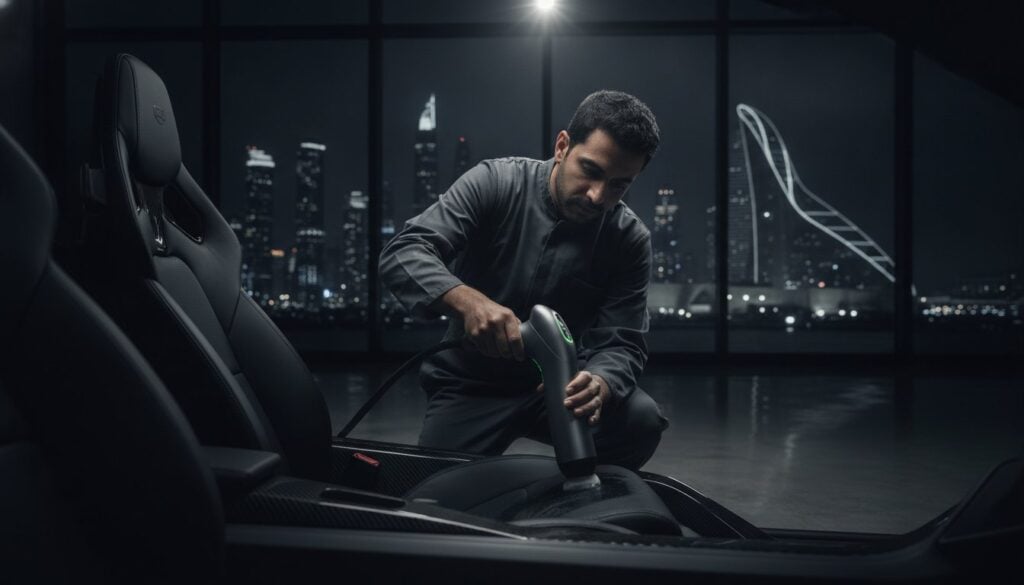
Scrubbing a blemish is often the fastest way to permanently devalue a luxury interior. While the instinct is to rub away the evidence of a spill, mechanical friction usually drives contaminants deeper into the fibers. Effective car upholstery cleaning for stubborn stains is a precise chemical extraction process, not a test of physical strength. You aren’t just fighting a spot; you’re defending your vehicle’s resale value and aesthetic legacy. It’s frustrating to watch a DIY attempt fail, leaving behind a phantom ring or a patch of faded material that no amount of standard detailing can fix.
We understand the anxiety that comes with maintaining high-end materials like Nappa leather or advanced technical textiles. This 2026 guide provides a definitive roadmap for removing the most difficult automotive marks without compromising the integrity of your cabin. You’ll gain clarity on material-safe cleaning agents and professional extraction protocols used by elite technicians. We also outline the critical threshold where cleaning ends and specialized leather restoration begins, ensuring your interior remains a pristine sanctuary of performance and style. Prepare to transform your approach to interior maintenance with professional precision.
Key Takeaways
- Identify your specific material first. Nappa leather and Alcantara require vastly different chemical approaches to prevent permanent surface damage.
- Master the chemistry of extraction. Using pH-neutral surfactants ensures effective car upholstery cleaning for stubborn stains while preserving the factory finish.
- Recognize the technical risks of DIY attempts. Consumer-grade equipment often lacks the suction power needed to remove deep-seated contaminants, leading to phantom rings.
- Follow a structured protocol. Prioritize dry extraction and hidden test spots to protect your luxury interior from chemical incompatibility and color migration.
- Know when to restore. For stains that have already compromised the material, professional leather restoration is the only way to return a cabin to showroom condition.
Diagnosing the Stain: Identifying Material and Contaminant
Successful car upholstery cleaning for stubborn stains begins with a clinical evaluation of the surface. You cannot treat a blemish effectively if you don’t understand the substrate. In the context of comprehensive auto detailing, luxury cabins require a diagnostic approach that mirrors high-end mechanical engineering. While standard fleet vehicles often use mass-produced synthetics designed for high-impact wear, your luxury vehicle utilizes materials chosen for their tactile elegance and specific performance properties. Treating these surfaces with generic chemicals is a recipe for permanent damage.
Understanding Luxury Automotive Materials
Before applying any cleaning agent, you must identify the specific material. Luxury interiors generally fall into three categories:
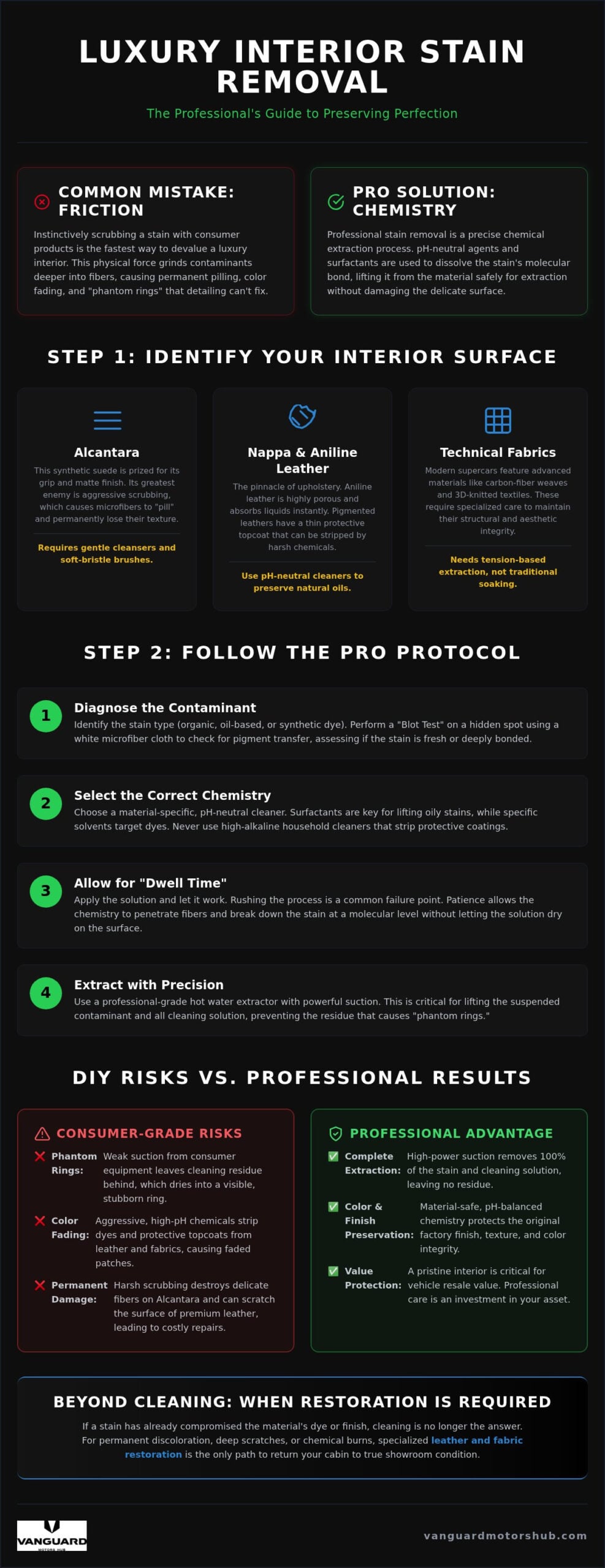
- Alcantara: This synthetic suede-like material is prized for its grip and matte finish. Its primary enemy is aggressive scrubbing, which causes the microfibers to “pill” and lose their signature texture.
- Nappa and Aniline Leather: These represent the pinnacle of upholstery. Aniline leather is highly porous and absorbs liquids almost instantly, while pigmented leathers have a thin protective coating. Knowing the difference determines whether a stain is on the surface or deep within the hide.
- Technical Fabrics: Modern supercars often feature carbon-fiber weaves or advanced 3D-knitted textiles that require specialized tension-based extraction rather than traditional soaking.
The Anatomy of a Stubborn Stain
The environmental conditions in the UAE play a significant role in how stains behave. Intense UV exposure and high ambient temperatures act as catalysts, effectively “baking” contaminants into the upholstery fibers. This thermal setting process turns a simple spill into a permanent dye if not addressed with the correct chemistry. We categorize these stubborn marks into three groups: organic proteins like food or blood, petroleum-based grease from mechanical components, and synthetic dyes found in ink or denim transfer.
To assess the severity of the situation, perform a “Blot Test” using a clean, white microfiber cloth. Press firmly without rubbing; if the pigment transfers easily, the stain is likely fresh and surface-level. If there is no transfer, the contaminant has likely bonded with the material at a molecular level. Using multipurpose household cleaners on these high-end dyes is dangerous. These products often have high pH levels that can strip the natural oils from leather or dissolve the structural adhesives in technical fabrics. Professional car upholstery cleaning for stubborn stains requires a material-first mindset to ensure the cabin’s aesthetic integrity remains uncompromised.
The Chemistry of Extraction: Breaking Down Stubborn Bonds
A pristine cabin is an exercise in chemical balance. Most off-the-shelf cleaners rely on high-alkaline formulas to achieve results, but these aggressive substances strip the protective topcoats from luxury materials. Professional car upholstery cleaning for stubborn stains prioritizes pH-neutral agents. These solutions maintain the structural integrity of the leather or fabric while targeting the specific molecular bond of the contaminant. It’s a surgical approach to restoration that prevents the long-term degradation of your vehicle’s interior.
Surfactants play a vital role in this process. These molecules act as bridges between water and oils, surrounding grease particles and lifting them from deep within the weave. This allows the contaminant to be suspended in the cleaning solution, ready for extraction. For detailed advice on specific substances, The American Cleaning Institute’s guide offers a scientific breakdown of how different agents interact with common spills. Dwell time is the silent partner of successful extraction. Rushing the process leads to incomplete cleaning. Professionals allow the chemistry to work, giving the surfactants enough time to penetrate the fibers without letting the solution dry. This patience ensures that even the most resilient marks are loosened before any physical agitation occurs.
Solvents vs. Surfactants: Choosing Your Weapon
The choice between a solvent and a surfactant depends entirely on the stain’s origin. Organic spills like coffee or protein-based marks respond best to water-based surfactants. However, petroleum-based grease or adhesive residue requires mild solvents. For water-sensitive luxury fabrics, “dry cleaning” solvents are the standard. These evaporate quickly, preventing the saturation that can lead to mold or structural warping in high-end seat cushions. Choosing the wrong agent can lead to permanent discoloration, making professional expertise essential for high-value cabins.
The Impact of the UAE Climate on Interior Stains
In the UAE, the environment is a constant variable. High ambient temperatures accelerate the oxidation of organic stains, making car upholstery cleaning for stubborn stains significantly more complex the longer they sit. While steam is a powerful tool, it requires absolute temperature control. If the steam is too hot, it can “steam-lock” a stain, effectively sealing it into the fiber forever. Professional technicians monitor these levels meticulously to ensure the heat aids extraction rather than causing damage. If you’re concerned about a particularly resilient mark, speak with our interior specialists for a professional assessment.
DIY vs. Professional Detailing: Assessing the Risk to Your Interior
Attempting car upholstery cleaning for stubborn stains at home often feels like a logical cost-saving measure, yet it carries the risk of permanent aesthetic failure. The gap between consumer-grade equipment and industrial extractors isn’t just about power; it’s about precision moisture management. Standard household vacuums lack the lift required to pull contaminants from the deep foam layers. Instead, they often leave the material damp, which creates a breeding ground for bacteria. Professional supercar detailing ensures that every milliliter of moisture is accounted for, protecting the vehicle’s structural and financial value.
Common DIY Failures and How to Avoid Them
The “Ring Effect” is one of the most frequent errors in amateur detailing. This occurs when spot cleaning is confined to a small area, causing the dirt and cleaning agent to migrate outward and settle in a visible circle. It turns a minor blemish into a glaring defect. Over-saturation is another silent killer. When liquid penetrates the seat foam, it’s nearly impossible to remove without specialized suction. In the humid pockets of the UAE, this trapped moisture leads to mildew within 48 hours. You must also avoid stiff-bristled brushes. These tools are far too abrasive for the delicate “nap” of Alcantara or suede, leading to irreversible texture loss that no cleaner can fix.
When Professional Restoration is the Only Option
There is a definitive “Point of No Return” where DIY efforts become dangerous. Deep-set dye transfer, such as blue jean pigment on white or oyster leather, is a primary example. This isn’t a surface stain; the dye has bonded with the material’s top-coat at a molecular level. Attempting to scrub this away will only destroy the leather’s finish. When a contaminant has breached the protective factory layer, standard cleaning is no longer the solution. This is where professional leather restoration becomes necessary. Experts can strip the compromised finish, neutralize the stain, and re-apply a factory-standard pigment and sealant. Choosing professional car upholstery cleaning for stubborn stains early prevents the need for these more intensive repairs, maintaining the cabin’s elite atmosphere.
Step-by-Step Guide to Lifting Stubborn Stains Safely
Executing car upholstery cleaning for stubborn stains requires a disciplined sequence. It isn’t about speed. It’s about maintaining the cabin’s equilibrium while surgically removing the intruder. Professionals follow a five-step protocol that prioritizes material safety over aggressive physical force. This structured approach ensures that you don’t trade a temporary stain for permanent surface damage.
- Step 1: Dry Extraction. Use a high-lift vacuum to remove all loose particulates. If you apply liquid to a dusty seat, you create mud that sinks deeper into the textile weave.
- Step 2: The Test Spot. Apply your chosen agent to a hidden area. This is non-negotiable for assessing chemical compatibility on exotic dyes or delicate Nappa leathers.
- Step 3: Controlled Application. Utilize foam instead of liquid. Foam provides superior surface dwell time, allowing the chemistry to work without the risk of deep-layer saturation.
- Step 4: Agitation and Extraction. Employ the “Cross-Hatch” technique. Work in overlapping vertical then horizontal strokes. This ensures uniform chemical distribution and prevents the “Ring Effect” discussed in previous sections.
- Step 5: Conditioning. Cleaning naturally strips essential oils. You must replace them. High-grade conditioners restore suppleness and provide a vital UV barrier against the intense UAE sun.
Specific Protocol for Grease and Oil
Petroleum-based marks require a two-phase approach. First, use absorbent powders to “wick” the oil out of the fabric before it sets. If the grease is older, controlled heat can liquefy the bond, making it easier for surfactants to lift the residue. This allows for a final degreasing pass that leaves the material clean without stripping the factory finish. It’s a delicate balance of temperature and chemistry that requires constant monitoring.
Removing Ink and Dye Transfer from Leather
Ink removal is a high-stakes operation. Alcohol-based cleaners are effective but extremely drying. You must work in small increments and apply conditioner immediately to prevent the leather from cracking. If the pigment doesn’t lift after two attempts, the dye has likely become part of the leather’s molecular structure. At this stage, consult our interior restoration team to discuss professional recolouring options. Recognizing when a cleaning task has transitioned into a restoration project is the hallmark of an elite owner.
Beyond Cleaning: Total Interior Preservation at Vanguard Motors Dubai
Maintaining a luxury interior requires more than reactive maintenance. While mastering car upholstery cleaning for stubborn stains is essential for immediate spill management, true preservation involves a proactive strategy. Vanguard Motors Dubai provides a comprehensive ecosystem of care that extends beyond the surface. We treat the cabin as a high-performance environment where every texture must remain flawless. When a contaminant persists despite professional intervention, cosmetic car repair becomes the logical next step to restore the factory-new aesthetic that defines your vehicle.
Our methodology at Vanguard Motors Dubai combines technical expertise with a passion for automotive excellence. We don’t just clean; we protect. By applying premium interior ceramic coatings, we create a molecular barrier that repels liquids and prevents UV degradation. This ensures that future car upholstery cleaning for stubborn stains is a simple, non-invasive process rather than a high-stakes rescue mission. We understand that your vehicle is a significant investment. Our precision detailing services are engineered to maximize long-term resale value by maintaining the original factory luster of every material, from Nappa leather to delicate technical textiles.
The Vanguard Premium Package: Holistic Protection
Elite vehicle care shouldn’t be fragmented. Our Vanguard Premium Package integrates meticulous interior preservation with high-performance exterior solutions like paint protection film. This holistic approach ensures that your car remains a sanctuary of perfection from the inside out. At Vanguard Motors Dubai, we pay meticulous attention to detail in every corner of the cabin, ensuring that hidden vents, stitching, and seat tracks receive the same level of care as the primary surfaces. For busy owners across the UAE, our mobile detailing van brings this level of professional precision directly to your location, providing elite care without the logistical burden.
Bespoke Interior Transformations
Sometimes, a total transformation is the only way to satisfy a vision for excellence. If cleaning and restoration aren’t enough, Vanguard Motors Dubai offers bespoke upgrades that redefine the driving experience. This includes the installation of custom carbon fiber interior trim to enhance the cabin’s athletic profile and structural integrity. For aging or heavily damaged surfaces, our specialized leather restoration and re-trimming services provide a factory-new feel. We craft personalized aesthetics that reflect your specific lifestyle, ensuring your vehicle remains a unique expression of technical and creative mastery. Our team handles every supercar with a focus on meticulous care and aesthetic perfection, transforming your interior into a bespoke masterpiece.
Elevate Your Interior Standards for the Future
Mastering car upholstery cleaning for stubborn stains is about more than just aesthetics; it’s about preserving the soul of your luxury vehicle. You’ve learned that a material-first diagnostic approach and precise pH-neutral chemistry are the only ways to handle elite textiles without causing permanent damage. Whether you’re managing a fresh spill or navigating the complex “Point of No Return,” the goal remains a pristine cabin that reflects your commitment to excellence. Vanguard Motors Dubai operates as a national leader across the UAE, specializing in supercar and luxury vehicle detailing with an emphasis on technical precision.
For those who demand a higher standard of care, professional intervention ensures your interior remains an asset rather than a liability. Our experts at Vanguard Motors Dubai excel in specialized leather restoration and bespoke conversions, providing the meticulous attention required for the world’s most exclusive marques. We provide premium national service that meets the needs of the most discerning owners. Restore Your Interior to Perfection with Vanguard Motors Dubai. Don’t let a single blemish compromise your driving experience. Secure the future of your cabin with meticulous care today.
Frequently Asked Questions
Can I use vinegar or baking soda on luxury car upholstery?
You should avoid using vinegar or baking soda on luxury car upholstery. While these are popular home remedies, their high acidity or abrasive texture can strip the protective factory top-coats from Nappa leather and damage delicate technical fabrics. For effective car upholstery cleaning for stubborn stains, you must use pH-neutral agents designed specifically for automotive use. These ensure the material’s structural integrity remains intact while safely breaking down the contaminant without leaving a harmful residue behind.
How do I remove coffee stains from Alcantara without ruining the texture?
Removing coffee from Alcantara requires a gentle, moisture-controlled approach. Start by blotting the spill with a clean microfiber cloth to absorb as much liquid as possible. Never scrub, as this causes the microfibers to pill and lose their soft texture. Apply a dedicated Alcantara foam cleaner and use a soft-bristled brush in a light motion. This lifts the stain to the surface for extraction without saturating the deep-layer padding or ruining the material’s signature nap.
Is steam cleaning safe for all types of car leather?
Steam cleaning is not universally safe for all car leather types. While it’s highly effective for sanitizing pigmented leathers, it can be disastrous for aniline hides which are highly porous. Excessive heat can cause these premium materials to shrink, harden, or lose their natural oils. Professional technicians use precisely calibrated steam equipment to ensure the temperature remains within a safe range, preventing the moisture from steam-locking contaminants into the leather’s grain or causing irreversible textural changes.
What is the best way to prevent blue jean dye transfer on light-coloured seats?
The most effective way to prevent blue jean dye transfer is the application of a premium interior ceramic coating. These advanced coatings create a hydrophobic barrier that stops pigments from bonding with the leather’s surface. Regular maintenance with a dedicated leather cleaner also helps remove light transfer before it becomes a permanent issue. This proactive strategy is essential for light-coloured interiors, ensuring the cabin retains its showroom aesthetic despite the daily challenges of friction and clothing dyes.
How often should a supercar interior be professionally detailed in the UAE?
We recommend that a supercar interior be professionally detailed every three to six months in the UAE. The intense regional heat and airborne particulates accelerate the degradation of natural oils in leather and the breakdown of technical textiles. Frequent car upholstery cleaning for stubborn stains prevents contaminants from baking into the fibers under the sun. This recurring schedule ensures your luxury cabin remains a pristine environment while maintaining the vehicle’s long-term resale value and material health.
What should I do if a stain has already dried and “baked” in the sun?
If a stain has already baked in the sun, do not attempt to scrub it out manually. The heat has likely bonded the contaminant to the material, and physical friction will only damage the surrounding fibers. You require a professional chemical extraction process that uses specialized surfactants to break those bonds at a molecular level. Technicians will typically use a combination of controlled heat and pH-neutral solvents to safely lift the residue without compromising the material’s finish.
Can professional detailing remove cigarette or pet odours along with stains?
Professional detailing is highly effective at removing persistent cigarette or pet odours along with physical stains. Unlike surface-level scents that merely mask smells, industrial-grade extraction and ozone treatments neutralize odour-causing molecules trapped deep within the upholstery and ventilation system. This process ensures the cabin returns to a neutral, factory-fresh state. It’s a comprehensive solution for owners who want to restore both the visual and sensory appeal of their luxury vehicle’s interior sanctuary with professional precision.
Will professional cleaning affect the warranty on my luxury vehicle’s interior?
Professional cleaning typically does not affect your luxury vehicle’s interior warranty when performed by experts using approved methods. Manufacturers generally encourage regular maintenance to prevent material failure. However, using harsh DIY chemicals or aggressive mechanical scrubbing can void your coverage if it leads to surface damage or discoloration. It’s best to rely on specialists who understand the specific requirements of your vehicle’s marques and use only pH-neutral, material-safe products during the cleaning and restoration process.