
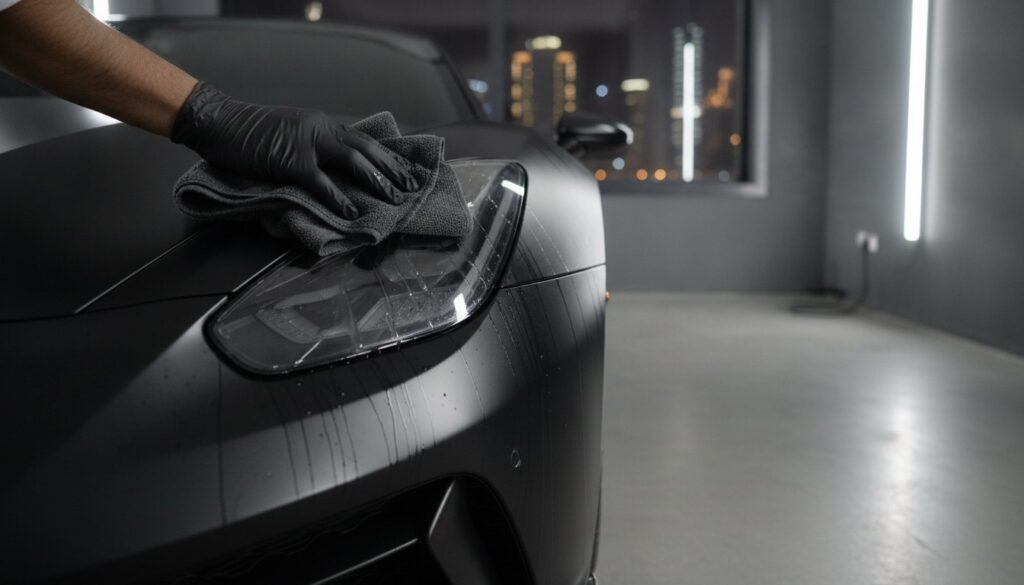
What if the very routine you use to maintain your vehicle is actually shortening the lifespan of its finish? A premium wrap is a high-performance skin that demands a level of care far beyond standard automotive paint. It’s natural to feel a sense of hesitation when approaching a fresh installation, especially when you’re faced with the fear of micro-scratching the vinyl or choosing a chemical that might strip the depth from a matte surface. At Vanguard Motors Dubai, we understand that maintaining a showroom glow in an intense national climate requires technical precision and the right chemistry.
This 2026 guide is designed to remove the guesswork by identifying the specialized car wrap aftercare products and maintenance protocols necessary to protect your automotive investment. We provide a clear shopping list of safe products and a repeatable schedule to ensure maximum longevity for your aesthetic upgrade. From defending against extreme UV exposure to preserving the intricate details of a bespoke body kit, these expert strategies represent the elite standard of vehicle preservation for those who value both form and function.
Key Takeaways
- Learn why specialized maintenance is vital for vinyl to prevent adhesive failure and edge lifting.
- Identify the essential car wrap aftercare products, including pH-neutral shampoos and high-GSM towels, to eliminate the risk of micro-marring.
- Master the specific protocols for matte, satin, and gloss finishes to preserve their unique textures without using destructive gloss-enhancers.
- Discover 2026-standard UV protection strategies, such as ceramic-infused detailers, to safeguard your wrap in high-heat environments.
- Understand when to elevate your maintenance routine with professional luxury detailing or the comprehensive Vanguard Premium Package.
Understanding Why Specialized Car Wrap Aftercare Products are Non-Negotiable
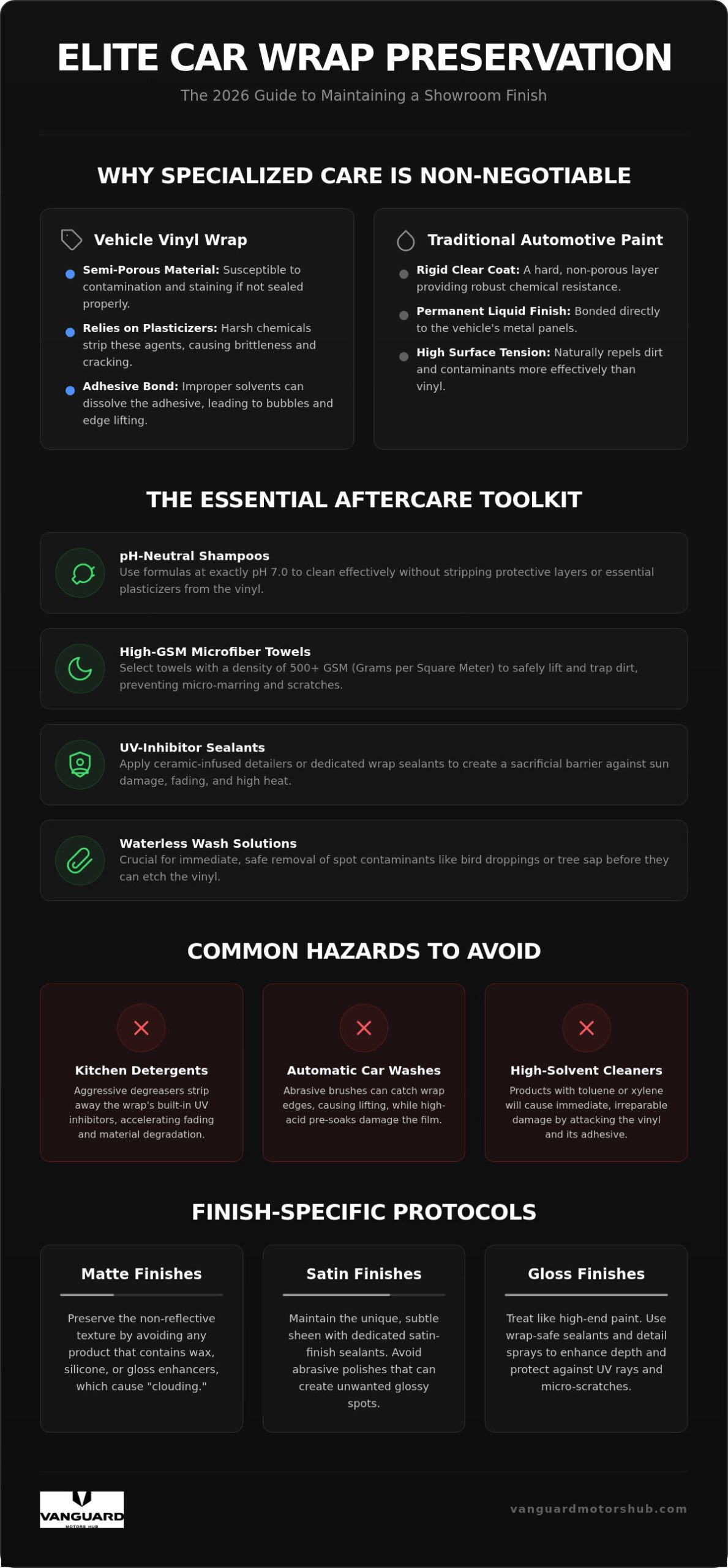
A vehicle wrap is a precision-engineered polymer layer, not a permanent liquid finish. While automotive paint relies on a rigid clear coat, vinyl is a semi-porous material that remains dynamic throughout its lifespan. This fundamental difference in material science dictates your maintenance strategy. Using the wrong car wrap aftercare products can lead to a catastrophic failure of the material’s molecular bond. When you apply harsh industrial cleaners, you aren’t just washing the surface; you’re potentially dissolving the adhesive that keeps your aesthetic upgrade secure. Professional care is about preserving the molecular integrity of the film while defending against the harsh reality of the road.
The flexibility of your wrap depends on chemicals called plasticizers. These agents allow the vinyl to conform to the aggressive lines of a Brabus or Mansory body kit without cracking. High heat and caustic chemicals accelerate the leaching of these plasticizers, leaving the film brittle and prone to “lifting” at the edges. Once the adhesive bond is compromised by improper chemical exposure, environmental contaminants like bird droppings and tree sap become even more dangerous. In climates exceeding 40°C, these acidic substances can bake into the vinyl within minutes, causing permanent etching that no amount of polishing can fix.
The Vulnerability of Vinyl vs. Automotive Paint
Surface tension plays a critical role in how your vehicle sheds dirt. Traditional paint has a high-gloss, non-porous surface, but Understanding Vehicle Wraps reveals that vinyl surfaces react differently to friction and chemical bonding. If you apply traditional carnauba waxes to a premium colored wrap, you risk “clouding.” This happens because the wax particles get trapped in the film’s microscopic pores, creating an uneven, hazy appearance. Petroleum-based solvents are equally destructive. They penetrate the vinyl layer and attack the adhesive underneath, leading to bubbles and premature peeling that ruins the showroom finish.
Avoiding Common Chemical Hazards
Protecting your investment means knowing exactly what to keep away from your vehicle. You must maintain a strict ban on several common household and automotive chemicals to ensure long-term durability. Avoid these hazards at all costs:
- Kitchen Detergents: These contain aggressive degreasers that strip UV inhibitors from the vinyl.
- Automatic Car Washes: The recycled water often contains high-acid pre-soaks and abrasive brushes that catch on wrap edges.
- High-Solvent Cleaners: Anything containing toluene or xylene will cause immediate and irreparable damage to the film.
It’s vital to stick to pH-balanced solutions. Products that are too acidic or too alkaline will cause the pigments in your wrap to fade, turning a vibrant finish into a dull, weathered surface long before its time. Precision in product selection is the only way to guarantee a result that matches the elite quality of your vehicle.
The Essential Toolkit: Selecting the Best Cleaning Products for Wrapped Vehicles
Professional maintenance starts with professional chemistry. You’ve invested in a high-end wrap, perhaps even a bespoke Brabus or Mansory conversion, so your cleaning arsenal must reflect that elite standard. The right car wrap aftercare products don’t just clean the surface; they preserve the film’s structural integrity. To maintain a showroom finish, your toolkit should be built around five non-negotiable essentials:
- pH-Neutral Shampoos: Specialized formulas that hit exactly pH 7.0 to clean without stripping essential plasticizers.
- High-GSM Microfibers: Towels with a density of 500+ GSM to trap dirt safely away from the vinyl.
- UV-Inhibitor Sealants: Dedicated wrap sealants that act as a sacrificial barrier against sun damage.
- Waterless Wash Solutions: Essential for the immediate, safe removal of acidic contaminants like bird droppings or tree sap.
- Non-acidic Wheel Cleaners: Safe formulas that won’t etch or stain the wrap on fenders and side skirts during overspray.
PH-Neutral Shampoos and Foaming Agents
Traditional soaps often contain hidden degreasers that can dull a wrap’s finish over time. Using a high-quality snow foam is the gold standard for a safe pre-wash. This thick foam encapsulates surface grit and carries it away before you ever touch the vehicle with a wash mitt. For the safest results, consult a professional Vehicle Wrap Care Guide to ensure your technique matches your product choice. High-lubricity soaps are vital because they create a slick barrier, significantly reducing the friction that causes swirl marks on sensitive films.
Microfiber Technology and Drying Aids
Not all towels are created equal. For drying, use a dedicated 1000+ GSM “twisted loop” towel to absorb water in a single pass, minimizing contact. For applying detailers or sealants, a 350-500 GSM towel provides the perfect balance of bite and softness. Using a drying aid is a pro-level secret. It adds a layer of lubrication during the drying process, which prevents water spots from forming on dark or gloss wraps. Keep your towels segregated. You should never use a cloth that has touched heavy waxes on your wrapped panels to avoid clouding. If you’re unsure which specific formulas suit your unique finish, our team can recommend professional-grade solutions tailored to your vehicle.
Finish-Specific Care: Products for Matte, Satin, and Gloss Finishes
A “one size fits all” approach is the quickest way to degrade a premium vehicle wrap. Your wrap’s texture is its primary identity, and the chemistry you apply must respect its specific light-reflective properties. Using the wrong car wrap aftercare products can permanently alter the appearance of your vehicle, turning a stealthy matte into a blotchy mess or a deep gloss into a hazy surface. Precision in product selection ensures that your aesthetic upgrade remains as striking as the day it was installed.
Maintaining the Stealth of Matte and Satin Wraps
Matte and satin wraps are engineered with microscopic peaks and valleys that scatter light to create their signature non-reflective look. If you apply traditional carnauba waxes or gloss-enhancing sealants, you fill those valleys and “polish” the film. This results in an unwanted, uneven shine that is impossible to reverse. Maintenance for these surfaces requires an absolute ban on any product containing waxes, silicones, or gloss-enhancing agents.
- Residue-Free Detailers: Select detail sprays specifically labeled for matte finishes to remove light dust without adding luster.
- Fingerprint Management: Satin surfaces are prone to oily fingerprints. Use a dedicated matte cleaner and a clean microfiber towel to lift oils with minimal pressure.
- No Scrubbing: Excessive friction can create “shiny spots” on matte vinyl. Always let the chemistry do the work.
For those currently exploring finish options for a new project, The 2026 Car Wrap Buying Guide provides a technical breakdown of how these textures perform under different lighting conditions and maintenance levels.
Enhancing the Depth of Gloss and Metallic Finishes
Gloss and metallic wraps are designed to mimic the depth of high-end automotive paint. To achieve a true “wet look,” you should utilize polymer-based spray sealants. These advanced formulas bond to the vinyl’s surface, creating a sacrificial barrier that heightens clarity and depth. Unlike matte care, gloss maintenance thrives on products that increase surface tension and light reflection. Utilizing a gloss-safe detailer during your daily routine will keep the finish vibrant while providing a slick surface that helps shed dirt and water more efficiently.
Textured and chrome wraps represent the highest tier of sensitivity. Chrome films are particularly susceptible to micro-scratching and hazing. You must use non-abrasive, alcohol-free detailers and the softest possible microfiber towels to preserve the mirror-like finish. For textured films like carbon fiber, a soft-bristled detailing brush is often necessary to remove dust trapped within the grain, as standard towels may snag or leave lint behind in the pattern.
Climate-Resilient Maintenance: Protecting Your Wrap Against High Heat and UV
Extreme heat isn’t just uncomfortable; it’s a chemical catalyst for wrap degradation. In regions where temperatures routinely exceed 40°C, your vehicle’s finish faces a relentless thermal assault that can compromise even the highest quality films. High heat accelerates the chemical breakdown of vinyl, making the selection of specialized car wrap aftercare products a matter of preservation rather than just aesthetics. The 2026 standard for defense is the integration of ceramic-infused detailers specifically engineered for film. Unlike traditional paint coatings, these formulas are designed to remain flexible, moving with the vinyl as it expands and contracts under intense thermal cycles.
Thermal management is critical for long-term integrity. Infrared (IR) rejection coatings are becoming an essential secondary layer for wrapped assets, reflecting heat away from the surface to keep the adhesive stable. You must also adhere to the “early morning or late evening” washing rule. Applying water or chemicals to a sun-baked surface causes immediate evaporation, leading to mineral spotting and chemical etching that can become permanent in minutes. If the surface is too hot to touch, it’s too hot to wash.
UV Inhibitors and Ceramic Sealants
Modern sealants bond at a molecular level to create a sacrificial UV barrier. It’s vital to distinguish between ceramic for paint and ceramic for wraps. Standard paint coatings are often too rigid and can cause high-end films to become brittle or crack over time. Wrap-specific ceramic sealants provide the necessary UV inhibitors while maintaining the film’s elasticity. In extreme climates, you should double your application frequency. Instead of a seasonal application, a bi-monthly treatment ensures the protective layer remains robust against constant solar radiation.
Spot Cleaning and Contaminant Removal
Heat-set stains are the primary cause of premature wrap failure. When bird droppings or tree sap sit on a 60°C surface, they bake into the pores of the vinyl almost instantly. Every supercar owner should carry an emergency kit in the trunk, consisting of a waterless wash solution and several high-GSM microfibers. For those who enjoy high-performance driving, safe removal of road tar and rubber marks is essential. While a clay bar can be used to lift stubborn contaminants, it must be performed with extreme lubrication to avoid marring the finish. If your vehicle has been exposed to heavy environmental fallout, you can book a professional decontamination session to restore the surface safely.
Professional Detailing and Long-Term Wrap Preservation Strategies
Consistent home maintenance using the correct car wrap aftercare products is the foundation of longevity, yet professional intervention is mandatory to preserve a true showroom finish. DIY routines are excellent for surface decontamination, but they cannot address the subtle signs of film fatigue or micro-lifting at the complex edges of a Brabus or Mansory body kit. Transitioning to luxury car detailing allows for a technical audit of your vehicle’s exterior. This ensures the bond between the film and the substrate remains absolute while refreshing the protective layers that home washing might miss.
Peelable paint applications represent the next generation of customization, offering a seamless finish that bridges the gap between vinyl and traditional paint. Aftercare for these systems requires a nuanced approach. You must focus on maintaining surface tension without compromising the peelable layer’s structural integrity. Because these coatings are thicker and more resilient than standard vinyl, they benefit significantly from professional-grade ceramic infusions applied in controlled, dust-free environments. This level of precision care prevents the material from becoming brittle, ensuring it remains as vibrant and flexible as the day it was sprayed.
The Vanguard Approach to Total Vehicle Protection
Our methodology centers on the Vanguard Premium Package, a holistic strategy designed for the most demanding automotive enthusiasts. We often recommend integrating Paint Protection Film over your colored wraps to create an impenetrable shield against rock chips and road debris. This layered defense is the ultimate standard for 2026, providing both aesthetic transformation and mechanical protection in a single, cohesive application.
Convenience is a core pillar of our service model. Our mobile detailing van brings elite-level expertise directly to your location, providing professional concierge care that fits your schedule. During these sessions, our technicians perform rigorous inspections for edge lifting or any signs of environmental stress. Catching these potential issues early is the key to extending the lifespan of your wrap and avoiding the costs of a full re-wrap due to neglect.
Preserving High-End Aesthetic Upgrades
A truly bespoke vehicle is a symphony of different materials. We specialize in the aftercare for carbon fiber car parts that are frequently installed alongside premium wraps. These components require specific UV-stable resins and specialized polishing techniques to prevent yellowing or cracking. By maintaining a synergy between exterior protection, leather restoration, and cosmetic repair, we ensure your vehicle’s interior remains as flawless as its striking exterior. Precision care is not just a service; it’s a commitment to excellence. Protect your investment today with Vanguard Motors Dubai and experience the intersection of technical skill and creative expression.
Securing Your Automotive Masterpiece for the Road Ahead
Preserving a world-class finish requires more than just occasional effort; it demands a technical understanding of how your vehicle’s skin interacts with the environment. By selecting the right car wrap aftercare products and adhering to a finish-specific maintenance schedule, you ensure your aesthetic upgrade remains as vibrant as the day it was installed. Precision is your best defense against degradation, especially when navigating high-heat climates or maintaining the aggressive lines of a bespoke Brabus, Mansory, or Jetour conversion.
At Vanguard Motors Dubai, our expert technicians specialize in the meticulous care required for high-end PPF and colored wraps. We bring elite convenience to your doorstep through our mobile detailing service, ensuring your vehicle receives professional-grade protection without disrupting your schedule. Don’t leave your investment to chance. It’s time to elevate your maintenance routine and keep your vehicle in showroom condition. Book a Luxury Detailing Consultation at Vanguard Motors Dubai today. Your vehicle is a statement of excellence, and we’re here to help you protect it.
Frequently Asked Questions
Can I use a pressure washer on my vinyl-wrapped car?
You can use a pressure washer provided you follow strict technical parameters. Keep the pressure below 2000 psi and ensure the water temperature stays under 60°C. It’s vital to maintain a minimum distance of 30 centimeters from the surface. Never aim the nozzle directly at the edges or seams at a sharp angle. This precision prevents the high-velocity water from getting under the film and forcing the adhesive to lift.
How often should I wash my wrapped vehicle in a dusty climate?
In dusty environments, you should wash your vehicle at least once a week. Dust particles act as micro-abrasives that can dull the finish over time. Using a pH-neutral snow foam is an efficient way to lift grit without touching the surface. Regular maintenance with specialized car wrap aftercare products prevents environmental contaminants from bonding to the film, ensuring the aesthetic remains sharp and the material stays flexible.
Is it safe to wax a car wrap?
Traditional carnauba waxes are unsafe for most wraps, especially matte and satin finishes. These products contain oils and petroleum-based solvents that can cloud the film or create an uneven shine. For gloss wraps, only use synthetic polymer sealants that are specifically labeled as safe for vinyl. If you have a matte finish, avoid all wax-based products entirely to preserve the stealthy, non-reflective texture that defines your vehicle’s unique look.
What is the best way to remove bird droppings from a wrap without scratching?
The safest method involves chemical softening rather than mechanical force. Saturate the area with a wrap-safe detailer or warm water and let it dwell for at least 60 seconds. This breaks down the acidic content of the dropping. Once softened, use a clean, high-GSM microfiber towel to gently lift the contaminant away. Avoid any scrubbing motion, as the grit within the dropping can easily cause permanent micro-scratches on the film.
Does a ceramic coating help maintain a car wrap?
A ceramic coating is an excellent investment for long-term wrap preservation. It creates a hydrophobic sacrificial layer that repels water, dirt, and UV radiation. This makes your routine cleaning much faster and more effective. It’s important to use a coating engineered specifically for flexible films rather than rigid paint. These specialized car wrap aftercare products provide the necessary protection while allowing the vinyl to expand and contract during extreme temperature cycles.
Can I use a waterless wash on a matte wrap?
You can use a waterless wash on matte wraps if the formula is free of gloss-enhancing agents. These products are ideal for removing light dust or oily fingerprints between full washes. Always ensure the spray is matte-specific to avoid adding an unwanted luster to the finish. Using a clean, plush microfiber towel is essential to prevent polishing the matte peaks into a shiny spot through excessive friction or pressure.
How do I prevent the edges of my wrap from peeling during cleaning?
Preventing edge failure requires careful technique during the washing process. Always move your wash mitt or towel from the center of the panel toward the edges rather than pushing against the seams. Avoid using high-pressure water directly on the film’s boundaries. Using high-lubricity shampoos reduces the physical drag on the edges. If you notice any lifting, seek professional assistance immediately to trim or reseal the area before dirt compromises the adhesive.
What should I do if my wrap starts to look yellow or faded?
Yellowing or fading is typically a sign of terminal UV damage or chemical oxidation. This often happens when the wrap’s built-in UV inhibitors have been exhausted. While some professional decontamination cleaners can lift surface staining, deep discoloration within the film usually cannot be reversed. In these cases, it’s best to consult a technician about a replacement. Upgrading to a premium color PPF can provide superior resistance to these issues in high-heat environments.