
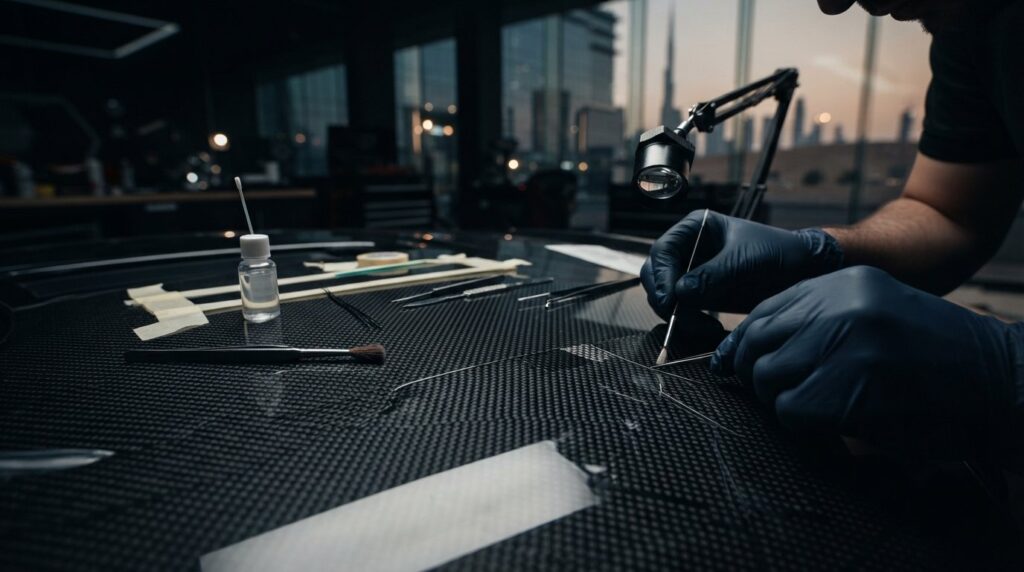
A single degree of deviation in a carbon fiber weave is the difference between a masterpiece and a mistake. When you invest in a bespoke Brabus or Mansory kit, you’re paying for geometric perfection. However, a minor impact or a poor previous installation can leave your components looking stretched or distorted. Professional carbon fiber weave alignment repair is the only way to correct these visual anomalies without the exorbitant cost of full OEM panel replacement. At this level of automotive excellence, good enough simply doesn’t exist.
You understand that even the smallest weave shift reflects light erratically, drawing the eye to exactly the wrong place and eroding your vehicle’s resale value. This guide explores the technical precision required to restore straight tow lines and a mirror-finish surface. We’ll master the nuances of advanced scarf repair ratios and optical magnification techniques used to preserve both structural integrity and the aesthetic value of your elite investment. From correcting 3K tow distortions to applying UV-stabilized clear coats, we’re detailing the precise path back to visual perfection.
Key Takeaways
- Understand the geometric principles of tow and warp that create the signature three-dimensional depth in high-end carbon fiber components.
- Identify the primary triggers for weave distortion, ranging from manufacturing defects like ‘bridging’ to thermal expansion caused by high-heat climates.
- Learn how professional carbon fiber weave alignment repair uses specialized resin-down techniques and precision masking to correct visual drift.
- Evaluate the cost-benefit ratio of restoring rare bespoke components versus the logistical challenges of sourcing full replacements for limited edition kits.
- Discover how pairing professional restoration with advanced paint protection film preserves the structural and aesthetic integrity of your automotive investment.
The Geometry of Excellence: Understanding Carbon Fiber Weave Alignment
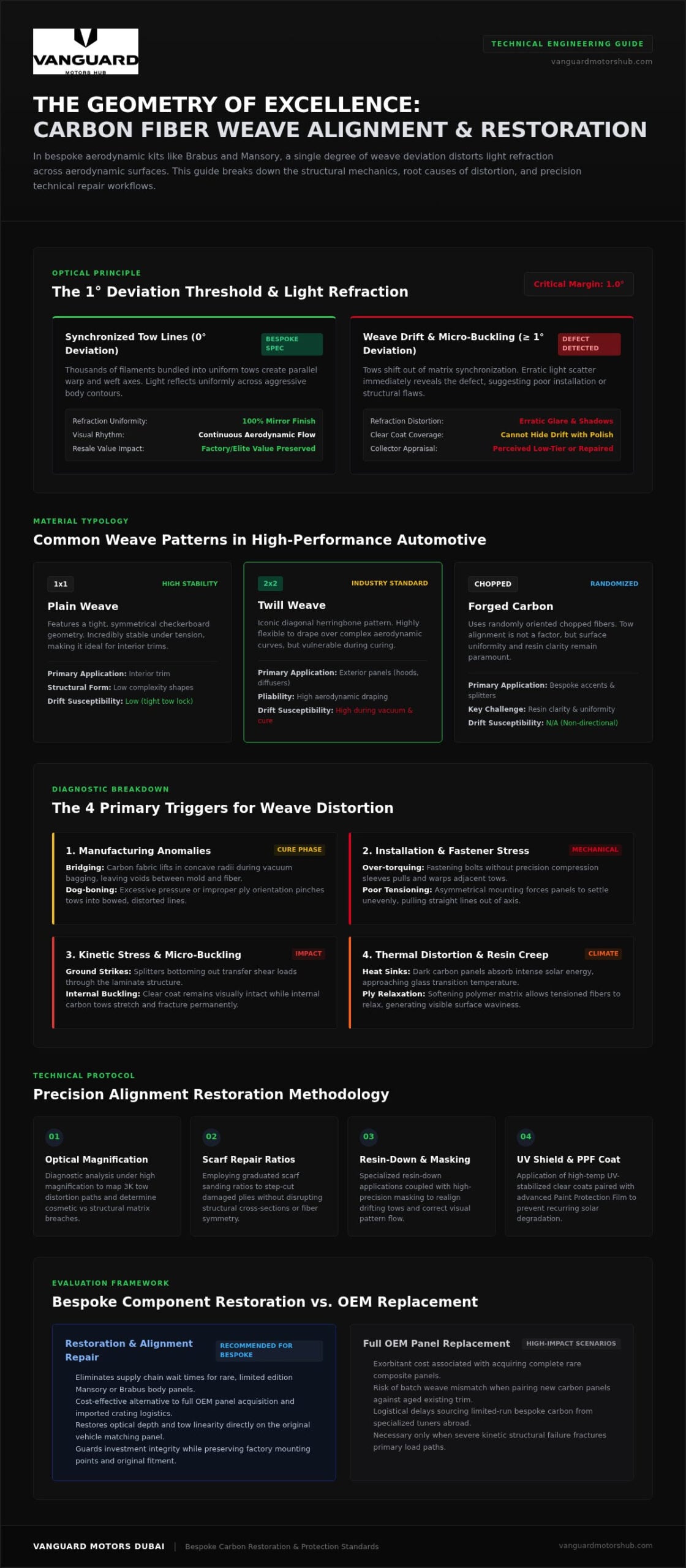
Weave alignment is the geometric synchronization of carbon fibers within a polymer matrix. It represents the linear precision of carbon tows across a complex aerodynamic surface. In the world of elite automotive design, this isn’t just about structural integrity; it’s about visual rhythm. When a carbon component is manufactured, thousands of individual filaments are bundled into “tows.” These tows are woven together, creating the “warp” and “weft” that give carbon fiber its iconic 3D depth. If these lines drift even slightly, the light refraction changes. This creates a visual distortion that can’t be hidden by clear coats or polishing. Achieving a perfect finish often requires specialized carbon fiber weave alignment repair to ensure the pattern flows seamlessly across every aggressive curve.
Common Weave Patterns in Luxury Automotive Design
Most enthusiasts recognize the distinctive patterns that define modern supercars. The Plain Weave (1×1) offers a tight, symmetrical checkerboard appearance. It’s incredibly stable and often used for interior trim where structural complexity is low. In contrast, the Twill Weave (2×2) is the industry standard for exterior panels. Its diagonal herringbone pattern drapes beautifully over complex aerodynamic shapes, but this flexibility makes it highly susceptible to misalignment during the curing process. Forged carbon takes a different approach by using chopped fibers in a random orientation. While alignment isn’t a factor here, maintaining surface uniformity and resin clarity is still vital for a premium aesthetic.
The Impact of Misalignment on Supercar Valuation
Visual symmetry is critical for high-visibility areas like hoods, roofs, and diffusers. “Weave drift” signals a lack of precision, often suggesting a low-quality aftermarket kit or a rushed manufacturing process. This distortion has a significant psychological impact on a vehicle’s factory-fresh appeal. Collectors and enthusiasts view alignment perfection as a prerequisite for elite conversions, especially for kits from Brabus or Mansory. A visible flaw in the weave doesn’t just look bad; it suggests the component might have hidden structural weaknesses or poor resin saturation. Investing in professional carbon fiber weave alignment repair protects the resale value by ensuring the car meets the exacting standards expected of a high-performance masterpiece. It’s the difference between a vehicle that looks bespoke and one that looks repaired.
Root Causes: Why Carbon Fiber Weaves Distort and Shift
Carbon fiber is prized for its rigidity, yet the visual weave is surprisingly fluid during both the curing and lifecycle phases. Distortions aren’t always the result of a crash; often, they’re baked into the component from day one. Manufacturing defects like bridging occur when the carbon fabric lifts in concave radii during vacuum bagging, creating a gap between the mold and the fiber. Conversely, dog-boning happens when excessive pressure or poor ply orientation pinches the tows, causing a bowed effect. These subtle shifts are why owners eventually seek carbon fiber weave alignment repair to restore the intended geometry of their Mansory or Brabus kits.
Installation errors are another frequent culprit. Over-torquing fasteners without proper compression sleeves can warp adjacent tows, while poorly tensioned components may settle unevenly. Even minor kinetic stress, such as a front splitter bottoming out, can stretch the weave. This micro-buckling occurs within the laminate, leaving the clear coat intact but the visual pattern permanently skewed. These imperfections are magnified on large, flat surfaces like hoods or roofs, where the symmetry of the 2×2 twill is most exposed.
Thermal Distortion in High-Performance Environments
Dark carbon surfaces act as efficient heat sinks, often reaching surface temperatures that challenge the resin’s glass transition temperature. In high-heat climates, this leads to resin creep, where the matrix softens enough to allow the fibers to relax or shift. This ply relaxation results in subtle waviness that ruins the mirror-like reflection of the panel. Protecting alignment requires the use of high-temperature stable resins and specialized UV-protective coatings to mitigate the effects of intense solar absorption and maintain the fiber’s original position.
Structural vs. Cosmetic Misalignment
It’s vital to distinguish between a visual-only defect and a structural failure. A minor weave deviation might be purely aesthetic, but a sudden shift in pattern often indicates underlying delamination or matrix cracking. Professional restorers use ultrasonic testing to ensure the integrity of the component remains intact. If you’ve noticed a shift in your vehicle’s carbon pattern, it’s worth consulting a technical expert to determine if a cosmetic fix is sufficient. Specialized carbon fiber weave alignment repair can often save a panel that looks beyond help, provided the core laminate is still sound.
Professional Techniques for Carbon Fiber Weave Alignment Repair
Artisan-level carbon fiber weave alignment repair transforms visual imperfections into a seamless finish. While many shops suggest total replacement, sophisticated restoration techniques offer a surgical alternative for rare or expensive components. The “Resin-Down” method is a primary intervention; it involves carefully sanding away the clear coat to reach the fiber layer without severing the tows. This allows technicians to address the substrate directly. For distortions caused by the resin creep mentioned earlier, controlled localized heat manipulation can settle the matrix back into its original state. In pre-cure stages for bespoke parts, technicians use precision micro-picks to manually realign fibers before the final bake; this ensures the geometry is perfect before the resin ever sets.
The Cosmetic Restoration Process
Restoring a distorted weave requires a structured, multi-stage approach to ensure the repair is invisible to the naked eye. This process moves beyond simple polishing to address the underlying visual geometry of the part.
- Step 1: High-Resolution Mapping: Technicians perform surface decontamination followed by a detailed mapping of the weave drift. This identifies exactly where the tow lines deviate from the factory standard.
- Step 2: Leveling the Matrix: We level the UV-stable clear coat to eliminate “lens effects.” These optical distortions often exaggerate the look of a misaligned weave by bending light unevenly across the surface.
- Step 3: Optical Resin Application: Specialized optical resins are applied to fill surface irregularities. These resins match the refractive index of the original material, ensuring a consistent 3D depth across the entire component.
Advanced Visual Masking for Permanent Distortion
When a weave is physically locked into a distorted position, we utilize advanced visual masking to achieve the gold standard for carbon fiber weave alignment repair. Ghost tints act as a visual sleight of hand; they redirect light refraction away from minor tow deviations. By subtly adjusting the tint in the clear coat, technicians can draw the eye toward the straight lines of the surrounding factory weave. The art of blending is critical here; it ensures there’s no visible “hard edge” between the repaired area and the original panel. The final finishing stage involves a multi-stage correction to achieve a mirror-like surface. This doesn’t just hide the correction; it enhances the natural depth of the carbon, making the restoration indistinguishable from a pristine OEM part.
Decision Framework: Repair vs. Replace for Carbon Components
Choosing between a full replacement and a precision restoration is a high-stakes calculation for any supercar owner. While a new OEM panel might seem like the simplest solution, the reality of the global supply chain often dictates otherwise. Sourcing a replacement component for a limited edition Mansory or Brabus kit can involve lead times stretching into several months. Opting for carbon fiber weave alignment repair allows you to bypass these logistical hurdles. It restores your vehicle’s aesthetic perfection in a fraction of the time it takes to ship a bespoke part from Europe. This efficiency ensures your investment remains on the road rather than sitting in a service bay.
Cost-benefit analysis also plays a significant role in this decision. An OEM front splitter for a modern McLaren can cost approximately $14,000, while a full carbon roof panel might exceed $9,000 before specialized installation labor. When compared to the investment required for artisan-level weave restoration, the savings are substantial. However, the choice isn’t purely financial. We must also evaluate the rarity of the component. For discontinued kits or vintage exotics, a replacement part may literally no longer exist. In these scenarios, technical restoration isn’t just an option; it’s the only way to preserve the vehicle’s historical and aesthetic integrity.
When Repair is the Superior Option
Restoration is the gold standard for correcting minor surface waviness on large, high-visibility panels like roofs or trunks. These areas are prone to the thermal distortions discussed earlier, which ruin the car’s visual rhythm without compromising its safety. Repair is also essential for custom-finished parts featuring unique tints or specialized clear-coat variations that are impossible to match with off-the-shelf replacements. If the damage is limited to the clear-coat matrix or superficial tow drift, professional carbon fiber weave alignment repair provides a mirror-finish result that’s indistinguishable from factory-new.
The ‘Red Line’ for Replacement
Safety must always override aesthetics. If a component exhibits severe tow breakage or a shattered weave pattern, the structural lattice is likely compromised. Delamination that extends into the mounting points or structural hardpoints of the component is another non-negotiable red line. Damage to high-load aerodynamic parts like active wings or front splitters also mandates replacement if the internal flexural strength cannot be guaranteed to match the pristine laminate’s original rating. Before you commit to an expensive replacement, book a technical assessment to determine the most efficient path forward for your supercar.
The Vanguard Approach: Bespoke Carbon Restoration and Protection
Excellence isn’t just about fixing damage; it’s about engineering perfection from the first step. We integrate carbon fiber weave alignment repair directly into our bespoke car conversion process. This ensures that every aerodynamic component, from the front splitter to the rear diffuser, maintains absolute geometric harmony. Professional installation serves as the ultimate preventative repair. By seating panels correctly and managing fastener tension with precision, we prevent the structural shifting and tow distortion that often plague lesser builds. It’s a proactive strategy that keeps your vehicle’s visual rhythm intact for years.
There’s a powerful synergy between carbon fibre car parts repair and advanced surface protection. A restored weave is only as good as its defense against the elements. Our final quality control protocol involves high-intensity studio lighting that mimics harsh sunlight. We verify alignment from every conceivable angle to ensure the 2×2 twill remains perfectly straight. This meticulous verification process guarantees that the repair is invisible, even under the most scrutiny-heavy conditions.
Protecting Your Restored Carbon Fiber
The intense UV radiation in high-heat climates is a constant threat to resin stability. Applying paint protection film is mandatory to prevent future resin drift and fiber migration. Specialized, optical-grade PPF preserves that iconic “wet look” while acting as a thermal barrier. To keep your repaired components in showroom condition, follow these essential maintenance tips:
- Avoid Abrasive Chemicals: Use only pH-neutral soaps to prevent clear-coat degradation.
- Heat Management: Park in shaded areas to keep surface temperatures below the resin’s glass transition point.
- Film Integrity: Regularly inspect your PPF to ensure the self-healing topcoat is free of debris that could trap heat.
Elite Kit Integration: Brabus and Mansory
Continuity is the hallmark of a master conversion. During a Brabus body kit installation, we ensure the weave pattern flows seamlessly across panel gaps. Our “Zero-Defect” commitment means we don’t accept a 2-degree weave deviation on high-visibility areas like hoods or fenders. We map your vehicle’s carbon journey from the initial carbon fiber weave alignment repair to the final protective layer. This holistic approach ensures your Mansory or Brabus conversion remains a flawless investment in both form and function.
Elevate Your Automotive Aesthetic to Factory-Fresh Standards
Precision is the hallmark of the supercar world. You’ve seen how manufacturing defects, thermal stress, and minor impacts can compromise the geometric perfection of your vehicle’s carbon components. Mastering carbon fiber weave alignment repair is the only way to ensure your bespoke Brabus or Mansory kit remains a flawless investment. By choosing artisan-level restoration over costly and time-consuming replacements, you preserve both the structural integrity and the resale value of your high-performance machine.
Our advanced cosmetic repair facility specializes in the technical nuances of composite restoration. We combine this expertise with comprehensive protection solutions, using premium PPF to shield your corrected finish from future UV-induced resin drift. It’s time to eliminate visual distortions and restore the iconic 3D depth of your carbon fiber panels. Your vehicle represents a peak of engineering; its finish should reflect nothing less than absolute perfection.
Restore your vehicle’s carbon fiber perfection with Vanguard Motors and experience the standard of excellence your supercar deserves. We’re ready to transform your vision into reality.
Frequently Asked Questions
Can you fix a ‘wavy’ carbon fiber weave that came from the factory?
Yes, factory-induced waviness is a common issue that we address through advanced cosmetic techniques. These defects often occur during the vacuum bagging process or due to resin relaxation in high-heat environments. By utilizing localized heat manipulation and optical resin leveling, we can significantly reduce the appearance of manufacturing drift. This process ensures your supercar meets the visual standards expected of elite kits from Brabus or Mansory without needing a full replacement.
Does carbon fiber weave repair affect the strength of the part?
Cosmetic carbon fiber weave alignment repair focuses on the visual matrix and doesn’t compromise the part’s structural integrity. We carefully assess each component to ensure the damage is limited to the clear coat and superficial fiber layers. If the core laminate remains intact, our restoration process actually adds a layer of UV-stable protection. This maintains the component’s original flexural strength while restoring the mirror-finish aesthetic required for high-visibility areas like hoods and roofs.
How long does a professional weave alignment repair take?
The duration of a professional restoration typically ranges from three to seven business days depending on the severity of the distortion. This timeline includes surface mapping, resin application, and the necessary curing periods required for a durable finish. While a complex Mansory hood might take longer than a mirror cap, it’s still significantly faster than waiting months for international shipping. Our efficient workflow focuses on getting your vehicle back on the road with zero visual defects.
Will the repair be visible to the naked eye?
An artisan-level repair is virtually indistinguishable from the factory finish to the naked eye. We achieve this through ghost tints and specialized optical resins that match the refractive index of the original material. By blending the repair into the surrounding factory weave, we eliminate hard edges and visual breaks. Our final quality control involves inspecting the component under high-intensity studio lighting to verify that the tow lines appear perfectly straight from every angle.
Can weave alignment issues be fixed on interior carbon trim?
Yes, we can perform carbon fiber weave alignment repair on interior trim components with the same level of precision as exterior panels. Interior pieces often utilize a 1×1 plain weave, which is more stable but can still suffer from resin yellowing or minor impact trauma. Whether it’s a center console or a dashboard inlay, our technicians use micro-leveling techniques to restore the 3D depth and geometric symmetry that define luxury automotive interiors.
How much does it cost to repair a distorted carbon fiber weave?
Repair costs are determined by the complexity of the weave drift and the total surface area requiring correction. Every project is unique, as a large roof panel with significant thermal distortion requires more labor than a minor edge correction on a diffuser. While we don’t provide flat rates, restoration represents a strategic alternative to the high cost of OEM replacements. It allows you to protect your investment in bespoke kits without the logistical burden of sourcing new parts.
Can PPF hide minor weave alignment issues?
Paint Protection Film (PPF) is an essential protection layer, but it isn’t designed to hide significant alignment issues. While the film’s high-gloss finish can enhance the wet look and provide a deep luster, the underlying weave geometry remains visible. We recommend completing a professional alignment repair first to ensure the fibers are straight. Applying PPF afterward serves as the ultimate shield, preventing future UV-induced resin creep and preserving the restored visual perfection.
What is the difference between weave repair and clear coat repair?
Clear coat repair involves leveling and polishing the outermost protective layer to remove scratches or swirls. In contrast, weave repair is a more intensive process that addresses the visual orientation of the carbon tows themselves. This might involve the resin-down method to access the fiber layer or using tinted resins to mask permanent drift. While clear coat work restores shine, weave alignment restoration fixes the geometric pattern that creates carbon fiber’s iconic 3D appearance.