
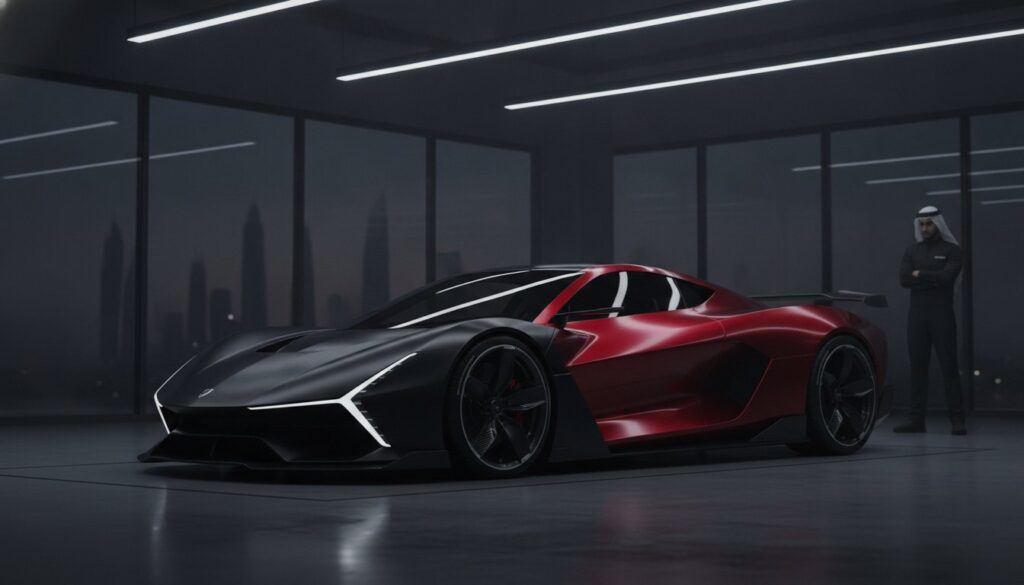
A supercar’s silhouette is only as fast as the light it reflects. While many enthusiasts view a palette as a purely subjective choice, the reality is that your vehicle’s finish acts as a functional layer that can either sharpen its aggressive lines or completely wash out its most expensive aerodynamic features. Choosing the right car wrap color in the UAE market requires a sophisticated understanding of how our unique, high-intensity light interacts with different pigments and finishes. We understand the pressure of wanting a bespoke statement while fearing a choice that might look dated or “cheap” next to premium carbon fiber components.
This guide will help you master the principles of automotive CMF design to manipulate vehicle proportions and emphasize raw performance. You’ll learn how to use advanced solutions like peelable paint and colored PPF to experiment with bold 2026 trends like Midnight Purple or Satin Black while protecting your investment. We are diving into the science of elite aesthetics to ensure your next transformation is both technically precise and visually authoritative. It’s time to move beyond simple stickers and embrace the future of high-end automotive styling.
Key Takeaways
- Understand the CMF triad to ensure your color, material, and finish work as a single cohesive unit for a factory-plus aesthetic.
- Learn to manipulate visual weight to make your vehicle appear lower and more aggressive through the science of light and dark tones.
- Master the process of choosing the right car wrap color to create a bespoke statement that reflects elite status while preserving investment value.
- Identify your vehicle’s core character, such as Performance, Luxury, or Heritage, to select a base tone that complements its specific aerodynamic intent.
- Discover how colored PPF and peelable paint provide a risk-free canvas for bold experimentation under the intense UAE sun.
The Foundations of Automotive Color Theory
In the elite automotive sector, color is a language of physics and emotion. It is the study of how hue, saturation, and value interact with complex 3D surfaces to create a specific visual impact. Unlike a flat canvas, a vehicle moves through varying environments, meaning choosing the right car wrap color requires an understanding of how light wraps around a fender or disappears into a vent. Professional designers rely on automotive color theory to ensure that a chosen palette doesn’t just look good on a sample swatch, but thrives on the road.
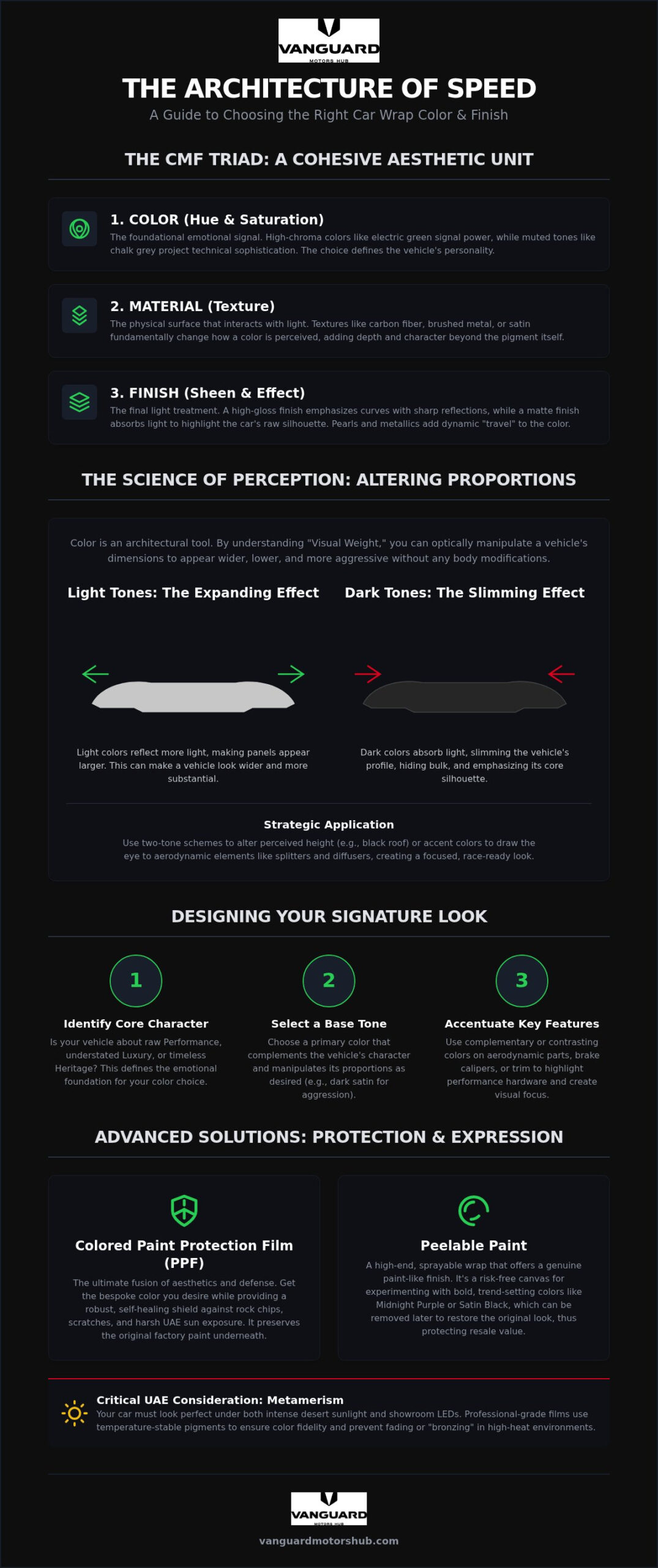
The “CMF” triad-Color, Material, and Finish-is the cornerstone of modern vehicle aesthetics. These three elements must be designed as a single cohesive unit. A deep navy blue might look regal in a high-gloss finish, yet appear industrial and flat in a matte material. When selecting a scheme, you can utilize the automotive color wheel to achieve different goals:
- Complementary: High-contrast pairings that make details like brake calipers or carbon fiber accents pop.
- Analogous: Colors sitting next to each other on the wheel for a harmonious, fluid appearance.
- Monochromatic: Varying shades of a single hue to emphasize the vehicle’s structural silhouette.
High-chroma performance colors like vibrant oranges or electric greens signal raw power and audacity. In contrast, muted tones like chalk greys or deep satins project a sense of understated technical sophistication. Your choice defines the vehicle’s personality before the engine even starts.
The Role of CMF in Luxury Customization
Material texture fundamentally changes how the eye perceives color. In 2026, professional designers prioritize “Finish” as much as the “Color” itself to create depth. Solid colors offer a bold, direct statement, but complex multi-stage finishes like pearls and metallics use microscopic flakes to catch light at different angles. This creates a “travel” in the color, making the vehicle look dynamic even while stationary. At Vanguard Motors Dubai, we treat the material as the foundation for the pigment, ensuring the texture enhances the car’s natural lines.
Light, Surface, and Metamerism
Metamerism is a critical factor for UAE car owners. It explains why your car wrap looks different under white workshop LEDs versus the intense natural sunlight of the desert. The science of light reflection varies between curved and flat panels. Curved surfaces create highlights and shadows that can shift the perceived depth of a color. Modern 2026 wrap films utilize temperature-stable pigments that prevent “bronzing” or fading, maintaining color fidelity even in high-heat environments. This technical precision ensures that your bespoke statement remains consistent from the showroom to the open road.
The Science of Perception: How Color Alters Vehicle Proportions
Color choice is an architectural decision. It manipulates how the human eye processes a vehicle’s dimensions and stance. By understanding “Visual Weight,” you can make a supercar look wider or an SUV look more athletic without a single body modification. Choosing the right car wrap color involves more than matching a swatch to your personality; it’s about optimizing the car’s physical presence through optical manipulation.
Light colors possess an “expanding” effect. They reflect more light, making panels appear larger and more prominent. Dark tones have a “slimming” effect, which is why black or deep charcoal is often used to mask bulk or hide complex panel gaps. Strategic two-tone schemes can even trick the eye into seeing a shorter or longer wheelbase. By wrapping the roof in a contrasting shade, you can visually disconnect the cabin from the body, altering the car’s entire profile and perceived height.
Highlighting aerodynamic features requires surgical precision. Applying a secondary color to splitters, diffusers, and spoilers draws the eye to the vehicle’s performance hardware. This highlights the car’s downforce capabilities and creates a focused, race-ready aesthetic. When choosing the right car wrap color, you must evaluate how these accents will interact with the primary hue to either sharpen or soften the car’s aggressive lines.
Color as a Tool for Proportional Correction
Large SUVs often struggle with looking top-heavy. Using dark lower-body accents or a darker wrap on the bottom third of the vehicle “grounds” the design, making it appear more planted and athletic. Conversely, high-chroma, bright colors emphasize the compact, muscular stance of mid-engine supercars by drawing attention to their tight packaging and aggressive venting. A lighter roof color effectively lowers the perceived center of gravity by drawing the eye downward toward the car’s beltline.
The Impact of Finish: Matte vs. Gloss
Finish is the final layer of proportional manipulation. Gloss finishes emphasize organic curves through specular highlights that move as the viewer walks around the car. This adds a sense of fluid motion. Matte finishes act as light absorbers, which helps emphasize the “bone” lines and sharp edges of the chassis. When Choosing Your Signature Finish: Matte vs Gloss PPF, consider how you want the UAE sun to define your vehicle’s character. If you’re ready to see how these principles apply to your specific model, you can consult with our design experts today.
The Resale Value Paradox: Decoupling Expression from Depreciation
For decades, the luxury automotive market was haunted by the specter of depreciation. This fear dictated a sterile palette of “safe” colors: silver, white, and black. In the UAE, these shades dominated showrooms not because they were the most evocative, but because they were the easiest to trade in. When choosing the right car wrap color, owners previously felt forced to prioritize the hypothetical next buyer over their own aesthetic vision. This cautious approach often resulted in a sea of identical vehicles that failed to reflect the owner’s status or personality.
The landscape in 2026 has shifted fundamentally. Individuality is now the primary marker of elite status. Bespoke, individualized color expressions are increasingly recognized as a sign of a true connoisseur rather than a risk to the bottom line. We’ve seen the rise of “Signature Colors” for limited edition supercar releases where a unique, factory-adjacent hue can actually drive market value higher among collectors. Modern protection technology has finally decoupled personal expression from financial loss, allowing for total creative freedom without compromising the vehicle’s secondary market appeal.
The Psychology of Luxury Resale in 2026
Conservative buyers still lean toward neutral tones, but a new segment of collectors seeks out vehicles with high-quality, bespoke finishes that stand out in a crowded market. A meticulously applied, unique color scheme can act as a differentiator that attracts premium offers. The key is the preservation of the factory paint underneath. Experimenting with temporary color changes is no longer a gamble; it’s a strategic move for those who understand that elite aesthetics and asset protection are not mutually exclusive.
Risk-Free Transformation Technologies
Peelable paint and colored PPF represent the ultimate evolution in risk-free design. These technologies provide a thick, protective barrier that guards against the harsh UAE environment while delivering a finish indistinguishable from a custom spray job. You can enjoy a radical transformation for years and then revert to OEM specifications instantly for a trade-in or private sale. This flexibility is essential for maintaining the integrity of your vehicle’s history. If your current finish has suffered from road debris, our expertise in Luxury Automotive Restoration and Cosmetic Repair ensures your car is the perfect canvas for its next evolution. Choosing the right car wrap color is now a decision about the present, secured by the technology of the future.
Designing Your Signature Look: A Framework for Customization
Creating an elite automotive aesthetic requires a disciplined approach to design. It’s not about following a fleeting trend; it’s about architectural synergy. When choosing the right car wrap color, you’re essentially acting as the final architect of the vehicle’s identity. We recommend a five-step framework to ensure your bespoke statement is both technically sound and visually impactful.
- Step 1: Identify Character. Determine if the vehicle’s primary persona is Performance, Luxury, or Heritage. A high-chroma orange suits a track-focused McLaren, while a deep metallic emerald might better serve a vintage-inspired Bentley.
- Step 2: Base Selection. Select a primary hue that complements the car’s structural lines. This is where choosing the right car wrap color anchors the entire project.
- Step 3: Accent Coordination. Choose secondary colors for calipers, badges, and even interior stitching to create a cohesive CMF profile.
- Step 4: Material Integration. Incorporate technical materials like carbon fiber into the palette, treating them as textured neutrals rather than just parts.
- Step 5: Light Validation. Test the scheme under various UAE lighting conditions, from the sharp midday sun to the warm glow of evening city lights, to ensure the finish maintains its depth.
This structured process eliminates the anxiety of a “cheap” or mismatched result. It replaces guesswork with professional precision, ensuring every element of the car’s exterior works in harmony.
Integrating Carbon Fiber into the Palette
Modern customization treats carbon fiber as a critical component of the color wheel. The unique weave of traditional or forged carbon acts as a textured neutral, providing a sophisticated break between painted panels. When you complement forged carbon with high-contrast accent colors, you highlight the vehicle’s technical upgrades and structural integrity. If your existing carbon components have lost their luster, our team specializes in Carbon Fibre Parts Repair and Installation to restore that essential technical edge.
Body Kits and Color Harmony
Bespoke conversions from manufacturers like Brabus and Mansory fundamentally change the “canvas” of your vehicle. These kits introduce aggressive transitions and complex vents that require a new color logic to avoid looking cluttered. Using color to blend these transitions creates a seamless “OEM plus” look that suggests the car left the factory in its current form. Our expertise in Bespoke Brabus Body Kit Installation allows us to guide you through these complex aesthetic decisions. If you’re ready to define your vehicle’s signature look, connect with our design consultants today.
Vanguard’s Approach: Elevating Aesthetics through Precision Protection
Vanguard Motors Hub bridges the gap between high-level design theory and practical application. We don’t just offer color changes; we provide a sophisticated consultation that treats choosing the right car wrap color as a strategic investment. Our experts evaluate your vehicle’s silhouette against light-reflectance data to ensure the chosen finish thrives in the intense UAE sunlight. This approach transforms a simple aesthetic update into a holistic design process that respects the car’s original engineering.
We utilize Colored PPF and peelable paint as the primary mediums for this transformation. These aren’t just aesthetic tools; they are high-performance shields. Colored PPF offers the depth of a premium paint job with the self-healing properties of traditional protection film. Peelable paint allows for high-fidelity, risk-free color experimentation. It enables you to test bold 2026 trends without a permanent commitment to the factory chassis, providing a professional medium for total creative freedom.
Our bespoke conversions, including specialized Brabus and Mansory kit installations, integrate every element of the car’s personality. We synchronize visual hues with mechanical signatures, ensuring that a custom exhaust modification is matched by an equally aggressive visual presence. This unified design philosophy ensures your vehicle makes a statement that is both heard and seen. Precision is our baseline, and transformation is our specialty.
The Vanguard Premium Package
The Vanguard Premium Package represents our most comprehensive approach to automotive evolution. It’s designed for elite owners who demand a 100% custom finish without sacrificing the factory-fresh condition of their investment. Technical precision in the application phase is just as vital as the initial color choice. Our technicians ensure every edge is seamless and every tuck is invisible. We focus on maintaining the “New Car” look while delivering a completely unique aesthetic that stands out in any collection.
The Future of Automotive Color
Looking toward the end of 2026, we see a shift toward iridescent finishes and temperature-stable pigments. These advanced materials are engineered specifically for extreme climates, ensuring that deep satins and complex pearls don’t degrade under high thermal stress. Vanguard stays ahead of these global styling trends to provide visionary results for our clients. We remain committed to maintaining the highest standards of excellence in every project. If you are ready to redefine your vehicle’s identity, consult with Vanguard Motors for your bespoke transformation.
Mastering the Future of Automotive Aesthetics
Automotive design is a sophisticated intersection of physics and personal branding. You’ve learned how CMF design principles and visual weight manipulation can fundamentally redefine your vehicle’s stance and character. Choosing the right car wrap color is no longer a compromise between bold personal expression and future resale protection. With advanced technologies like colored PPF and peelable paint, you can command attention on the road while securing your vehicle’s factory integrity against the harsh UAE climate.
Vanguard Motors Hub stands as the premier authority on these technical transformations. Our expertise spans from intricate Brabus and Mansory kit conversions to elite supercar detailing. We don’t just apply a finish; we execute a visionary design backed by professional precision. Whether you’re seeking a subtle satin refinement or a high-chroma performance statement, our team ensures the result is technically flawless and visually authoritative. Your vehicle is a high-performance canvas that deserves a bespoke signature.
Explore Bespoke Color Transformations at Vanguard Motors Hub and define your legacy on the road today. We are ready to bring your vision to life with meticulous care and expert skill.
Frequently Asked Questions
Does changing the color of my car with a wrap affect its resale value?
A professional wrap typically preserves or even enhances resale value by shielding the original factory paint from stone chips and UV damage. Since the application is non-permanent, you can revert to the OEM finish before a sale. This flexibility is a major advantage when choosing the right car wrap color for a bespoke look without the financial risk of a permanent respray. It ensures the vehicle remains an attractive asset for future collectors.
What is the difference between a colored car wrap and peelable paint?
Colored sticker wraps are vinyl films applied as sheets, while peelable paint is a sprayed-on coating that mimics the texture and depth of factory paint. Peelable paint offers a seamless finish with no visible edges, making it ideal for complex body kits and aggressive vents. Both provide protection and are removable, but peelable paint is often preferred for high-fidelity transformations that require the look of a professional spray job without the permanence.
Can color theory make my car look faster or more aerodynamic?
Color theory can manipulate the perceived speed and aerodynamics of a vehicle through optical illusion. By using high-contrast “Performance” colors on aerodynamic components like splitters and diffusers, you draw the eye to the car’s technical hardware. Darker tones on the lower body can visually “ground” the car, making it appear lower to the pavement and more aggressive. This architectural manipulation creates a sense of motion even when the car is stationary.
Which colors are best for hiding dirt and scratches on a supercar?
Metallic grays, silvers, and champagne tones are the most effective at masking the fine desert dust common in the UAE. These colors have a similar visual “value” to the dust itself, making light contamination less visible between detailings. For supercars, a metallic or pearl finish helps hide minor surface swirls that might be more obvious on a flat, solid black or deep navy surface. These finishes maintain their luster longer in daily driving conditions.
How do I choose an accent color for my brake calipers?
Selecting a caliper color depends on whether you want a complementary or monochromatic scheme. High-visibility colors like Acid Green or Racing Red create a sharp focal point behind the wheels, emphasizing the vehicle’s braking performance. If you prefer a sophisticated, integrated look, match the calipers to a secondary accent color found in your interior stitching or carbon fiber weave. This ensures total aesthetic harmony across the entire vehicle’s CMF profile.
Is matte paint harder to maintain than gloss paint in high-heat climates?
Matte finishes aren’t necessarily harder to maintain, but they do require specialized products that don’t contain waxes or gloss enhancers. In high-heat climates, matte surfaces can absorb more heat than reflective gloss finishes, though modern temperature-stable pigments mitigate this effect. Gloss finishes are more prone to showing “swirl marks” and light scratches from improper washing, which can be highly visible under the intense UAE sun. Both require meticulous care to stay pristine.
What is CMF design in the automotive industry?
CMF stands for Color, Material, and Finish. It’s a specialized area of industrial design that focuses on the chromatic, tactile, and decorative identity of a product. In the automotive world, CMF designers ensure that the chosen pigment, the texture of the material, and the final finish work together to define the vehicle’s luxury or performance character. This holistic approach ensures that every surface of the car feels intentional and high-end.
How does carbon fiber affect the overall color scheme of a vehicle?
Carbon fiber acts as a “textured neutral” within a vehicle’s color palette. Its unique weave pattern provides visual depth without introducing a new hue, which allows it to pair seamlessly with almost any primary color. When choosing the right car wrap color, consider how the carbon fiber’s dark, technical appearance will contrast with your base tone. Forged carbon adds a marbled aesthetic that complements high-end, bespoke transformations by adding a layer of organic complexity.