

Can a single component simultaneously shed up to 75% of its factory weight while offering a marbled aesthetic that is entirely unique to your vehicle? For the elite tier of supercar owners, a forged carbon fiber bonnet replacement represents the pinnacle of 2026 automotive evolution. It moves beyond the repetitive patterns of traditional weaves to offer an isotropic strength profile and a bespoke, organic texture. You recognize that your vehicle deserves more than off-the-shelf parts; it requires a transformation that honors its engineering pedigree.
It’s common to feel hesitant about aftermarket bodywork. You’ve likely seen the horror stories of misaligned panels, unsightly gaps, or clear coats that cloud under the intense heat. This guide cuts through the uncertainty to show you how professional installation and modern material science solve these common pains. We will examine the structural benefits of compression-molded composites, the necessity of high-solids UV protection, and the precise calibration required to maintain factory safety standards. You’re about to discover how to achieve a flawless, high-performance finish that redefines your car’s front-end presence while ensuring a precision fitment that rivals the original manufacturer.
Key Takeaways
- Understand why the unique, non-repeating marble aesthetic of forged carbon ensures your vehicle remains a one-of-one masterpiece.
- Learn how autoclave compression molding allows for complex, vented geometries that traditional woven carbon cannot easily achieve.
- Discover the technical requirements for a forged carbon fiber bonnet replacement to ensure flawless integration with factory hinges and safety sensors.
- Identify the importance of millimetric alignment and professional fitment to prevent high-speed lift and maintain factory-plus aesthetics.
- Explore the benefits of pairing bespoke carbon installations with advanced paint protection film to safeguard against UV yellowing and impact damage.
Forged Carbon Fiber: The Ultimate Bonnet Upgrade
Forged carbon fiber has redefined the boundaries of automotive design. Unlike traditional woven sheets, this material utilizes a forged composite technology where thousands of chopped carbon fiber strands are suspended in resin and molded under extreme pressure. The result is a structure that’s both chaotic in its beauty and incredibly precise in its performance. Choosing a forged carbon fiber bonnet replacement isn’t just about following a trend. It’s about adopting a material originally pioneered in the labs of Lamborghini to meet the demands of high-performance racing.
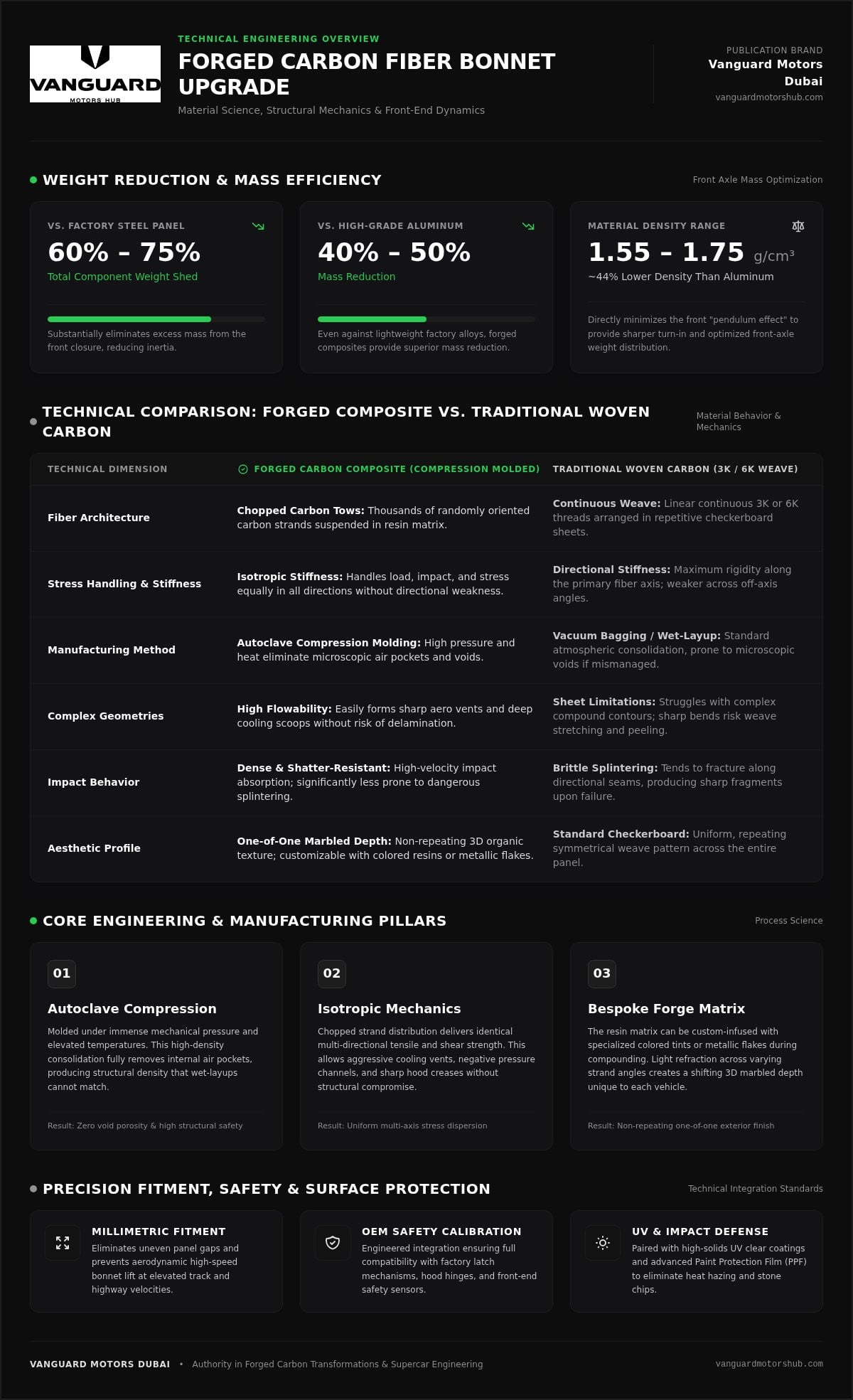
This technology has transitioned from experimental exotics to the most coveted upgrade for supercars in 2026. One of the most immediate benefits is the drastic reduction in front-end mass. Swapping a factory steel panel for a forged carbon alternative can shed between 60% and 75% of the component’s weight. Even compared to high-grade aluminum, owners can expect a 40% to 50% reduction. This weight loss directly translates to sharper turn-in and improved weight distribution across the front axle, enhancing the vehicle’s overall agility.
The Science of Chopped Carbon Strands
Traditional carbon fiber relies on a woven pattern that offers strength primarily along the axis of the weave. Forged carbon is different. Because the fibers are randomly oriented, the material provides isotropic stiffness. This means it handles stress equally from all directions, making it ideal for the complex geometries of modern engine covers. High-pressure compression during the manufacturing process eliminates the microscopic air pockets often found in lower-quality wet-layup panels. This density makes the bonnet significantly less prone to shattering during high-velocity impacts. It provides a safety margin that matches its elite performance.
Aesthetic Superiority in 2026
By 2026, the standard 3K checkerboard weave has become common. Forged carbon offers a sophisticated alternative with its signature marbled finish. No two panels are identical. The way the light hits the shredded fibers creates a three-dimensional depth that shifts as you move around the vehicle. Vanguard Motors Dubai specializes in taking this further by incorporating colored resins or metallic flakes into the forge. This level of customization allows you to align your forged carbon fiber bonnet replacement with your car’s specific livery or interior accents. It creates a truly bespoke aesthetic that stands out at any event, ensuring your vehicle remains a unique statement of engineering and style.
Forged vs. Traditional Woven Carbon: The Technical Comparison
Selecting the right material for your forged carbon fiber bonnet replacement requires a deep dive into structural mechanics. Traditional woven carbon fiber relies on continuous 3K or 6K threads. While visually iconic, these weaves are limited by their directional strength. Forged carbon utilizes chopped tows suspended in a resin matrix. This allows it to flow into complex 3D profiles that traditional sheets simply cannot accommodate. If your supercar features aggressive aero vents or deep cooling scoops, forged carbon provides the structural integrity needed to maintain those sharp edges without risk of delamination.
Manufacturing methods also set these materials apart. Traditional carbon often uses vacuum bagging, which is suitable for flatter panels. High-end forged components utilize autoclave compression molding. This process applies immense pressure and heat to eliminate microscopic air pockets. The result is a part with isotropic stiffness, meaning it resists stress equally from all directions. While traditional weaves are marginally stiffer along the fiber axis, forged carbon excels in overall impact resistance. It’s less likely to splinter into sharp shards, making it a safer choice for high-speed road use.
Weight Savings and Performance Gains
The performance benefits of a forged carbon fiber bonnet replacement are rooted in physics. According to automotive lightweight materials research, composite closures can reduce vehicle mass by 50% to 75% compared to conventional steel. In practical terms, forged carbon features a density of approximately 1.55 to 1.75 g/cm³. This is roughly 44% lower than structural aluminum. By shedding kilos from the front axle, you directly improve the vehicle’s turn-in response and overall weight distribution. This reduction in “pendulum effect” ensures the nose of the car stays planted during rapid direction changes.
Durability and Thermal Stability
Engine bay heat is the primary enemy of aftermarket composites. Poorly manufactured bonnets often suffer from resin “yellowing” or warping over time. To prevent this, premium forged panels use high-solids, 2K automotive-grade UV-resistant clear coats. These coatings act as a barrier against both solar radiation and thermal soak from the engine. Forged carbon is particularly adept at heat management because its non-directional fiber structure resists the thermal expansion that can cause woven panels to bow. If you’re concerned about how your upgrade will handle the intense heat of a high-performance engine, you can consult our technical team for a tailored protection strategy.
Repairability is another often-overlooked advantage. If a traditional woven bonnet is chipped by road debris, the damage often severs the continuous fibers, making a “perfect” invisible repair nearly impossible. Forged carbon is different. Because the pattern is organic and marbled, skilled technicians can patch and blend repairs with much higher success rates. This ensures your bespoke aesthetic remains flawless for the life of the vehicle.
Selecting the Right Forged Carbon Bonnet for Your Supercar
Securing the perfect forged carbon fiber bonnet replacement involves more than just selecting a part from a catalog; it requires a deep understanding of your vehicle’s structural ecosystem. Most factory bonnets are designed with specific crumple zones and sensor placements. When you move to a composite alternative, you must ensure the new panel retains these safety features. Compatibility extends to the mechanical hardware. High-quality aftermarket bonnets should feature pre-machined receiver points for factory hinges and primary latches. If these aren’t millimetrically accurate, you risk latch failure or alignment issues at high speeds.
Before the panel ever touches your car, a rigorous pre-fitment inspection is non-negotiable. You’re looking for resin depth consistency and an absence of surface pinholes. A “dry” spot in the resin can lead to premature cracking under the intense heat stress of a supercar engine bay. Verifying these technical details early ensures your forged carbon fiber bonnet replacement delivers the performance gains and bespoke style you expect from a top-tier upgrade.
Integrating with Elite Body Kits
Consistency is the hallmark of a professional build. If your vehicle already features a full Brabus body kit, the forged pattern on your bonnet must match the density and shimmer of the existing components. This is especially critical for owners of the Jetour T2 or G700 who are looking to add forged accents. A mismatched pattern can break the visual flow of the car, turning a premium upgrade into a disjointed modification. You should also consider how the exposed carbon transitions into the factory paint. A seamless fade or a sharp, defined border can completely change the vehicle’s character.
Functional Features: Vents and Intakes
Aero vents should never be purely decorative on a high-performance machine. Functional venting helps manage under-hood pressure and directs cooling air toward the engine bay. However, this functionality brings practical challenges that you must address during the selection process:
- Rain Guards: Ensure the bonnet includes removable guards to protect electrical components during inclement weather.
- Drainage Systems: Check for integrated channels that prevent water from pooling near the air intake or sensitive sensors.
- Aerodynamic Balance: High-speed stability depends on vents that don’t create unwanted lift or turbulence.
Choosing a bonnet with functional ducting requires a balance between aggressive styling and real-world utility. A well-engineered forged carbon panel will incorporate these features without compromising the structural integrity of the part. This attention to detail separates elite aftermarket manufacturers from budget alternatives that prioritize form over function.
Precision Installation and Protecting the Forged Finish
The technical excellence of a forged carbon fiber bonnet replacement is only fully realized through meticulous installation. A high-end component deserves a “factory-plus” fitment, where panel gaps are measured to millimetric tolerances. At Vanguard, we treat every installation as a high-stakes calibration. We understand that even a two-millimeter deviation can disrupt the visual flow of a supercar’s design. Our technicians utilize specialized shimming techniques and hinge adjustments to ensure that the marbled pattern aligns perfectly with the front fenders and bumper, maintaining the vehicle’s original aerodynamic profile.
Precision fitment is about more than just aesthetics; it’s a matter of structural safety. Because forged carbon panels are significantly lighter than OEM steel, the tension in factory gas struts often requires tuning. If the struts are too powerful, they can exert excessive pressure on the composite panel, leading to bowing or latch failure. We carefully calibrate the primary and secondary locking mechanisms to ensure the bonnet remains secure even under the intense aerodynamic loads experienced at supercar speeds.
The Installation Process: Beyond the Bolts
Modern supercar architecture is a complex web of sensors and cameras. Many 2026 models feature ADAS sensors or thermal imaging hardware integrated near the bonnet line. These systems require precise recalibration once the new panel is seated to ensure factory safety standards remain intact. We also inspect the under-hood heat shielding to prevent thermal soak from affecting the resin’s structural integrity. Attempting a DIY installation not only voids your component warranty but also introduces significant safety risks by potentially compromising the primary latching system.
Shielding Your Investment with PPF
Once the fitment is perfected, protecting the resin surface becomes the priority. While high-quality forged panels include UV-resistant clear coats, they remain vulnerable to high-velocity road debris. Applying paint protection film is the industry standard for preserving an exposed carbon finish. This 8-mil to 10-mil TPU layer acts as a sacrificial barrier against rock chips, sand abrasion, and environmental fallout. It effectively stops the micro-pitting that can dull the shimmer of the forged strands over time.
Customization continues even in the protection phase. Owners can choose between a high-gloss film to amplify the three-dimensional depth of the forged flakes or a satin finish for a more aggressive, muted aesthetic. This layer also provides critical UV protection, preventing the resin from yellowing or becoming brittle under the intense UAE sun. This holistic approach ensures that your investment remains as striking as the day it was installed. If you are ready to elevate your vehicle’s profile with a professional fitment, contact our installation specialists today to discuss your bespoke transformation.
Vanguard Motors: The Authority in Forged Carbon Transformations
Vanguard Motors Dubai stands as the definitive authority for forged carbon fiber bonnet replacement across the UAE. We recognize that elite owners demand more than a simple swap of factory components. They seek a technical transformation that reflects their personal vision. Our state-of-the-art facility is purpose-built to accommodate the intricate requirements of the world’s most exclusive luxury and performance vehicles. We don’t just source parts; we engineer solutions. Every forged pattern we install is scrutinized for density and visual flow, ensuring it enhances the vehicle’s unique silhouette rather than distracting from it.
Our team bridges the gap between technical skill and creative expression. We maintain an authoritative grip on the latest composite advancements, allowing us to handle complex fitments that standard shops often refuse. This professional precision is paired with a high-octane passion for automotive excellence. We treat every supercar as a masterpiece in progress. By integrating your new bonnet into our supercar detailing workflows, we provide a level of preservation that safeguards both the aesthetics and the long-term value of your machine.
Custom Carbon and Restoration Services
Even the most resilient composites can suffer from environmental wear or minor road mishaps. We provide specialized carbon fiber car parts repair to address surface imperfections or resin degradation. Our restoration process involves carefully blending new resin into the existing forged matrix to erase signs of damage while maintaining structural integrity. This level of restoration is a Vanguard Motors Dubai specialty. Beyond repairs, we can extend the forged aesthetic into the cabin. We develop custom interior forged carbon trims that perfectly match your exterior bonnet, creating a unified design language that flows from the engine bay to the driver’s seat.
The Ultimate Conversion Experience
A forged bonnet is often the centerpiece of a much larger vision. We act as your sophisticated guide for full-body conversions, including the installation of world-renowned Mansory, Brabus, or Rox kits. Our expertise extends to specialized modifications for Chinese car brands, including the Jetour T2 and G700 kits. Our approach is holistic and highly organized. We manage every detail, from the mechanical alignment of aerodynamic components to the final leather restoration of your interior. This ensures your vehicle leaves our facility as a balanced, high-performance work of art that stands out on any road. Transform your vehicle with Vanguard Motors Dubai and secure a legacy of elite performance and bespoke style.
Secure Your Place at the Pinnacle of Automotive Design
Choosing a forged carbon fiber bonnet replacement is a commitment to both engineering excellence and bespoke artistry. You’ve seen how this material sheds significant weight from the front axle while offering a marbled finish that’s impossible to replicate. It’s a structural evolution that balances isotropic strength with a visual depth that traditional weaves simply can’t match. This upgrade doesn’t just change the look of your vehicle; it redefines its performance profile and aerodynamic stability.
Vanguard Motors provides the technical authority to bring this vision to life. As specialists in Brabus and Mansory conversions, we maintain an expert carbon fiber repair facility and offer advanced PPF solutions to ensure your investment remains flawless. We understand the millimetric precision required for supercar fitment and the meticulous care needed for long-term preservation in the UAE’s demanding climate. Our team is ready to guide you through every step of this high-performance transformation.
Don’t settle for standard when you can achieve the extraordinary. Request a Bespoke Forged Carbon Consultation today. Your vehicle’s evolution into a unique performance masterpiece is just one conversation away.
Frequently Asked Questions
Is forged carbon fiber stronger than traditional woven carbon fiber?
Forged carbon fiber provides isotropic strength, meaning it handles stress equally from all directions. Traditional woven carbon is stronger along the primary fiber axis but weaker off-axis. Because a forged carbon fiber bonnet replacement uses randomly oriented chopped strands, it excels in complex 3D shapes. This makes it less likely to splinter or delaminate under multi-axial loads. It’s a robust evolution that offers superior impact resistance for high-performance road use.
Will a forged carbon bonnet replacement affect my car’s safety rating?
A professional installation ensures your vehicle’s safety telemetry remains fully functional. Modern supercars use active pedestrian safety hinges and under-hood sensors that must be carefully transferred to the new panel. When using certified components, the material is engineered to fracture safely upon impact rather than creating sharp shards. We prioritize the calibration of primary latching systems to maintain factory standards, ensuring your safety is never compromised for aesthetics.
How do I maintain the shine on my forged carbon fiber hood?
Maintaining the signature shimmer requires a non-abrasive approach to car washing. You should use pH-neutral shampoos and high-quality microfiber mitts to prevent swirl marks on the resin surface. While regular polishing helps, the most effective way to preserve the finish is through a professional detailing regimen. Applying a ceramic coating or paint protection film provides a long-lasting barrier against environmental contaminants and oxidative stress.
Can forged carbon fiber be painted or wrapped?
You can certainly paint or wrap forged carbon, though most enthusiasts prefer the exposed marbled texture. Some owners choose to paint the edges of the bonnet to create a seamless transition into the factory bodywork. Others utilize colored sticker wraps or peelable paint for temporary style changes. If you decide to cover the carbon, ensure the surface is properly prepped to prevent adhesion issues with the resin clear coat.
Does a forged carbon bonnet help with engine cooling?
A forged carbon bonnet significantly improves thermal management when it includes functional aero vents. These ducts are designed to extract hot air from the engine bay and reduce under-hood pressure at high speeds. This airflow optimization helps keep critical components cool during spirited driving. Even without vents, the material’s thermal stability ensures it won’t warp or bow under the intense heat generated by a high-output supercar engine.
Why is forged carbon more expensive than standard carbon fiber?
The higher cost reflects the complexity of the autoclave compression molding process. Unlike traditional hand-laid weaves, forged carbon requires high-pressure machinery to eliminate air pockets and ensure a dense, isotropic structure. The labor involved in crafting these unique, non-repeating patterns is also more intensive. You’re investing in a material that offers superior structural integrity and a bespoke aesthetic that cannot be mass-produced using cheaper vacuum bagging methods.
How long does a professional forged carbon bonnet installation take?
A professional forged carbon fiber bonnet replacement typically requires three to six hours of dedicated labor for the physical fitment. This timeframe includes the removal of OEM hardware, hinge alignment, and latch calibration. However, if your vehicle requires sensor recalibration or the application of protective films, the process can extend to a full day. We focus on millimetric precision to ensure the panel gaps match factory-plus standards before the vehicle is released.
Do I need to apply PPF to my new forged carbon bonnet?
Applying Paint Protection Film (PPF) is essential for preserving the clarity of the forged finish. The resin used in carbon composites is susceptible to micro-pitting from road debris and yellowing from intense UV exposure. A high-quality TPU film acts as a sacrificial barrier that absorbs impacts and blocks harmful radiation. Without this protection, the marbled pattern can become dull over time, making PPF a non-negotiable step for elite vehicle preservation.