
Your high-performance engine is a precision instrument that, by its very design, is slowly suffocating itself. Modern Gasoline Direct Injection systems offer incredible power but leave behind a stubborn residue that robs you of the elite driving experience you expect. You’ve likely noticed a subtle loss of punch during acceleration or a frustratingly rough idle during your daily commute. It’s a common concern for UAE drivers who want to avoid long-term damage while maintaining peak output. If you’re asking how often should you carbon clean your engine, you’re already ahead of the average owner.
This 2026 performance guide identifies the precise mileage intervals and technical triggers that signal your vehicle needs a professional clean to restore factory-level efficiency. We’ll explore the impact of local driving conditions and provide a clear roadmap for maintaining your car’s mechanical integrity and signature performance. By understanding these specific maintenance cycles, you can ensure your vehicle remains a benchmark of engineering excellence. We’ll provide the clarity you need to extend your vehicle’s lifespan while enjoying the full potential of its power plant.
Key Takeaways
- Understand the “GDI Dilemma” and why modern high-performance engines require specialized cleaning that standard fuel additives simply cannot provide.
- Identify the subtle early warning signs of performance degradation, including rough idling and the distinctive “cold start stumble” caused by soot buildup.
- Master your maintenance schedule by discovering exactly how often should you carbon clean your engine to ensure peak efficiency and long-term mechanical health.
- Compare professional decarbonization methods, from hydrogen cleaning to precision walnut blasting, to determine the most effective restoration path for your vehicle.
- Learn how proactive carbon management serves as a critical pillar of a holistic vehicle preservation strategy for discerning owners in the UAE.
Understanding Engine Carbon Buildup in Modern Performance Vehicles
Engine carbon cleaning is the surgical removal of soot and polymer deposits from your intake valves and combustion chambers. These residues are more than just a nuisance; they’re a physical barrier to performance. Carbonization is the byproduct of incomplete combustion that adheres to internal engine components. While high-performance engines are engineered for power, they’re inherently prone to this internal decay. This reality leads many owners to ask how often should you carbon clean your engine to maintain that factory-fresh response and elite efficiency.
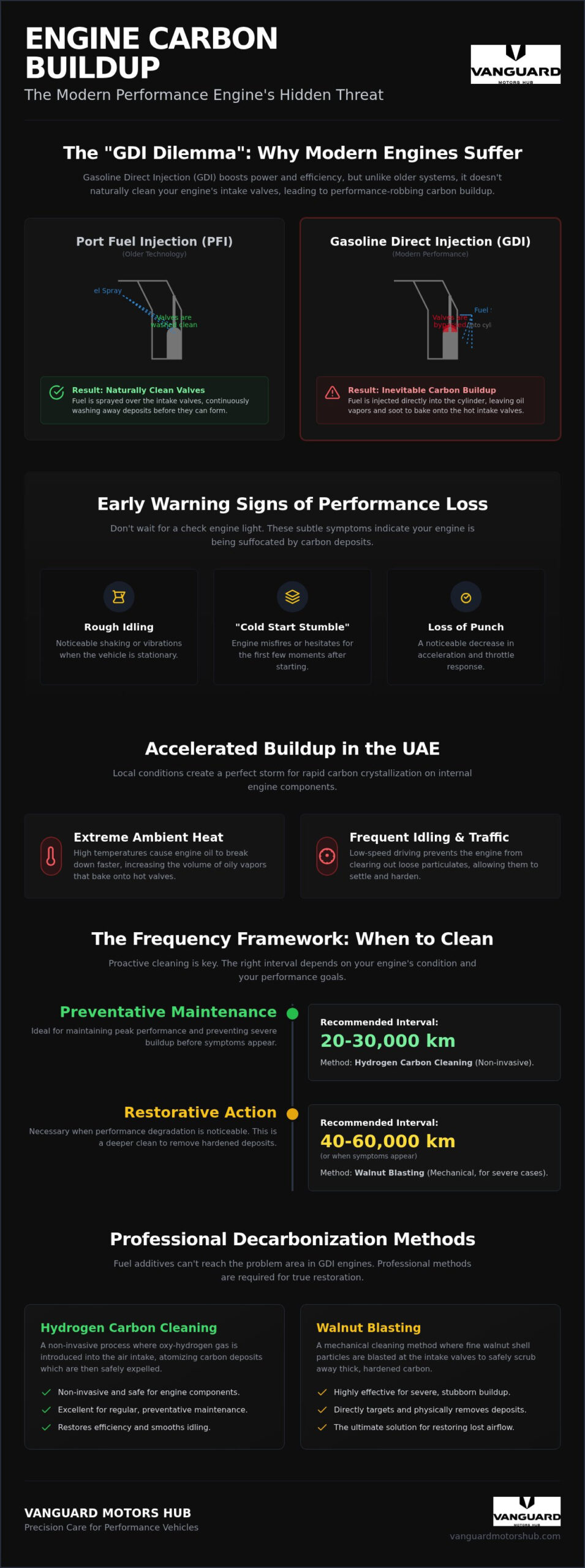
The “GDI Dilemma” has redefined modern maintenance. In older Port Fuel Injection systems, fuel sprayed over the intake valves, effectively washing them clean with every stroke. Modern Gasoline Direct Injection (GDI) sprays fuel directly into the combustion chamber, bypassing the valves entirely. This lack of a “fuel bath” allows oil vapors and particulates to bake onto the metal surfaces without interruption. When combined with oil blow-by from the Crankcase ventilation system, these deposits harden into a restrictive crust that standard fuel additives cannot touch.
The Role of Direct Injection Technology
Luxury and supercars almost exclusively utilize GDI to maximize thermal efficiency and throttle response. This technology allows for incredible precision in fuel metering but ignores the mechanical hygiene of the intake tract. As layers of carbon accumulate, they disrupt the intended air-to-fuel ratio and restrict high-velocity airflow. Your engine becomes “choked.” It loses the very precision that defines its performance tier. Restoring this balance requires a targeted approach to remove the soot that blocks the engine’s vital airways.
Environmental Factors: Heat and Idling
The unique climate of the UAE accelerates this degradation process significantly. Extreme national temperatures cause engine oil to break down more rapidly, which increases the volume of oily vapors entering the intake system. Frequent idling in heavy traffic further compounds the issue. It reduces the engine’s ability to “breathe” at high velocities, which is necessary to clear out loose particulates. This environment causes carbon to crystallize onto valves at an accelerated rate. Understanding these localized stressors is vital when determining how often should you carbon clean your engine to prevent long-term mechanical damage. Precision care is the only way to counteract these environmental pressures and preserve your vehicle’s signature power.
Mechanical vs. Chemical Decarbonization: Choosing the Right Precision Method
Not all cleaning methods are created equal. High-performance engines require specific technical interventions that go beyond generic shelf products. Many owners rely on fuel tank additives to solve their performance issues. This is a significant mistake for modern GDI systems. Because fuel never touches the intake valves in a direct injection setup, these chemicals simply pass through the combustion chamber without removing the hardened soot on the valves. Professional cleaning is the only way to ensure the structural integrity of your engine’s internal components while restoring its original flow characteristics.
Determining how often should you carbon clean your engine depends heavily on whether you are performing routine maintenance or reacting to noticeable performance loss. For high-value supercar engines, the safety profile of the chosen method is paramount. You need a solution that removes the “gunk” without compromising delicate seals or cylinder walls. Selecting the right precision method is just as vital as the frequency of the service itself. It’s the difference between a surface-level fix and a true mechanical restoration.
Hydrogen Carbon Cleaning: The Non-Invasive Approach
This method uses a specialized electrolysis process to create oxy-hydrogen gas. When introduced into the air intake while the engine is idling, this gas raises the internal combustion temperature just enough to atomize carbon deposits. These particles are then expelled through the exhaust system as harmless water vapor. It’s a highly effective preventative maintenance tool for engines that aren’t yet showing severe symptoms. This non-invasive approach is ideal for regular intervals, ensuring that light soot doesn’t have the chance to crystallize into a harder, more restrictive crust.
Walnut Blasting: The Gold Standard for Heavy Buildup
When an engine has been neglected or has high mileage, mechanical intervention becomes necessary. Walnut blasting involves using pressurized air to spray finely crushed walnut shells into the intake ports. These organic shells are hard enough to scrub away baked-on carbon but soft enough to leave the metal valves completely unharmed. This procedure requires the removal of the intake manifold, allowing a technician to provide a direct, visual confirmation of the restoration. It’s the ultimate reset for your engine’s breathing and is often required when you’ve exceeded the recommended timeframe for how often should you carbon clean your engine.
If you’re unsure which method fits your vehicle’s current state, you can consult our performance experts to evaluate your engine’s health and determine the most effective path forward.
The Frequency Framework: When to Schedule a Professional Carbon Clean
Establishing a maintenance rhythm is about preserving the soul of your machine. For most modern GDI vehicles, a preventative baseline of 20,000 to 30,000 kilometers is the industry standard for maintaining peak efficiency. However, a high-performance engine isn’t a standard commuter. These power plants operate at significantly higher internal pressures and temperatures, which can accelerate the bonding of soot to intake surfaces. Precision requires a proactive approach rather than a reactive repair.
Understanding how often should you carbon clean your engine is the first step in a holistic preservation strategy. You must account for the evolution of automotive engineering. A 2026 model year vehicle features much tighter tolerances than a car from 2010. While older engines might tolerate a bit of “sludge” before performance dips, modern sensors will detect even minor airflow disruptions. This can trigger efficiency drops or subtle timing pulls much sooner than you’d expect. In the high-stakes environment of elite automotive care, staying ahead of these deposits is essential.
Usage patterns play a decisive role in this framework. A vehicle that primarily enjoys high-speed highway cruising often stays cleaner for longer. Higher exhaust gas velocities help clear loose particulates before they settle. Conversely, a supercar that spends its life in urban traffic, idling at stoplights, is a prime candidate for rapid buildup. The lack of sustained heat and airflow allows oil vapors to condense and harden on the valves. Determining how often should you carbon clean your engine means looking at your odometer and your driving habits with equal scrutiny.
Mileage Milestones for Optimal Performance
- 15,000 – 20,000 km: This is the “Check-up” phase for dedicated performance cars. At this stage, a non-invasive hydrogen clean can prevent light soot from becoming a permanent fixture.
- 40,000 – 50,000 km: The “Essential Clean” window. For urban drivers, this is the point where performance degradation often becomes noticeable to the discerning driver.
- 100,000 km+: The “Restoration” phase. If your engine has never been treated, it likely requires mechanical intervention like walnut blasting to clear heavy, solidified “gunk” that has accumulated over years of service.
Factors That Accelerate the Need for Cleaning
Several variables can shorten these intervals. Frequent short trips are particularly damaging because the engine never reaches its optimal operating temperature, leaving unburnt fuel to settle. Neglected oil changes also contribute, as degraded oil produces more vapors that recirculate through the intake system. Finally, modified engines with increased boost pressures or aftermarket tuning demand even more frequent attention. These high-stress environments create more blow-by, making regular carbon management a non-negotiable part of your vehicle’s long-term health.
How to Identify Carbon-Related Performance Degradation
Performance degradation is a silent thief. It doesn’t happen overnight; it’s a slow erosion of the driving experience that many owners mistake for natural aging. You might notice your vehicle isn’t reacting with its usual surgical precision, or perhaps the exhaust note sounds slightly muffled. This is where the question of how often should you carbon clean your engine moves from a theoretical maintenance task to a practical necessity. Waiting for a check engine light to illuminate is a reactive strategy that often results in unnecessary wear on sensitive internal components.
The “Cold Start Stumble” is one of the most reliable early warning signs. When your engine is cold, carbon deposits on the intake valves act like a sponge, absorbing the initial spray of fuel. This creates a temporary lean condition that causes the engine to hunt for a steady idle or hesitate during the first few minutes of operation. Once the engine reaches operating temperature, the deposits become saturated, and the symptoms may fade. However, the underlying restriction remains, quietly robbing you of power and efficiency every time you’re on the road.
Carbon buildup also creates physical hot spots within the combustion chamber. These glowing embers of soot can ignite the air-fuel mixture prematurely, leading to “knocking” or pre-detonation. Modern engine management systems will detect this and retard the ignition timing to protect the engine, but this comes at the cost of significant power loss. Proactive diagnostics allow you to address these issues before they escalate into permanent mechanical damage.
The Five Red Flags of a Clogged Engine
- Throttle Lag: You’ll experience a distinct delay in response and “flat spots” during acceleration where the engine feels momentarily breathless.
- Erratic Idling: A rough or unstable idle, particularly after a period of high-speed driving, suggests the ECU is struggling to balance airflow.
- Efficiency Drop: A sudden, unexplained increase in fuel consumption occurs as the engine works harder to pull air through restricted ports.
- Exhaust Quality: Excessive smoke or a “heavier,” more pungent exhaust scent than usual indicates incomplete combustion.
- Hard Starting: The engine may require more cranks to fire up, as the carbon interferes with the initial air-to-fuel ratio.
Diagnostic Tools: Borescope Inspections
Professional technicians eliminate the guesswork by using high-definition borescope cameras to peer inside the intake tract. This provides visual proof of the soot levels on your valves before any service begins. It’s a level of transparency that aligns with the meticulous care found in supercar detailing, where every detail is scrutinized for perfection. Seeing the actual state of your intake ports provides the data-driven clarity needed to decide how often should you carbon clean your engine to maintain its elite status.
If your vehicle is showing signs of hesitation, schedule a precision borescope inspection to see exactly what’s happening inside your engine.
Professional Engine Carbon Cleaning at Vanguard Motors
Vanguard Motors Dubai stands at the intersection of mechanical mastery and aesthetic perfection. We don’t just clear soot; we restore the mechanical soul of your vehicle. Our facility is engineered to handle the specific requirements of luxury marques and supercars, where standard maintenance simply won’t suffice. When you ask how often should you carbon clean your engine, our answer is rooted in technical data and a deep understanding of your vehicle’s unique profile. We utilize precision equipment that mirrors the sophistication of your engine’s own design, ensuring that every service is performed with surgical accuracy.
The Vanguard Standard of Care
Our process begins with a meticulous diagnostic phase. We don’t believe in a one-size-fits-all approach for high-value assets. Whether your vehicle requires a non-invasive hydrogen treatment or a deep-clean walnut blast, our trained technicians apply their expertise in supercar engineering to ensure the safest, most effective outcome. We’re committed to restoring that elusive “factory feel,” ensuring your throttle response is as sharp as the day it left the showroom. It’s about precision, not just procedure. Every engine that enters our care is treated with the same level of technical rigor we apply to a complex body kit conversion or a forged carbon repair.
Integrating Performance and Protection
A truly elite vehicle is a balance of internal health and external brilliance. While we’re known for our industry-leading paint protection film, we know that external beauty is hollow without a heart that beats with full power. A clean engine provides the essential foundation for other high-performance upgrades, such as exhaust modifications or structural carbon fiber installation. By maintaining the internal airways of your engine, you ensure that every other modification can perform at its peak potential. It’s a holistic strategy that preserves both the value and the thrill of your vehicle.
Our specialists are ready to help you design a bespoke maintenance schedule tailored to your specific driving habits and performance goals. We understand the unique environmental stressors of the UAE and how they impact your engine’s longevity. Don’t let carbon buildup compromise your investment or your driving pleasure. Take a proactive step toward total vehicle preservation. Book your engine diagnostic via WhatsApp today and experience the Vanguard difference.
Secure Your Engine’s Future Performance
Maintaining the elite responsiveness of a high-performance vehicle requires more than just routine oil changes. Modern Gasoline Direct Injection has made preventative carbon management a technical necessity for every discerning owner. By understanding how often should you carbon clean your engine based on your specific UAE driving habits, you can prevent performance lag and ensure your vehicle’s mechanical integrity remains uncompromised. Precision diagnostics move you from guesswork to guaranteed results.
At Vanguard Motors Hub, we combine advanced diagnostic borescope technology with an elite facility designed for comprehensive automotive care. Our specialists in luxury and supercar maintenance are dedicated to restoring the factory-level efficiency that defines your driving experience. Don’t wait for performance degradation to become permanent damage. Take the proactive step toward total engine restoration today. Your vehicle deserves the meticulous attention that only a specialized performance hub can provide.
Restore Your Engine’s Power: Message Our Experts on WhatsApp
Frequently Asked Questions
Is engine carbon cleaning safe for my car?
Professional carbon cleaning is exceptionally safe when performed by specialists using precision equipment. Non-invasive methods like hydrogen cleaning are designed to atomize soot without any mechanical stress on the engine. Mechanical walnut blasting is also safe for high-performance engines, provided it is executed by trained technicians who ensure intake valves are completely sealed during the process to protect the combustion chamber.
Can carbon cleaning improve my car’s fuel economy?
Restoring your engine’s internal airflow directly improves combustion efficiency, which frequently leads to a measurable increase in fuel economy. When carbon restricts the intake ports, the ECU often compensates by adjusting fuel trims, which leads to wasted petrol. Removing these deposits allows your engine to operate within its intended parameters, ensuring you get the maximum range from every liter of fuel.
How much does a professional engine carbon clean cost?
The investment for a professional service in the UAE depends on your vehicle’s engine configuration and the cleaning method required. Hydrogen cleaning is a cost-effective preventative measure, while mechanical walnut blasting involves more intensive labor. Owners should request a bespoke quote in UAE Dirham (AED) that reflects the specific technical requirements of their luxury or supercar model to ensure precision care.
What happens if I never carbon clean my engine?
Neglecting this maintenance leads to a permanent loss of throttle response, increased fuel consumption, and eventual mechanical failure. Over time, heavy deposits can cause valves to stick or even break, which results in catastrophic engine damage. Understanding how often should you carbon clean your engine is essential for any owner who wants to avoid the high costs of a full engine teardown.
Is hydrogen carbon cleaning better than walnut blasting?
Neither method is universally superior; they serve different stages of engine care. Hydrogen cleaning is an elite preventative tool that keeps soot from hardening into a crust. Walnut blasting is the gold standard for heavy, solidified buildup that has been neglected for years. The correct choice depends on a visual borescope inspection to determine the actual state of your intake valves.
Will carbon cleaning fix a “Check Engine” light?
It can resolve a warning light if the trigger is related to airflow restrictions, lean conditions, or carbon-induced misfires. However, a professional diagnostic is the only way to confirm the root cause. While carbon cleaning is a powerful restorative service, it cannot repair faulty sensors or broken mechanical components that might also trigger an alert on your dashboard.
Does a new car need carbon cleaning?
A brand-new vehicle doesn’t require immediate service, but soot accumulation begins from the very first kilometer in GDI engines. Establishing a proactive schedule for how often should you carbon clean your engine around the 20,000 km mark is a visionary strategy. Starting early prevents the heavy crystallization of carbon, ensuring your vehicle maintains its signature factory performance and efficiency for years to come.
How long does a professional carbon cleaning service take?
The duration of the service is dictated by the complexity of the procedure. A non-invasive hydrogen cleaning session typically requires 60 to 90 minutes to complete. A mechanical walnut blasting service is a more intensive operation that can take several hours. This extra time is necessary because technicians must carefully remove the intake manifold to access and scrub the valves with surgical precision.