
Did you know that without professional-grade shielding, your vehicle’s high-performance carbon fiber can begin to yellow in as little as three months of direct sun exposure? It’s a frustrating reality for any owner who appreciates the technical precision of a Brabus or Mansory kit. You’ve invested in the pinnacle of automotive engineering, only to watch the deep, mirror-like weave turn cloudy and brittle under a relentless sky. We understand that maintaining that elite finish isn’t just about vanity; it’s about preserving the resale value and the mechanical soul of your machine.
This 2026 professional guide reveals exactly how to protect carbon fiber from UV damage using a sophisticated, multi-layered defense strategy. You’ll master the technical nuances of epoxy resin degradation and discover why high-end Paint Protection Films are now the gold standard for blocking 99% of harmful radiation. From chemical ceramic barriers to physical structural shields, we’re outlining the precision care required to keep your carbon weave flawless and structurally sound for the long haul.
Key Takeaways
- Understand why epoxy resin is the primary point of failure in carbon composites and how UV radiation triggers irreversible structural degradation.
- Learn why high-end Paint Protection Film (PPF) and Peelable Paint serve as the ultimate physical barriers, blocking up to 99% of harmful radiation.
- Discover the technical steps for how to protect carbon fiber from UV damage through professional decontamination and surface correction before sealing.
- Identify the early warning signs of resin yellowing and the specific protocols required to restore clarity to damaged clear coats.
- Explore bespoke shielding strategies designed specifically for the complex geometry of Brabus and Mansory aerodynamic kits.
The Science of UV Degradation: Why Carbon Fiber Yellows
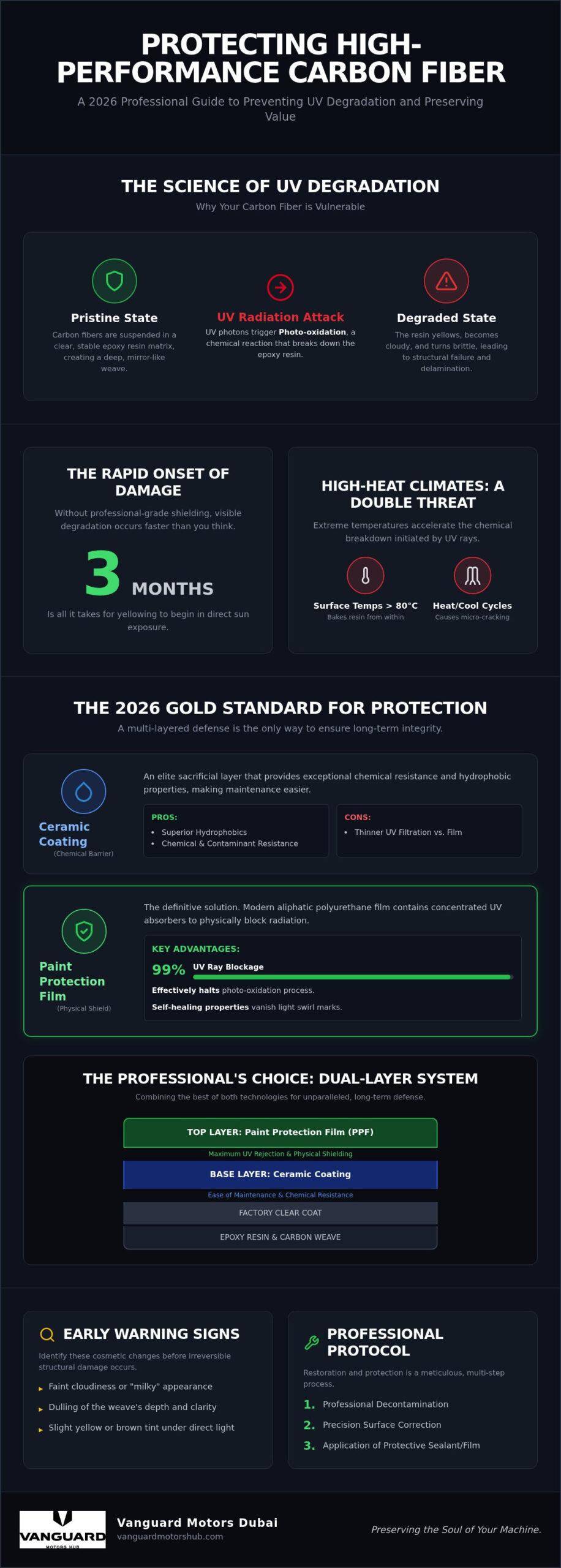
Carbon fiber is often celebrated for its incredible strength-to-weight ratio, yet its greatest weakness is invisible. To understand the vulnerability, you must look at the material’s composition. A typical automotive component is a carbon fiber reinforced polymer, where high-strength fibers are suspended in a matrix of epoxy resin. While the carbon filaments are largely immune to solar radiation, the epoxy resin is highly susceptible to the sun’s energy. When UV photons strike the surface, they trigger a destructive chemical reaction.
Photo-oxidation is the primary catalyst for carbon fiber aging. This process initiates chain scission, where the polymer’s long molecular chains are literally snapped apart by radiation. As these bonds fail, the resin begins to lose its transparency and its structural grip on the fibers. What starts as a slight change in light refraction eventually manifests as the dreaded “yellowing effect,” signaling that the resin is no longer chemically stable. Knowing how to protect carbon fiber from UV damage is essential because once this degradation reaches the weave, the damage is often irreversible.
Resin Oxidation vs. Structural Delamination
The first warning signs are usually cosmetic. You’ll notice a faint cloudiness or a “milky” appearance that dulls the depth of the carbon weave. This is surface-level oxidation. However, as the UV exposure continues, the resin becomes increasingly brittle. It loses its flexibility and its ability to bond the carbon layers together. This leads to delamination, where the structural layers physically pull apart. For owners of elite Brabus or Mansory kits, this isn’t just a visual flaw; it’s the beginning of a total component failure that compromises the aerodynamic integrity of the vehicle.
The Impact of High-Heat Climates on Carbon Fiber
In high-heat national environments, the sun acts as a double-edged sword. Extreme thermal energy accelerates the chemical breakdown initiated by UV rays. Surface temperatures on a dark carbon hood can easily soar past 80 degrees Celsius during peak summer hours. This creates a “greenhouse effect” that bakes the resin from the inside out. The constant cycle of rapid expansion in the heat and contraction in the cool evening air creates immense mechanical stress. This results in micro-cracking, which provides a gateway for moisture and oxygen to further degrade the composite matrix. Standard clear coats simply aren’t engineered to survive these cycles without specialized professional protection.
Top Protective Coatings for Carbon Fiber in 2026
Selecting the right defense mechanism for high-performance composites is a matter of technical precision. While factory clear coats offer a baseline of protection, they often lack the chemical density required for long-term stability in high-UV regions. In 2026, the industry has shifted toward multi-layered systems that address both surface contamination and deep-spectrum radiation. Understanding how to protect carbon fiber from UV damage requires evaluating the trade-offs between hydrophobic performance and absolute UV filtration. The most effective strategies now combine chemical inhibitors with physical barriers to ensure the underlying resin remains untouched by solar energy.
Paint Protection Film (PPF): The Physical Shield
Modern Paint Protection Film has evolved into the definitive solution for exposed carbon weave. Unlike early films that were prone to yellowing, 2026-generation aliphatic polyurethane contains concentrated UV absorbers that neutralize radiation before it reaches the epoxy. These films block up to 99% of UV rays, effectively halting the photo-oxidation process. Beyond radiation, PPF offers self-healing properties that vanish swirl marks and light abrasions with simple heat exposure. This makes it the ultimate shield for maintaining the deep, three-dimensional look of high-end carbon kits. It’s an essential investment for anyone running complex aerodynamic components that are difficult to polish or repair.
Ceramic Coatings and Peelable Paint
Ceramic coatings serve as an elite sacrificial layer against environmental hazards. They provide exceptional hydrophobic properties, causing water, bird droppings, and industrial fallout to bead off the surface instantly. While ceramic layers offer excellent chemical resistance, their physical UV filtration is thinner than film. This is why the 2026 gold standard involves applying a professional ceramic coating as a base for ease of maintenance, followed by a precision-cut PPF for maximum UV rejection. This dual-layer approach ensures that the carbon weave retains its mirror-like finish while being shielded from the elements.
Peelable Paint has emerged as a disruptive innovation for those seeking total protection with aesthetic flexibility. It provides a high-build, reversible barrier that offers a 100% UV block. This is ideal for preserving the integrity of original carbon components during long-distance events or periods of intense sun exposure. Whether you prefer a high-gloss finish to accentuate the weave or a stealthy matte appearance, these professional applications ensure your investment remains pristine. If you’re ready to secure your vehicle’s finish, you can speak with our technical team about bespoke protection packages for your specific carbon kit.
Step-by-Step Guide: How to Apply Professional UV Protection
Achieving a concours-level finish requires more than just high-end products; it demands a clinical approach to preparation. You can’t simply apply a shield over existing contamination and expect excellence. If you’re learning how to protect carbon fiber from UV damage, you must realize that the bond between the protective layer and the resin is only as strong as the surface beneath it. Professional application is a transformative process that begins long before the film touches the vehicle.
Preparation and Surface Correction
Before any UV-resistant layer is applied, the carbon surface must be surgically clean. Any existing oxidation or “cloudiness” must be corrected, or it will be permanently sealed under the new coating. We use specialized, non-abrasive polishes to restore clarity to the clear coat without thinning the delicate resin matrix. This step ensures the deep, three-dimensional weave of your Brabus or Mansory kit is fully visible. Once the surface is polished, a decontamination phase is required to remove embedded metallic particles and environmental fallout.
Follow these steps for a professional clay bar decontamination:
- Cleanse: Perform a thorough pH-neutral wash to remove loose surface debris.
- Lubricate: Apply a generous amount of dedicated clay lubricant to a manageable section.
- Glide: Using light pressure, move a synthetic clay bar across the surface in linear motions until the “drag” disappears.
- Inspect: Fold the clay bar frequently to expose a fresh surface and prevent scratching the resin.
- Refine: Wipe the area with a plush microfiber towel and verify that the surface feels as smooth as glass.
Application of the Protective Layer
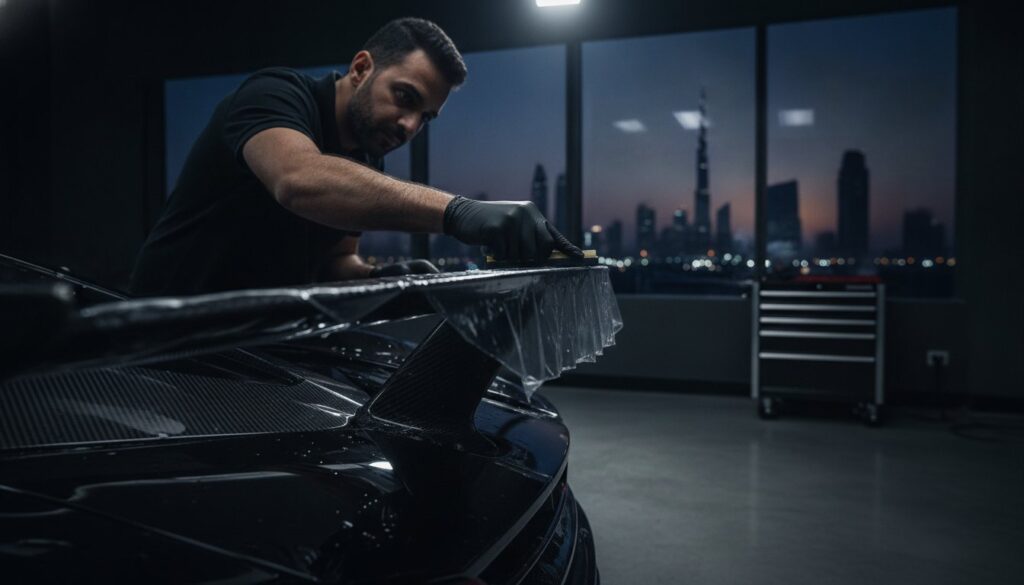
For large components like hoods and roofs, we utilize the “wet install” method. This involves a precision-calibrated slip solution that allows the film to be positioned perfectly before the adhesive sets. It’s the only way to ensure bubble-free adhesion on the intricate curves of high-performance kits. During the squeegee process, technicians must work from the center outward to evacuate all moisture, preventing “silvering,” which is the appearance of tiny trapped air pockets that can ruin the visual depth of the carbon weave.
The final touch involves edge-wrapping. We meticulously tuck the film around the edges of the carbon panels to provide 360-degree coverage and prevent lifting. Once applied, the vehicle requires a controlled environment for 24 to 48 hours to allow the moisture to evaporate and the bond to reach full strength. This technical precision is what separates a standard wrap from a professional shield. Mastering how to protect carbon fiber from UV damage involves a commitment to these rigorous standards. If you’re looking for elite results, visit vanguardmotorshub.com to see how we handle these complex installations.
Maintenance and Restoration of Exposed Carbon Weave
Applying a professional shield is only the first phase of long-term preservation. Once you have established a baseline of protection, the focus shifts to a rigorous maintenance schedule that prevents environmental fallout from compromising the top layer. Even the most advanced films and coatings require specific care to remain effective. Learning how to protect carbon fiber from UV damage involves understanding that the sacrificial layer is constantly under siege. Routine care ensures that this barrier remains transparent and chemically stable, preserving the deep visual impact of the weave beneath.
Safe Cleaning and Aftercare
The chemical composition of your cleaning products is critical. We recommend using strictly pH-neutral automotive shampoos that do not contain aggressive surfactants. In high-mineral regions, water spots can become etched into the clear coat or PPF, requiring abrasive removal that thins the protective layer. Utilizing deionized water for the final rinse eliminates this risk entirely. Pair this with high-GSM microfiber towels to avoid micro-marring the relatively soft resin surfaces. For those with ceramic-coated components, re-applying a dedicated ceramic booster every three to four months reinforces the UV-rejection properties and maintains the surface’s hydrophobic tension.
When to Repair vs. When to Replace
If your carbon fiber already shows signs of neglect, you must determine if the damage is cosmetic or structural. Surface-level cloudiness can often be corrected through a technical process of wet-sanding and re-clearing. This involves removing the oxidized top layer and applying a fresh, UV-stabilized clear coat to restore the mirror finish. However, you must be cautious. Over-polishing can easily burn through the thin resin layer and permanently damage the carbon filaments. If you notice signs of delamination or “lifting” of the weave, the component’s structural integrity may be compromised.
For high-value OEM parts or bespoke kits, restoration is often the most cost-effective path. A professional technician can salvage parts that appear beyond saving, provided the epoxy matrix hasn’t completely failed. If the resin has become brittle and started to crack, you are looking at a more intensive carbon fibre car parts repair. In cases where aftermarket parts show deep yellowing throughout the resin, replacement is often the only way to ensure the safety and aesthetics of the vehicle. If you’re unsure about the current state of your components, you can book a professional carbon inspection to receive a definitive technical assessment.
Professional Shielding: The Vanguard Motors Dubai Excellence
Elite automotive preservation is an art form that requires clinical execution. At Vanguard Motors Dubai, we don’t just apply coatings; we engineer a multi-layered defense system for the world’s most prestigious vehicles. Operating in a high-heat national market means our standards must exceed factory specifications to counteract the intense solar load. We’ve developed a specialized approach to preservation that addresses the thermal stress and radiation levels unique to this region. Masterfully knowing how to protect carbon fiber from UV damage is at the core of our technical mission, ensuring your investment remains immune to the elements.
Our facility offers a seamless transition from routine care to full-scale restoration. Whether you require our mobile detailing van for a maintenance boost or a comprehensive Vanguard Premium Package at our center, the quality remains uncompromising. We eliminate the friction of vehicle care by providing a single point of expertise for carbon fiber installation, repair, and protection. From the initial decontamination to the final curing phase, every step is handled with the precision of a high-end service center.
Precision Protection for Elite Body Kits
Intricate aerodynamic components like diffusers and spoilers present unique challenges for standard protection methods. Traditional film applications often fail on these complex shapes, leading to lifting or visible seams that ruin the aesthetic. We utilize precision-cut PPF technology to ensure total coverage on every fin and edge of your Brabus or Mansory kit. This meticulous attention to detail extends to the cabin, where we provide custom solutions for interior carbon fiber trim that synchronize perfectly with our leather restoration services. For a deeper look at our comprehensive standards, explore our Supercar Detailing: The 2026 Reference Guide to Meticulous Automotive Preservation.
The Vanguard Motors Dubai Guarantee of Quality
Our commitment to excellence is backed by the use of high-octane, professional-grade materials that define the 2026 industry standard. Every technician in our facility is trained in the latest application technologies, ensuring they understand exactly how to protect carbon fiber from UV damage using advanced polymer shields. We don’t settle for average results because we know your passion for performance demands perfection. By choosing a professional shield, you aren’t just maintaining a car; you’re preserving a legacy of engineering and design. It’s time to elevate your vehicle’s defense. Secure your carbon fiber’s future with Vanguard Motors Dubai and experience the pinnacle of automotive care.
Secure Your Carbon’s Mirror-Like Legacy
Preserving the technical perfection of your vehicle’s carbon fiber is a continuous commitment to excellence. We’ve explored how UV radiation relentlessly targets the epoxy resin matrix, leading to irreversible yellowing and structural delamination if left unshielded. By utilizing a multi-layered defense strategy, combining hydrophobic ceramic coatings with 2026-generation UV-resistant PPF, you create an impenetrable barrier against the harshest solar environments. Mastering how to protect carbon fiber from UV damage is no longer just an aesthetic choice; it’s a vital preservation of your vehicle’s resale value and mechanical soul.
Vanguard Motors Dubai stands as a visionary leader in this high-stakes arena. Our expert technicians specialize in the precision installation of Mansory and Brabus kits, utilizing specialized UV-resistant PPF solutions tailored for complex aerodynamics. With our comprehensive carbon fiber restoration facility, we possess the technical skill to breathe new life into aged components while shielding new ones from the very first day. Don’t let the sun dictate the lifespan of your performance upgrades.
Protect your investment with Vanguard Motors Dubai’s elite Carbon Fiber Protection services and ensure your machine remains a masterpiece of form and function.
Frequently Asked Questions
Can I use regular car wax to protect carbon fiber from UV rays?
Traditional car waxes are not designed to block high-energy UV radiation effectively. While they provide a temporary gloss, their chemical structure lacks the density required to prevent photo-oxidation in epoxy resin. For a reliable defense, you need dedicated UV inhibitors found in professional-grade films or ceramic coatings. Relying on standard wax often leads to disappointing results, especially in high-heat environments where the product can evaporate or degrade within weeks.
How long does PPF last on carbon fiber in high-heat environments?
In extreme high-heat conditions, premium Paint Protection Film typically maintains its integrity for five to seven years. Modern aliphatic polyurethane films are engineered to resist yellowing and cracking, even under intense solar exposure. However, regular maintenance with ceramic boosters can extend this lifespan significantly. If you notice edges lifting or the surface becoming dull, it is a sign that the film has reached its protective limit and requires professional replacement.
Is ceramic coating better than PPF for preventing carbon fiber yellowing?
Paint Protection Film is significantly more effective than ceramic coating for preventing carbon fiber yellowing. While ceramic coatings provide a thin chemical shield and excellent hydrophobic properties, PPF acts as a thick physical barrier that blocks up to 99% of UV rays. For the ultimate defense, we recommend a multi-layered approach. Applying a ceramic coating over the film provides the chemical resistance of a coating with the absolute radiation filtration of film.
What should I do if my carbon fiber has already started to turn yellow?
If your carbon fiber has begun to yellow, immediate professional intervention is required to salvage the component. Surface-level oxidation can often be corrected by wet-sanding the damaged clear coat and applying a fresh, UV-stabilized layer. However, if the yellowing has penetrated the epoxy resin matrix, the structural integrity may be compromised. It is essential to have a technician assess the depth of the damage before attempting any DIY polishing or restoration.
Does UV damage affect the structural strength of carbon fiber car parts?
Yes, prolonged UV exposure directly impacts the structural integrity of carbon fiber car parts. UV radiation triggers a process called chain scission, which breaks the molecular bonds within the epoxy resin. As the resin becomes brittle and loses its bonding properties, the part can suffer from delamination or micro-cracking. This is why learning how to protect carbon fiber from UV damage is a critical safety measure for high-performance vehicles, not just a cosmetic concern.
Can I apply UV protection to carbon fiber interior trim myself?
You can apply basic ceramic sprays to interior trim yourself, but professional installation is recommended for complex shapes. Interior carbon often features tight curves and intricate textures that are difficult to seal without specialized tools. A professional application ensures a bubble-free finish and prevents the film from lifting at the edges. Since interior carbon is frequently exposed to greenhouse heat through the windshield, a high-quality, precision-applied shield is vital for long-term clarity.
How often should I have my carbon fiber professionally inspected for UV damage?
We recommend having your carbon fiber components professionally inspected every six to twelve months. Regular assessments allow technicians to identify early signs of resin degradation or film failure before they become visible to the naked eye. In high-UV environments, these check-ups are essential for maintaining the ultimate shield on your vehicle. A quick inspection can determine if a ceramic booster is needed or if the protective film requires localized maintenance to prevent environmental etching.
Will protecting my carbon fiber parts help maintain my car’s resale value?
Protecting your carbon fiber parts is one of the most effective ways to maintain your vehicle’s resale value. Potential buyers of elite machines like Brabus or Mansory conversions look for pristine, glass-like finishes. Yellowed or cloudy carbon suggests neglect and can lead to significant price deductions or the need for expensive component replacements. Investing in professional how to protect carbon fiber from UV damage strategies ensures your vehicle remains a high-value asset in the luxury market.