
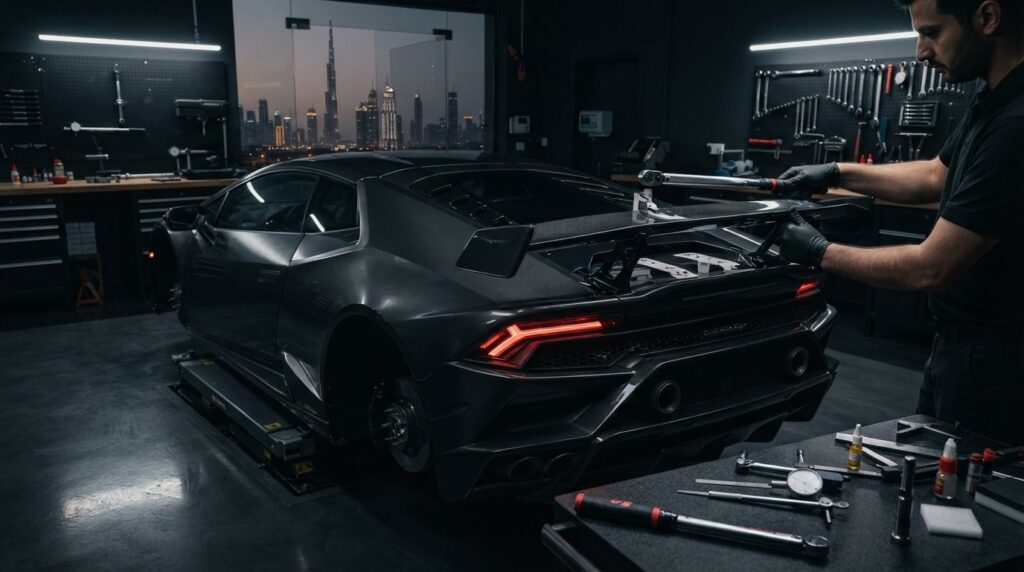
A high-performance rear wing isn’t merely a stylistic choice; it’s a high-stakes structural lever that can exert over 800 lbs of vertical load on your chassis at high speeds. You’ve likely spent years perfecting your vehicle’s silhouette, and the fear of compromising original bodywork or installing a low-quality “carbon look” component is a valid concern for any serious enthusiast. Achieving a flawless custom carbon fiber rear wing fitment is the critical boundary between a precision-engineered performance upgrade and a costly mechanical failure.
We recognize that elite quality demands more than just a visual match. This 2026 engineering guide provides the technical roadmap to secure a factory-level finish while maximizing high-speed stability and structural integrity. You’ll discover how to distinguish genuine autoclave-cured pre-preg fiber from inferior substitutes and learn the essential isolation protocols to prevent galvanic corrosion. From SCCA-compliant dimensions to advanced chassis-mount architecture, we’re detailing the exact methods used to transform your vehicle into a masterpiece of aerodynamic efficiency and preserved resale value.
Key Takeaways
- Identify the critical differences between autoclave-cured pre-preg carbon and wet-lay alternatives to guarantee maximum torsional stiffness and weight reduction.
- Understand the aerodynamic necessity of balancing rear-biased downforce with front-end splitter adjustments to maintain a stable center of pressure at high speeds.
- Execute a flawless custom carbon fiber rear wing fitment by utilizing precision templates and dielectric barriers to eliminate the risk of galvanic corrosion.
- Protect your investment with high-solid UV clear coats and professional maintenance schedules that safeguard the carbon’s structural integrity and visual depth.
- Learn how to secure high-load aerodynamic components directly to the vehicle’s structural frame to prevent trunk lid deformation during aggressive track maneuvers.
Understanding Custom Carbon Fiber Rear Wing Fitment Criteria
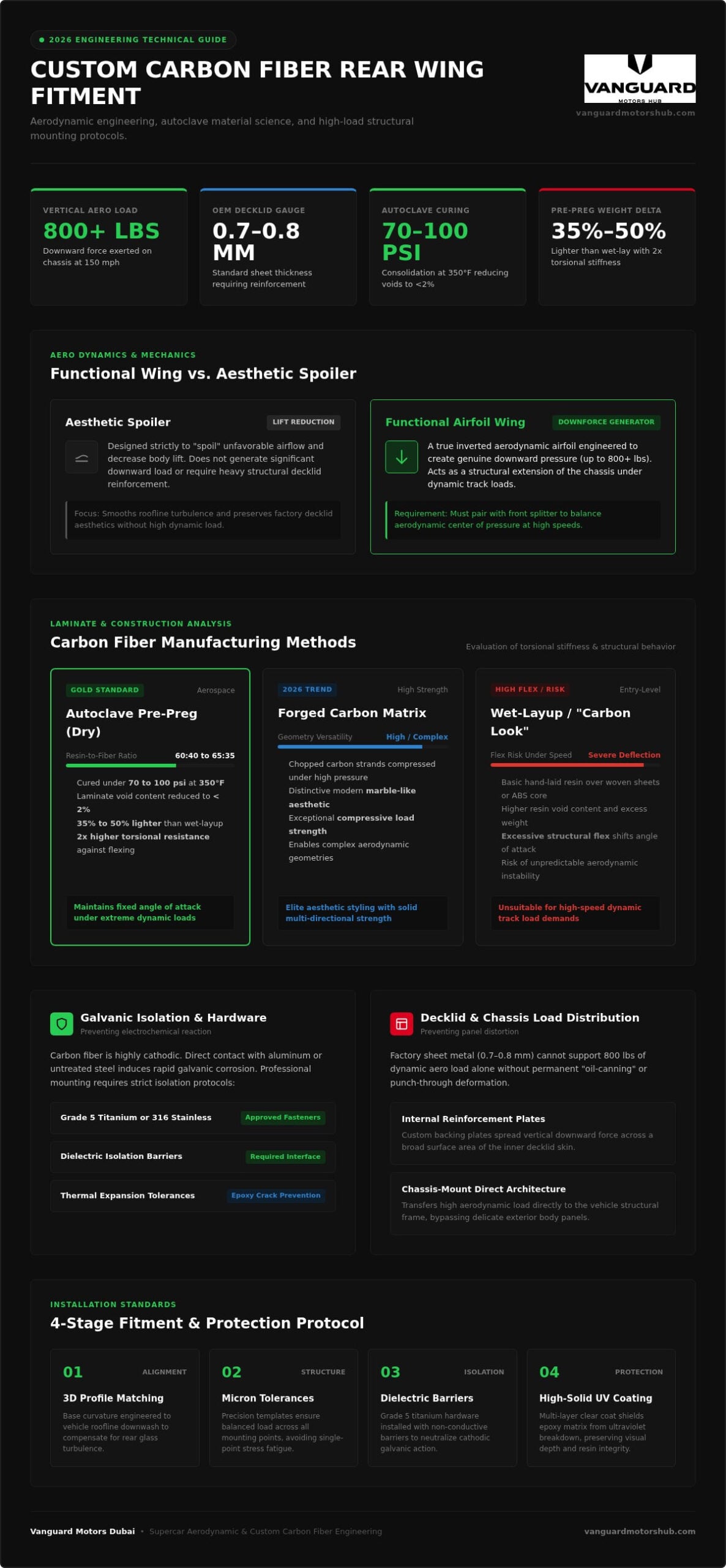
Precision fitment in the high-performance sector is defined by tolerances measured in microns. It’s the difference between a component that merely sits on a trunk and one that functions as a structural extension of the chassis. When discussing custom carbon fiber rear wing fitment, we’re looking for a synergy where the wing’s base perfectly mirrors the vehicle’s unique curvature. This ensures that aerodynamic loads, which can reach 800 lbs of vertical force at 150 mph, are distributed evenly across the mounting points rather than concentrated on a single stress area. At Vanguard Motors, we treat this alignment as a mechanical necessity to preserve the vehicle’s structural integrity.
Many enthusiasts confuse aesthetic spoilers with functional rear wings. A spoiler is designed to “spoil” unfavorable air movement to reduce lift; a wing is a genuine airfoil that generates downward force. Universal “one size fits all” wings often fail because they ignore the specific roofline downwash of your car. A vehicle-specific 3D wing profile is engineered to compensate for the turbulence created by the rear glass, ensuring the air hits the foil at the optimal angle of attack. Neglecting these measurements doesn’t just hurt performance; it can void factory warranties if the downward pressure causes panel misalignment or “oil-canning” on thin-gauge trunk lids.
Static vs. Dynamic Fitment Requirements
Achieving a flush mount is only the first step. While a wing might look perfect in a climate-controlled workshop, it must remain stable under intense vibration and varying aerodynamic loads. We also account for thermal expansion. Carbon fiber and metallic body panels expand at different rates in high-temperature environments. If the custom carbon fiber rear wing fitment is too rigid without proper tolerances, this differential expansion can lead to stress cracks in the epoxy resin or permanent distortion of the mounting surface.
The Role of Mounting Hardware
The choice of hardware is non-negotiable for long-term durability. Carbon fiber is highly cathodic, meaning it will induce galvanic corrosion if it comes into direct contact with aluminum or untreated steel. Professional installations utilize 316 stainless steel or Grade 5 titanium fasteners paired with dielectric isolation barriers. Because OEM steel decklids are typically only 0.7 mm to 0.8 mm thick, internal reinforcement plates are essential. These plates spread the load across a larger surface area, preventing the wing from punching through or deforming the sheet metal during high-speed maneuvers.
Selecting the Right Carbon Fiber Construction for Your Vehicle
Not all carbon fiber is created equal. While entry-level “carbon look” components often rely on ABS plastic or basic wet-layup methods, high-stakes performance demands a more rigorous material science. The structural rigidity of your wing determines its ability to maintain a consistent airfoil profile under intense aerodynamic pressure. If a wing flexes excessively, the angle of attack shifts, causing unpredictable handling and potentially dangerous loss of downforce. Choosing the correct construction is the foundation of a successful custom carbon fiber rear wing fitment that lasts for years rather than months.
Pre-preg Carbon Fiber: The Gold Standard
For those prioritizing mechanical excellence, pre-preg (dry) carbon fiber is the only viable choice. This material is pre-impregnated with a precise resin-to-fiber ratio, typically between 60:40 and 65:35 by volume. These components undergo autoclave consolidation, cured under pressures of 70 to 100 psi at temperatures reaching 350°F. This process reduces laminate void content to under 2%, delivering a component that is 35% to 50% lighter than wet-lay alternatives while offering double the torsional resistance. Vanguard Motors utilizes these aerospace-grade standards for all high-end conversions to ensure the wing remains a rigid, functional aerodynamic tool.
Forged Carbon Fiber Trends in 2026
Forged carbon has emerged as a dominant aesthetic trend in 2026, offering a unique marble-like finish that departs from the traditional 2×2 twill weave. Instead of using continuous woven sheets, forged carbon utilizes chopped fiber strands compressed under high pressure. While it provides incredible compressive strength and complex geometry options, it presents unique custom carbon fiber rear wing fitment challenges. The variable thickness of forged components requires specialized mounting considerations to ensure flush alignment with the vehicle’s body lines. Despite these nuances, its durability and modern visual appeal make it a premier choice for bespoke supercar builds.
Regardless of the weave you select, UV protection is non-negotiable. Raw epoxy resins are susceptible to photo-oxidation, which leads to yellowing and structural micro-cracking over time. We insist on 2K high-solid UV-blocking clear coats to seal the fibers and preserve the deep, three-dimensional luster of the carbon. This layer of defense is essential for maintaining the component’s integrity against the harsh sun. If you’re ready to elevate your vehicle’s performance with a precision-engineered airfoil, consult with our technical team today to explore your material options.
Balancing Aerodynamics: The Science of Downforce and Drag
Aerodynamics is a game of leverage. When you install a high-performance airfoil, you’re fundamentally shifting the vehicle’s aerodynamic center of pressure. While a 60-inch to 70-inch wing can generate between 200 lbs and 350 lbs of downforce at 100 mph, this vertical load is concentrated behind the rear axle. Without a counter-balance, this creates a pivot effect that lightens the front tires. The result is a dangerous loss of front-end grip and vague steering feedback during high-speed cornering. Achieving a professional custom carbon fiber rear wing fitment is only half the battle; the other half is ensuring that the extra rear grip doesn’t compromise the car’s overall balance.
The Importance of Aero Balancing
To maintain stability, the rear downforce must be paired with front-end aerodynamic enhancements. This usually involves integrating a front splitter, air dam, or canards to keep the center of pressure aligned with the vehicle’s center of gravity. Our comprehensive body kit conversions are engineered as complete systems where the front and rear components work in tandem. If the rear wing is too aggressive for the front aero package, the car will suffer from terminal understeer at the limit. We focus on creating a cohesive flow that keeps the chassis planted and the steering response razor-sharp.
Wind Tunnel Testing vs. CFD Modeling
Elite manufacturers like Mansory and Brabus don’t guess at performance; they validate it through Computational Fluid Dynamics (CFD) and wind tunnel testing. This data is crucial because downforce doesn’t scale linearly. A wing that feels stable at 100 km/h will exert exponentially more pressure at 250 km/h, often reaching loads exceeding 800 lbs. We also pay close attention to the end plates. These aren’t just for branding; they’re designed to reduce wing-tip vortices. By containing the high-pressure air on the top surface, end plates minimize drag and prevent the air from “spilling” over the edges, which significantly improves the wing’s efficiency.
Adjusting the “Angle of Attack” (AoA) is the final step in fine-tuning. For street-focused builds, a shallower angle between 4° and 8° provides a perfect balance of stability and fuel efficiency. For track applications, increasing the angle to 12° maximizes cornering force. However, pushing beyond 14° to 18° risks an aerodynamic stall. At this point, the boundary layer airflow separates from the wing, causing downforce to collapse while drag spikes. We ensure your fitment includes adjustable pylons that allow for these precise calibrations based on your specific driving environment.
Step-by-Step Guide to Professional Wing Installation
Professional custom carbon fiber rear wing fitment requires more than just a standard set of tools; it demands a surgical approach to the vehicle’s bodywork. While some retail sources suggest using only high-strength adhesives, these methods inevitably fail once aerodynamic loads exceed 150 lbs. A functional wing requires a robust mechanical bond to the chassis or a reinforced trunk lid to ensure it doesn’t detach or cause “oil-canning” deformation at track speeds. We treat every installation as a high-stakes engineering project where structural leverage is the primary concern.
Preparation and Surface Protection
Surface decontamination is our first priority. We use specialized pH-neutral cleaning agents that remove waxes and oils without compromising the carbon fiber’s epoxy resin. Before any drilling occurs, we apply high-visibility masking tape to the work area to prevent accidental scratches. A comprehensive PPF installation is critical at this stage. This film acts as a sacrificial barrier, protecting the paint from clear coat chipping during the mounting process and preventing edge-wear once the wing is under load.
Mechanical Fastening and Sealing
Precision drilling starts with laser-aligned templates to guarantee perfect symmetry. We use specialized step-bits to create clean pilot holes in aluminum or composite panels, which prevents the splintering often seen in amateur builds. Once the holes are cleared, we apply marine-grade anti-corrosion primers to any exposed metal edges. This step is non-negotiable to prevent moisture ingress and long-term oxidation beneath the mounting brackets. We also integrate dielectric isolation washers to ensure the carbon fiber never makes direct contact with metallic surfaces, eliminating the risk of galvanic corrosion.
The final stage involves applying structural adhesives to the bracket base for vibration dampening, followed by the primary fasteners. We use digital torque wrenches to meet exact specifications, ensuring the bolts are tight enough to withstand 800 lbs of vertical force but not so tight that they crush the carbon laminate. A final inspection for resonance and aerodynamic alignment ensures the wing is perfectly level. If you want your installation handled with this level of technical precision, book your professional fitment session today.
Ensuring Long-Term Integrity with Vanguard Motors Custom Solutions
A high-performance airfoil is a permanent investment in your vehicle’s aerodynamic profile. Even the most precise installation requires a lifecycle strategy to handle the rigors of high-speed driving and environmental exposure. Minor stone chips or stress from sustained downforce can eventually lead to delamination if the resin is compromised. This is why professional carbon fiber repair is essential for maintaining structural safety. We don’t simply address surface aesthetics; we restore the composite matrix to ensure the wing continues to manage loads exceeding 800 lbs without failure.
Precision custom carbon fiber rear wing fitment also plays a decisive role in your vehicle’s resale value. Amateur installations often leave permanent damage, such as rusted drill holes or distorted trunk panels. By utilizing non-destructive reinforcement plates and dielectric isolation barriers, we protect the underlying chassis. Elite supercar buyers prioritize modifications that reflect technical rigor. A wing that is perfectly aligned, securely fastened with titanium hardware, and shielded by UV-resistant clear coats signals a vehicle that has been maintained to the highest professional standards.
Bespoke Branding: Brabus, Mansory, and Beyond
Achieving a “factory-plus” look requires a holistic approach to design. We specialize in the seamless integration of bespoke car kits from legendary names like Brabus and Mansory. These components are engineered for specific aerodynamic synergies, and our technicians ensure every pylon and endplate flows perfectly with the vehicle’s silhouette. Authenticity is our benchmark. We perform rigorous checks to verify that every component is genuine autoclave-cured carbon, providing the structural density required for 2026 performance standards.
The Vanguard Advantage in Professional Fitment
Our national service coverage offers enthusiasts access to specialized tools and aerospace-grade materials that standard workshops simply don’t carry. From digital torque calibration to laser-aligned mounting, we eliminate the guesswork that leads to vibration or resonance. The Vanguard advantage continues long after the mechanical work is complete. Through meticulous supercar detailing, we ensure your carbon fiber exhibits a deep, three-dimensional luster that matches the rest of your vehicle’s finish. This comprehensive care ensures your custom carbon fiber rear wing fitment remains a functional and visual masterpiece for years to come.
Elevating Your Performance Through Precision Engineering
Mastering the intersection of material science and mechanical mastery is essential for any high-stakes automotive build. We’ve explored why autoclave-cured pre-preg carbon remains the gold standard for torsional stiffness and how professional aerodynamic balancing prevents dangerous front-end lift. A flawless custom carbon fiber rear wing fitment isn’t just a visual statement; it’s a structural commitment that preserves your vehicle’s resale value and high-speed stability. Vanguard Motors combines these technical principles with elite care, specializing in Brabus and Mansory kit conversions while maintaining an advanced carbon fiber repair facility for structural restoration.
Your vehicle deserves a finish that matches its performance potential. From comprehensive supercar detailing to precision mechanical anchoring, we ensure every component functions as a seamless extension of the chassis. Don’t leave your car’s integrity to chance with amateur methods or inferior materials. It’s time to secure a factory-level finish that dominates both the track and the street with absolute confidence.
Book Your Precision Carbon Fiber Installation at Vanguard Motors
Frequently Asked Questions
Do I have to drill holes to fit a custom carbon fiber rear wing?
Functional wings that generate significant downforce require mechanical fastening through the trunk lid or directly to the chassis. While some lightweight aesthetic spoilers use industrial adhesives, these cannot withstand the 200 lbs to 800 lbs of pressure generated at high speeds. Professional custom carbon fiber rear wing fitment involves precision drilling and the use of internal reinforcement plates. This ensures the wing remains secure and doesn’t deform your vehicle’s bodywork during aggressive track maneuvers.
Will a large rear wing reduce my car’s top speed?
A large rear wing increases aerodynamic drag, which typically results in a slight reduction in your vehicle’s absolute top speed. This is a deliberate engineering trade-off for significantly improved cornering stability and high-speed grip. By increasing the vertical load on the rear axle, you gain confidence through the bends at the cost of some straight-line velocity. We calibrate the angle of attack to find the perfect balance between minimizing drag and maximizing performance.
What is the difference between a spoiler and a rear wing?
Spoilers are designed to “spoil” unfavorable air movement, effectively reducing lift and drag to improve stability or fuel efficiency. In contrast, a rear wing is a genuine airfoil that actively generates downward force. Wings are usually mounted higher in cleaner airflow to exert pressure directly onto the vehicle’s chassis. While spoilers are often integrated into the trunk lid, wings use specialized pylons to reach into the high-velocity air stream for maximum efficiency.
Can I install a carbon fiber wing over my existing Paint Protection Film?
You shouldn’t install a high-load wing directly on top of existing Paint Protection Film (PPF) because the film can compress or shift under intense pressure. For a secure custom carbon fiber rear wing fitment, we carefully trim the film at the exact mounting points. We then apply a fresh, sacrificial layer of PPF specifically around the bracket edges. This prevents the hardware from vibrating against the paint while ensuring a rock-solid mechanical bond with the vehicle.
How do I maintain the shine of my carbon fiber wing in high-heat environments?
Maintaining the deep luster of carbon fiber in intense heat requires high-solid UV-blocking clear coats and regular detailing. Raw resins are prone to yellowing, so we recommend applying a hydrophobic ceramic coating or a specialized carbon-safe PPF. These layers act as a shield against photo-oxidation and thermal stress. Regular washing with pH-neutral soaps prevents mineral buildup, while periodic inspections of the clear coat ensure no micro-cracking occurs from sustained sun exposure.
Is it safe to take a car with a large carbon wing through an automatic car wash?
Automatic car washes are not recommended for vehicles equipped with large carbon fiber wings. The mechanical brushes can exert lateral forces that the wing pylons aren’t designed to handle, potentially causing stress cracks or mounting failure. Additionally, the harsh chemicals used in these facilities can degrade the UV clear coat over time. We advise hand-washing or utilizing a professional mobile detailing service to preserve the structural integrity and aesthetic finish of your aerodynamic components.
How can I tell if a carbon fiber wing is genuine or just a wrap?
Genuine carbon fiber features a distinct three-dimensional depth in the weave that a vinyl wrap cannot replicate. If you look at the underside or the edges, real carbon fiber components show the raw fiber structure rather than a printed pattern on plastic. Authentic pre-preg wings are also significantly lighter and more rigid than their “carbon look” counterparts. We perform authenticity checks on all premium components to ensure our clients receive high-density, autoclave-cured fiber instead of imitations.
What happens if my carbon fiber wing gets a crack or scratch?
Surface scratches in the clear coat can often be polished out through professional detailing. However, if the carbon matrix itself is cracked, it requires an immediate structural assessment. Cracks compromise the wing’s integrity and can lead to catastrophic failure under aerodynamic load. We provide specialized carbon fiber repair services that involve resin infusion and laminate reinforcement. This process restores the component’s strength, ensuring it remains safe for high-speed use while preserving the visual finish of the weave.