
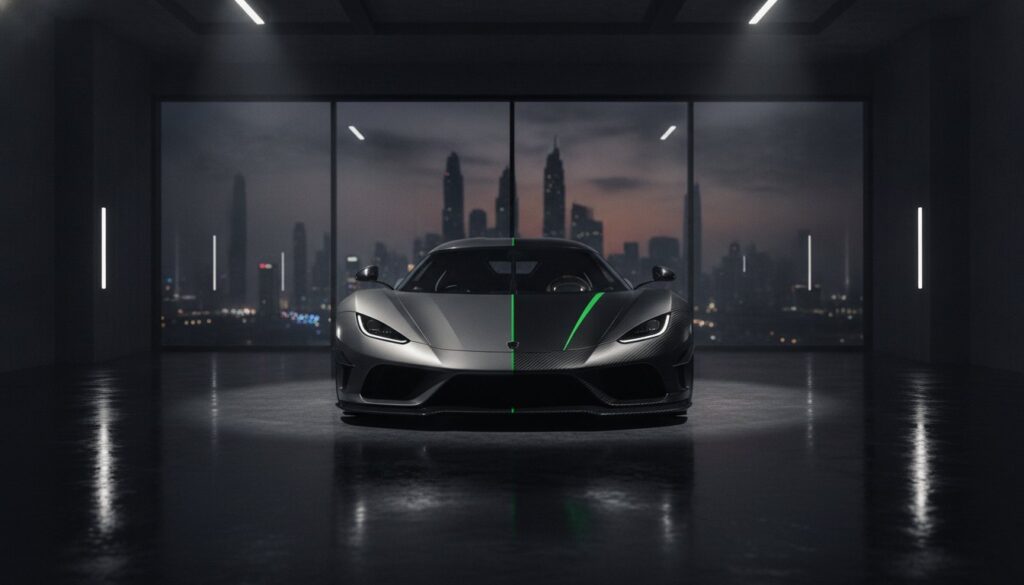
A factory finish is no longer the ceiling of automotive excellence; it’s merely the baseline for the discerning owner. While a standard vehicle offers safety and reliability, it often lacks the soul and distinction required to truly command the road. Navigating the choice between OEM vs aftermarket body kits is the first critical step in your vehicle’s aesthetic evolution, yet it’s a decision often clouded by concerns over unsightly panel gaps, material degradation, and depreciating resale values.
You’ve likely felt the tension between wanting a bold, bespoke look and fearing the poor fitment associated with lower-tier replicas. You deserve a vehicle that stands out from the factory crowd without sacrificing the meticulous precision of a showroom model. We understand that for an elite build, the “good enough” standard of mass production simply won’t suffice. This 2026 guide settles the debate by highlighting how professional tuning can actually rival or exceed factory standards.
We’ll examine the technical differences in material quality, comparing the durability of aerospace-grade carbon fibre against traditional ABS. You’ll gain a clear understanding of how elite conversions from names like Mansory and Brabus maintain vehicle integrity while delivering a transformative, high-performance silhouette.
Key Takeaways
- Master the fundamental distinctions between factory-standard components and elite engineering to define your vehicle’s unique aesthetic direction.
- Evaluate the technical trade-offs regarding material durability and fitment precision within the OEM vs aftermarket body kits landscape.
- Learn how bespoke tuning houses utilise 3D laser scanning to deliver a level of precision that often surpasses traditional factory standards.
- Protect your long-term investment by understanding the critical impact of professional installation on resale value and manufacturer warranties.
- Identify the essential role of integrated protection, such as Paint Protection Film, in maintaining the flawless finish of a high-end body conversion.
Defining the Standard: What are OEM and Aftermarket Body Kits?
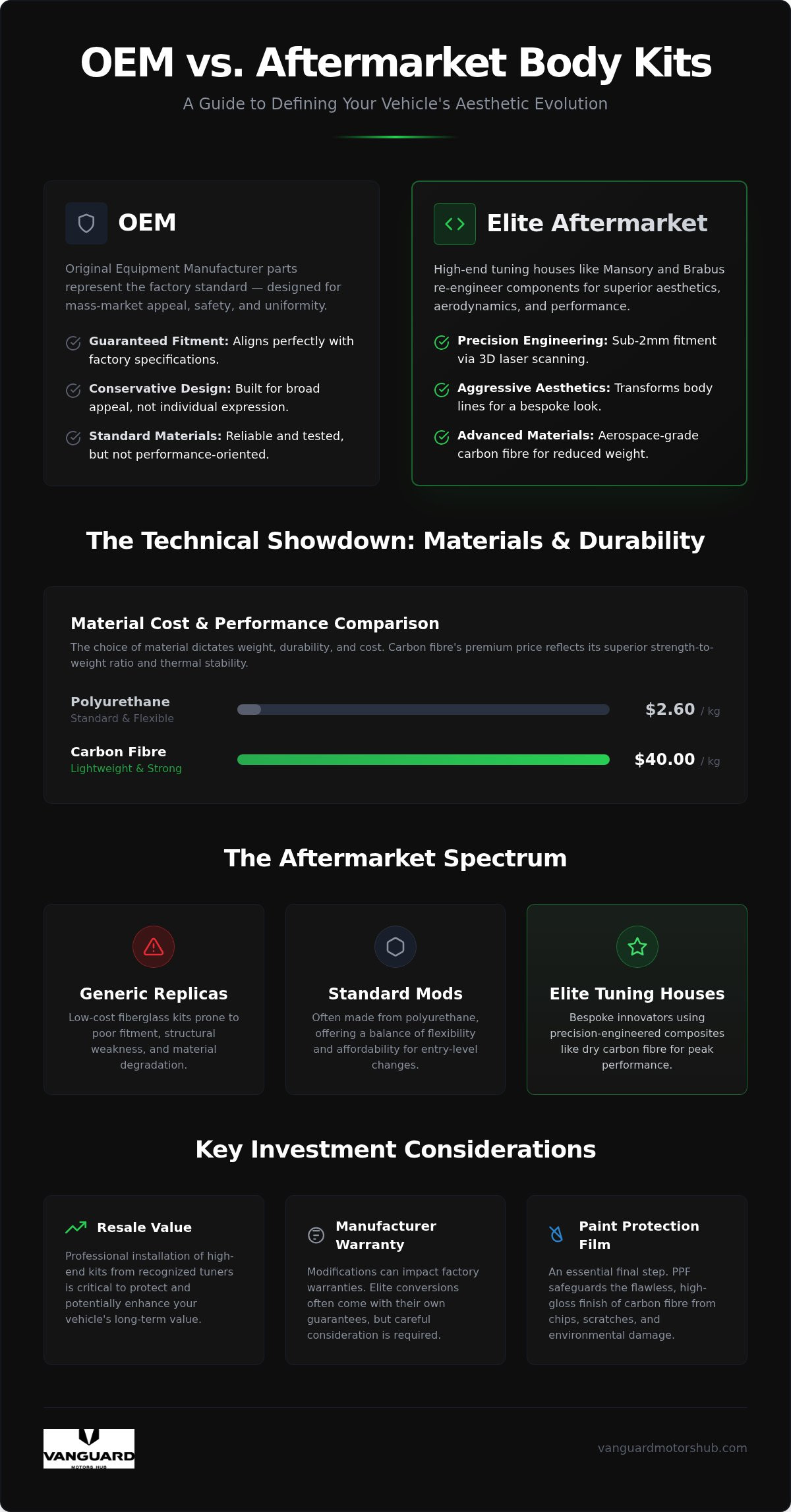
The choice between OEM vs aftermarket body kits determines whether a vehicle remains a standard production model or transforms into a unique statement of performance. An Original Equipment Manufacturer (OEM) component is a part designed, tested, and supplied by the vehicle’s creator. These parts represent the factory standard. They’re built for the average owner; reliable, predictable, and visually conservative. Choosing OEM ensures that every panel aligns with factory-gate precision, maintaining the exact silhouette intended by the brand’s lead designers.
In contrast, the aftermarket world has historically been viewed as a secondary market for budget-conscious replacements. By 2026, this definition has shifted dramatically. While entry-level replicas still exist, the high-end sector is now dominated by elite tuning houses. These firms create components that don’t just replace factory parts; they re-engineer them. For owners of luxury performance vehicles and supercars, the decision isn’t about saving money. It’s about achieving a level of aesthetic aggression and aerodynamic efficiency that manufacturers simply won’t provide on a mass-production scale.
The OEM Philosophy: Safety and Uniformity
Manufacturers design for the masses. Their philosophy prioritises conservative styling to ensure broad market appeal across global demographics. Every OEM component undergoes rigorous crash-test validation and meets strict material consistency standards. This guarantees a perfect fit, but it creates a “one-size-fits-all” aesthetic hurdle. Your vehicle looks exactly like every other unit on the assembly line. It’s safe, it’s functional, but it’s rarely exceptional. For the driver who demands distinction, the factory finish is often just the starting point.
The Aftermarket Spectrum: From Replicas to Bespoke
Not all aftermarket parts are created equal. The spectrum begins with generic fiberglass kits that often suffer from poor fitment and structural weakness. However, the top tier consists of precision-engineered composites that push design boundaries. Elite conversions, such as those from Mansory or Brabus, use advanced materials like forged carbon fibre to reduce weight and enhance downforce.
By 2026, the term “aftermarket” feels like a misnomer for these elite houses. They function as bespoke innovators, offering solutions that manufacturers avoid due to high production costs or niche appeal. Selecting a high-end conversion means opting for:
- Innovative designs that enhance original body lines without compromising structural integrity.
- Aerodynamic profiles tested for high-speed stability.
- Exclusive materials, such as dry carbon fibre, that provide a superior strength-to-weight ratio.
The Technical Showdown: Fitment, Materials, and Durability
Engineering a supercar conversion requires more than just aesthetic vision; it demands a mastery of material science. The debate over OEM vs aftermarket body kits often centres on fitment, but 2026 technology has narrowed the gap significantly. High-end tuners now utilise 3D laser scanning to map vehicle surfaces with sub-millimetre accuracy. While older aftermarket kits were notorious for uneven gaps, fewer than a dozen elite manufacturers now consistently achieve fitment tolerances under 2 mm. This level of precision ensures that bespoke components integrate seamlessly with the original chassis, mirroring factory standards.
Material choice dictates both longevity and performance. Polyurethane remains a common choice for entry-level modifications due to its flexibility. Raw material costs for reinforced polyurethane hover between $2.30 and $2.60 per kg. However, it can struggle with the intense heat of the national climate, leading to potential warping over years of exposure. For those seeking the pinnacle of durability, carbon fibre is the undisputed leader. Global prices for carbon fibre in Q2 2026 reached $40 per kg in major markets, reflecting its premium status. This investment pays dividends in weight reduction and thermal stability, ensuring the kit retains its shape under extreme conditions.
Carbon Fibre vs Traditional Composites
Lightweighting is the primary performance benefit of high-end kits. Dry carbon fibre is cured in an autoclave to remove excess resin, resulting in a part that’s significantly lighter and stronger than “wet” carbon alternatives. For those requiring maintenance on existing builds, carbon fibre car parts repair is essential for restoring structural integrity after minor impacts. The 2026 market has also seen a surge in forged carbon. This marbled composite offers a distinct, non-uniform aesthetic that has become the hallmark of elite bespoke conversions.
The Fitment Fact Check: Gaps and Alignment
Even the most expensive kit can look substandard if the installation is rushed. The “bolt-on” myth suggests that premium parts require no adjustment. In reality, every vehicle has slight factory variances. Expert technicians must fine-tune every mounting point to ensure perfect alignment across every panel. This CARFAX guide to OEM and aftermarket parts highlights how quality variables can affect the final result. A high-quality mould is identifiable by its clean edges and uniform thickness before the first bolt is turned. If you’re ready to explore how precision engineering can redefine your vehicle’s profile, speak with our technical team today to discuss your vision.
Elite Tuning Houses: When Aftermarket Surpasses OEM
The traditional binary choice of OEM vs aftermarket body kits is often misleading in the luxury sector. By 2026, the landscape has shifted toward the “Bespoke Conversion,” a tier of engineering that operates far beyond the reach of mass-market components. While factory parts offer safety, elite tuning houses like Brabus and Mansory provide a level of technical sophistication that frequently exceeds original manufacturer specifications. These aren’t merely additions; they’re complete vehicle evolutions designed for owners who refuse to settle for the assembly-line standard.
This evolution is particularly evident in the supercar and luxury SUV segments. While generic parts might compromise a car’s integrity, elite houses invest millions in research and development. They ensure their aerodynamic profiles and cooling ducts function in harmony with the vehicle’s high-performance mechanics. Choosing a bespoke conversion means opting for exclusivity that factory options cannot replicate.
The Brabus Standard of Excellence
Brabus has long been the gold standard for Mercedes-Benz refinement. A Brabus body kit installation represents a seamless fusion of aggression and elegance. Unlike lower-tier aftermarket options, Brabus components are designed to integrate perfectly with factory parking sensors, distronic systems, and active aerodynamic flaps. The prestige of the Brabus badge is so significant that it often bypasses the typical “aftermarket” stigma; instead, it positions the vehicle as a high-value collector’s piece with enhanced desirability.
Mansory and the Art of the Bold
Mansory specialises in the uncompromising. Their approach transforms elite marques like Ferrari and Lamborghini into one-of-one masterpieces. Their signature lies in the extensive use of bespoke carbon fibre weaves, often featuring forged patterns that no OEM would offer. While some believe modifications always hurt resale, this CARFAX guide to OEM vs. aftermarket parts highlights that brand reputation is a critical factor in value retention. A Mansory conversion is an investment in maximum visual impact and technical audacity.
Jetour Kits: Precision for the Modern SUV
The SUV segment has seen a surge in demand for sophisticated aesthetic upgrades. Jetour kits have emerged as a leader in this space, modernising SUVs with precision-engineered components that sharpen factory lines. These kits provide a bridge between standard utility and a bespoke lifestyle. They prove that even family-oriented vehicles can achieve a high-performance silhouette when the conversion is handled with professional care and technical precision.
Resale Value and Warranty: Navigating the Investment
The financial implications of choosing between OEM vs aftermarket body kits often centre on the fear of depreciating the vehicle’s assets. While low-quality modifications can undoubtedly hurt a car’s valuation, elite conversions operate under a different set of market rules. For the luxury and supercar segment, a professionally installed kit from a reputable house can attract a specific tier of premium buyers who value exclusivity over factory uniformity. The key to maintaining this value lies in the “reversibility factor.”
Smart owners always retain their original factory components. By keeping the OEM bumpers, side skirts, and spoilers in climate-controlled storage, you ensure the vehicle can be returned to its stock configuration at any time. This strategy provides a safety net for future resale, allowing you to appeal to both the collector seeking a pristine factory example and the enthusiast looking for a bespoke build. Insurance considerations have also evolved by 2026. Most premium providers now offer agreed-value policies for high-end conversions, provided the installation is documented and the parts are genuine.
Warranty concerns are often based on myths rather than mechanical reality. Aesthetic modifications typically don’t void a manufacturer’s powertrain warranty unless the components directly interfere with engine cooling, sensors, or safety systems. In 2026, manufacturer stances have become more nuanced, acknowledging that cosmetic enhancements are a standard part of the luxury ownership experience. As long as the conversion doesn’t compromise the vehicle’s structural or mechanical integrity, your core protections remain intact.
Protecting the Investment with PPF
A bespoke kit is only as valuable as the condition of its finish. High-end carbon fibre is particularly susceptible to stone chips and UV-related yellowing over time. This makes the installation of paint protection film a mandatory step for any serious conversion. Modern self-healing films preserve the “just-installed” look by absorbing minor abrasions and reflecting harsh sunlight. This layer of defence ensures that your investment in expensive composites doesn’t degrade due to the national climate’s intense heat and road debris.
The Role of Peelable Paint in Conversions
Peelable paint has revolutionised how we approach colour changes in bespoke builds. It allows for a complete aesthetic transformation without permanently altering the kit’s original surface or the vehicle’s factory paint. This versatility is vital for resale; you can enjoy a bold, seasonal colour today and return the car to its original hue before listing it for sale. It acts as a thick, protective skin that guards the underlying finish, effectively “freezing” the condition of the kit in its most pristine state.
Ready to enhance your vehicle’s profile while securing its future value? Contact our specialists to discuss your bespoke conversion strategy.
The Vanguard Verdict: Choosing Your Conversion Path
Deciding on the right path for your vehicle requires a clear assessment of your long-term objectives. When weighing OEM vs aftermarket body kits, you must determine if you seek a subtle “OEM-plus” refinement or a complete structural transformation. The most successful 2026 builds often strike a balance; they retain the core reliability of factory mounting points while introducing the aggressive, bespoke silhouettes of high-end tuning. This hybrid approach ensures your vehicle remains functional and road-legal while possessing a distinct, high-performance identity that commands attention.
A successful conversion relies on more than just the parts in the box. It requires a technical partner who understands the intersection of creative expression and mechanical engineering. Your chosen specialist must ensure that new components don’t interfere with integrated active aerodynamic systems or trigger warning lights in the vehicle’s sophisticated sensor array. Before committing to a build, run through a final checklist: verify material quality, confirm fitment tolerances, plan for long-term protection, and ensure the team has a proven track record with elite marques.
Why Professional Installation is Non-Negotiable
Precision is the difference between a masterpiece and a mistake. High-end supercar detailing requires an eye for the smallest alignment gaps that amateur shops often overlook. Integrating complex exhaust modifications and carbon fibre accents demands a seamless transition between the original chassis and the new components. The Vanguard Motors Dubai approach to bespoke automotive excellence focuses on meticulous care. We ensure every bolt, clip, and panel meets a standard that mirrors, or even exceeds, the original factory-gate finish.
Your Next Steps in Automotive Evolution
The path to a one-of-one vehicle begins with a professional consultation. We help you match a kit to your vehicle’s specific DNA, ensuring the final result feels like a natural evolution rather than an awkward addition. A holistic build doesn’t stop at the body panels; it incorporates custom wraps and essential protection layers to maintain the integrity of the work over thousands of kilometres. If you’re ready to redefine your driving experience and elevate your vehicle’s presence, Explore Bespoke Car Kit Conversions at Vanguard Motors Dubai and begin your journey toward automotive perfection.
Command the Road with Bespoke Precision
Navigating the choice of OEM vs aftermarket body kits is ultimately a decision between accepting a mass-market standard and demanding a unique automotive identity. Throughout this guide, we’ve explored how 2026 technology, from 3D laser scanning to aerospace-grade carbon fibre, has redefined what is possible for the modern supercar. A successful conversion isn’t just about the physical panels; it’s about a technical synergy that respects factory engineering while pushing aesthetic boundaries. By prioritising material integrity and integrated protection, you ensure your vehicle remains an asset of both performance and value.
Vanguard Motors Dubai stands at the intersection of this technical mastery and creative vision. Our expertise in Brabus, Mansory, and Jetour kit conversions ensures your vehicle receives the meticulous care it requires. We provide a complete ecosystem of excellence, from professional carbon fibre repair to the application of premium PPF and peelable paint. We don’t simply install parts; we orchestrate high-octane transformations for owners who refuse to blend in.
Your car is a canvas for your personal standards of excellence. Transform Your Vehicle with Vanguard Bespoke Conversions and begin your journey toward automotive distinction today.
Frequently Asked Questions
Will an aftermarket body kit void my vehicle’s manufacturer warranty?
Aesthetic modifications generally only affect the warranty of the specific parts you replace. Core mechanical protections for your engine and transmission remain intact unless the modification directly causes a failure. If a kit blocks essential cooling ducts or interferes with factory sensor arrays, those related systems might lose coverage. It’s vital to choose engineered kits that respect the vehicle’s original technical architecture to ensure your factory protections remain valid.
What is the best material for a high-end body kit: Carbon Fibre or ABS?
Carbon fibre is the undisputed leader for high-performance builds. While ABS plastic is durable and cost-effective, carbon fibre offers a superior strength-to-weight ratio and exceptional thermal stability. Global prices for carbon fibre reached 40 dollars per kg in Q2 2026, reflecting its status as a premium material. Dry carbon fibre is particularly valued for supercars as it provides maximum rigidity with minimal weight, unlike heavier traditional polymers.
Can I return my car to its original OEM look after installing a body kit?
Yes, you can restore your vehicle to its factory state if you retain all original components. Reversibility is a major factor in the OEM vs aftermarket body kits debate for collectors. By storing your original bumpers and side skirts in a climate-controlled environment, you preserve the option to revert the car for resale. This strategy allows you to enjoy a bespoke aesthetic while maintaining the vehicle’s long-term market flexibility.
How do I ensure an aftermarket kit has a perfect fit without panel gaps?
You must select a kit manufactured using high-precision 3D laser scanning. This technology maps the vehicle’s chassis to ensure the mould matches with sub-millimetre accuracy. Fewer than a dozen global manufacturers consistently achieve fitment tolerances under 2 mm. Even with a premium kit, expert adjustment during the installation process is necessary. Professional technicians fine-tune mounting points to account for the minor factory variances found in every production vehicle.
Does a Brabus or Mansory kit actually increase the value of my car?
Elite branding often adds significant desirability and prestige to a luxury vehicle. Unlike generic modifications, a genuine Brabus or Mansory conversion is viewed as a high-value evolution of the car. These marques carry international recognition that can attract a specific tier of enthusiast buyers. While standard aftermarket parts might lead to depreciation, these specific elite badges can preserve or even enhance the vehicle’s market value in the secondary sector.
How do I protect my new body kit from stone chips and heat damage?
Installing premium Paint Protection Film is the most effective way to guard your investment. PPF acts as a self-healing barrier against road debris and harsh UV radiation. In the national climate, intense heat can cause resins in lower-quality kits to degrade. Integrated solutions, including peelable paint and ceramic coatings, ensure your bespoke conversion retains its flawless finish. This layer of defence is essential for maintaining the kit’s structural and aesthetic integrity.
What is the difference between a ‘replica’ kit and a ‘bespoke’ conversion?
A replica kit is typically a low-cost imitation made from brittle fiberglass or inferior plastics. In contrast, a bespoke conversion involves precision-engineered components from houses like Mansory or Brabus. These elite kits use advanced materials and undergo rigorous aerodynamic testing. Choosing a bespoke conversion ensures your vehicle benefits from improved performance and structural integrity rather than just a superficial, and often poorly-fitted, aesthetic change that could compromise safety.
Is professional installation required for all body kit components?
Professional installation is mandatory for any high-end automotive build. Modern supercars and luxury SUVs feature complex sensor arrays and active aerodynamic systems that require expert integration. Attempting a DIY fitment often leads to unsightly panel gaps and can trigger electronic faults. Professional technicians ensure that every component is aligned to millimetre precision. This expertise is critical when comparing OEM vs aftermarket body kits to achieve a true showroom-quality result.