
Your new supercar might look flawless under the dealership spotlights, but the reality is that no factory finish is ever truly perfect. Many owners assume that applying a thick layer of film will mask existing imperfections, yet the truth is that paint correction before ppf is the only way to achieve that deep, liquid gloss you expect. Skipping this step doesn’t just save a few hours; it risks locking micro-scratches and swirl marks under a ten-year shield, turning a premium protection project into a permanent display of defects.
It’s natural to feel some hesitation regarding the total investment of a full restoration and protection service. You want to ensure every dirham spent translates into visible results and long-term durability. This guide provides a clear decision framework to help you determine exactly what your vehicle requires. You’ll discover the actual hiding capabilities of modern films, the common defects found on showroom-floor cars, and how the Vanguard Premium Package sets the gold standard for surface preparation in 2026. Prepare to transform your vehicle into a masterpiece of optical clarity and elite protection.
Key Takeaways
- Understand why mechanical leveling of the clear coat is essential for maximizing film adhesion and ensuring long-term durability in the UAE climate.
- Learn to identify hidden factory defects like sanding marks and transport damage that even brand-new luxury vehicles often carry from the showroom.
- Discover how performing professional paint correction before ppf installation prevents the permanent encapsulation of swirl marks and light refraction issues.
- Explore the technical benefits of the Vanguard Premium Package, which integrates deep decontamination with precision polishing for a bespoke finish.
- Gain clarity on how PPF acts as a lens that amplifies underlying paint texture, making surgical surface preparation the most critical phase of the project.
The Debate: Is Paint Correction Mandatory Before PPF?
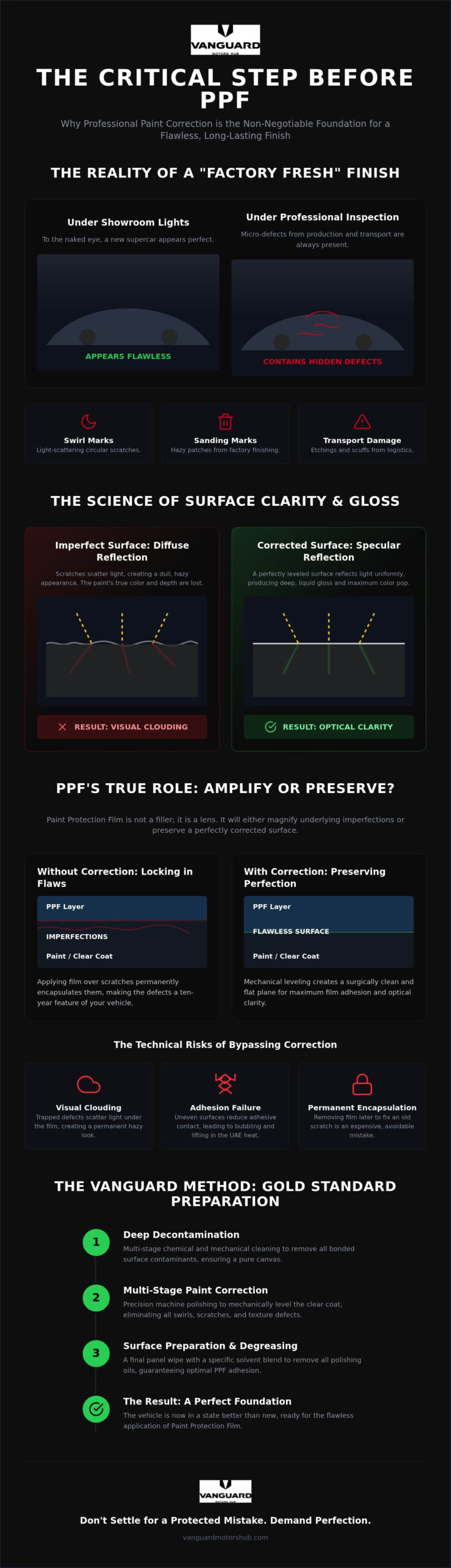
The automotive community often debates whether a factory-fresh supercar truly needs a machine polish before being wrapped. To the untrained eye, a new arrival looks perfect. However, paint correction before ppf is about more than just aesthetics; it’s about engineering the ideal surface for long-term bonding. True paint correction is the mechanical leveling of the clear coat to remove defects, ensuring the film sits on a surgically flat plane. Without this step, you’re simply sealing imperfections in a time capsule.
In a professional environment like Vanguard Motors Dubai, we distinguish between a clean car and a corrected one. Cleaning removes topical contaminants, while correcting reshapes the modern automotive paint itself to eliminate light-scattering scratches. For supercar owners, locking in these defects often leads to long-term regret. The film acts as a lens, and if that lens is placed over a distorted surface, the final result will never achieve its full potential.
The “Hiding” Capability of PPF
It’s a common misconception that PPF acts as a magic mask for all damage. While the adhesive layer can fill microscopic surface variations, it has strict limits. Light swirl marks might disappear, but deeper etchings, bird lime damage, and “orange peel” textures remain visible. If you’re opting for a matte or satin finish, preparation is even more critical. Matte films lack the depth of gloss that hides texture. This means every high point or jagged scratch in the clear coat will translate through the film as a visible inconsistency, ruining the sleek, uniform look you desire.
The Risk of Bypassing Correction
Choosing to skip the correction stage introduces several technical risks that can compromise your investment. Surfaces that haven’t been leveled often suffer from visual “clouding,” where the trapped defects scatter light under the film and reduce the vibrant “pop” of the paint. Beyond aesthetics, there’s the issue of adhesion. Contaminants or jagged surface textures prevent the film’s adhesive from forming a consistent bond, which can lead to premature lifting or bubbling in the UAE heat.
- Visual Clouding: Scratches under the film create a hazy appearance that no amount of washing can fix.
- Adhesion Failure: A rough surface provides less contact area for the film to grip effectively.
- Permanent Encapsulation: Removing a high-end film years later just to fix a scratch you ignored on day one is an expensive and avoidable headache.
At Vanguard, we treat every vehicle as a bespoke project. The Vanguard Premium Package ensures that the foundation is flawless before a single centimeter of film is applied. Don’t settle for a protected mistake. Demand a finish that reflects the true caliber of your vehicle.
The Science of Surface Clarity: Refraction and Gloss
Gloss is often misunderstood as a product of the film itself. In reality, the brilliance of your supercar depends entirely on how light interacts with the substrate. When a clear coat is covered in swirl marks or micro-scratches, light rays hit these jagged “valleys” and scatter in multiple directions. This phenomenon, known as diffuse reflection, is what causes paint to look hazy or dull. Performing professional paint correction before ppf is the only way to eliminate these light-scattering defects and restore the mirror-like finish your vehicle deserves.
Think of PPF as a secondary clear coat that acts as a magnifying lens. While some low-tier installers claim the film’s adhesive fills in scratches, the reality is that the film actually amplifies the underlying texture. If the paint surface isn’t perfectly flat, the film will highlight “orange peel” and other inconsistencies rather than hiding them. To achieve that deep, liquid “wet look” common in elite UAE showrooms, the surface must be leveled to a surgical degree before the first piece of film is laid down.
Light Scattering vs. Specular Reflection
Visual clarity depends on the clear coat’s ability to reflect light uniformly. Modern research into clearcoat scratch resistance shows that even microscopic abrasions can significantly degrade optical performance. When we level the clear coat, we transition the surface from diffuse reflection to specular reflection. Specular reflection is the key to supercar gloss. By creating a perfectly flat plane, we ensure that light bounces back to the viewer’s eye at a consistent angle, resulting in maximum color “pop” and depth that remains visible even through the thickest protection film.
Adhesion and the Molecular Bond
Chemical bonding is just as critical as visual clarity. Environmental contaminants like iron fallout, rail dust, and industrial pollutants embed themselves into the pores of the paint. These microscopic spikes interfere with the film’s “tack,” preventing a seamless molecular bond. If these aren’t removed through mechanical claying and polishing, the film’s edges are more likely to lift over time, especially when exposed to the intense heat and dust cycles characteristic of the region.
At Vanguard Motors Dubai, we treat surface preparation as a bespoke engineering task. We ensure the clear coat is chemically pure and physically flat so the PPF can perform its job without compromise. If you’re unsure whether your current finish is ready for protection, you can speak with a specialist to discuss the necessity of paint correction before ppf installation for your specific vehicle.
Assessing Your Vehicle: When is Correction Required?
The belief that a brand-new supercar is delivered in pristine condition is a common misconception. Between the assembly line and the showroom floor, your vehicle undergoes a long journey involving rail transport, port storage, and multiple handlings. Each stage introduces potential hazards, from industrial fallout to aggressive dealership washing. Scientific research into automotive coatings highlights the critical role of surface preparation in the longevity of protective layers. Without performing paint correction before ppf, you’re merely preserving factory-installed defects.
Our diagnostic process at Vanguard involves high-intensity lighting and ultrasonic depth gauges to reveal the truth beneath the surface. We frequently identify three primary issues on “fresh” arrivals:
- Transport Damage: Microscopic iron particles from rail transport that embed into the clear coat.
- Factory Sanding Marks: Hazy spots left by technicians during the final assembly finishing process.
- Acid Rain Etching: Chemical marks caused by water sitting on the paint during outdoor storage at shipping ports.
The New Car Reality Check
It’s vital to understand that dealership Pre-Delivery Inspection (PDI) teams aren’t detailing specialists. They often use high-speed buffers and reused wash mitts to prep cars quickly, which creates holograms and fine swirl marks. These defects are often masked with temporary fillers that wash away after the first few rains, revealing a damaged finish. At Vanguard, we perform a thorough paint depth analysis to ensure there’s sufficient clear coat for a safe correction. This data-driven approach allows us to restore the surface to a better-than-factory state without compromising the paint’s structural integrity.
The Decision Framework for Owners
Choosing the right level of preparation depends on your vehicle’s history and your personal standards for perfection. New arrivals with minimal transit damage typically require a single-stage correction to enhance gloss and ensure maximum film adhesion. However, pre-owned vehicles or those with visible etching always require a multi-stage process to level deeper imperfections. You shouldn’t view this as an optional add-on, but as the essential foundation of the Vanguard Standard. For a deeper look at our meticulous processes, consult our Supercar Detailing Reference Guide.
Balancing your budget with your desired outcome is a bespoke conversation. While a light polish might satisfy a daily driver, a supercar finish demands surgical precision. Investing in paint correction before ppf ensures that the final result isn’t just protected, but optically perfect. Don’t let a “new” car’s hidden flaws compromise your investment. Every project we touch is treated with the same high-octane passion and professional precision that defines the UAE’s elite automotive culture. If you’re still weighing the value of professional-grade protection, our guide on car paint protection myths debunked for 2026 addresses the most common misconceptions that lead owners to make costly decisions.
The Vanguard Method: A 5-Step Prep Guide
Achieving a world-class finish requires more than just a quick polish. At Vanguard Motors Dubai, we treat every vehicle as a bespoke project, following a rigorous protocol to ensure the substrate is flawless. This systematic approach to paint correction before ppf installation is what separates a standard wrap from a true automotive masterpiece. Our five-step method is engineered to eliminate every microscopic barrier between the clear coat and the film, ensuring the Vanguard Premium Package delivers unmatched results.
- Step 1: Decontamination. We begin by removing iron particles, tar, and industrial fallout using advanced chemical agents that dissolve contaminants without abrasion.
- Step 2: Mechanical Claying. This step extracts embedded grit that chemicals alone can’t reach, ensuring the surface is surgically smooth to the touch.
- Step 3: Precision Correction. We tailor our polishing stages to your vehicle’s specific paint hardness, removing swirls and restoring optical clarity with machine precision.
- Step 4: Surface Cleansing. Every trace of polishing oil and residue is stripped away using specialized cleaners to create a chemically pure bond for the film.
- Step 5: Final Inspection. Our technicians use high-CRI lighting to verify perfection from every possible angle, ensuring no defect remains.
Advanced Decontamination Techniques
Preserving the integrity of your supercar means using the right chemistry. We utilize pH-neutral chemicals to protect delicate trim and specialized carbon fiber components during the prep stage. Many detailers overlook the seams, but we prioritize pressure washing every panel gap and crevice. This prevents hidden dust or grit from blowing out during the film application, ensuring a clean, edge-to-edge finish. For those who demand the best, The Ultimate Shield PPF Guide provides deeper insight into why this level of detail is non-negotiable for elite protection.
Precision Polishing and Finish Verification
Every paint system is unique. A Lamborghini’s finish reacts differently to a machine polisher than the clear coat on a Rolls-Royce. We match specific pad and compound combinations to your car’s paint type to achieve maximum leveling with minimal clear coat removal. Our “Zero Residue” rule is a cornerstone of our facility. We use multiple rounds of IPA wipes to verify that the gloss is real, not just masked by temporary fillers. This transparency ensures that the paint correction before ppf provides a permanent bond and unmatched depth that lasts for years.
Ready to give your vehicle the elite preparation it deserves? You can book your surface assessment today and experience the Vanguard difference firsthand.
Beyond the Film: The Holistic Protection Strategy
The protection of a supercar is never a single-step event. It’s an integrated ecosystem of services designed to maintain a showroom finish in the demanding UAE environment. While paint correction before ppf provides the necessary optical foundation, the most sophisticated owners look toward a holistic strategy. This involves layering advanced technologies to ensure every surface, from the clear coat to the carbon fiber accents, remains in peak condition despite the heat and dust cycles of 2026.
Adding a professional ceramic coating over your PPF is a standard practice for elite enthusiasts who demand the best. While the film provides essential physical impact resistance against stone chips and road debris, the coating adds a high-performance sacrificial layer. This combination enhances the film’s hydrophobic properties, making maintenance effortless. Dust and environmental contaminants slide off the surface during a routine wash, preventing the film from becoming stained or dull over time. It’s the ultimate synergy of durability and aesthetics. Understanding the full landscape of car paint protection options and the myths surrounding them can help you make more informed decisions about which combination of services is right for your vehicle.
The Vanguard Premium Package
The Vanguard Premium Package represents the pinnacle of our service offerings. It doesn’t just stop at exterior protection. We integrate precision paint correction and film installation with comprehensive leather restoration and interior care. This ensures that the tactile experience inside the cabin matches the visual brilliance of the exterior. Many elite owners choose a single, specialized facility like ours for all their customization needs to ensure a consistent standard of quality across every detail of their bespoke project.
Maintenance is the final piece of the protection puzzle. Once your vehicle is corrected and protected, keeping that finish alive requires professional care. Our Mobile Detailing Van provides professional-grade maintenance at your preferred location. This service ensures that only the safest, scratch-free techniques are used to wash your protected vehicle. By avoiding the aggressive chemicals and dirty mitts of standard car washes, you preserve the clarity of the film and the gloss of the underlying paint for years to come.
Preserving Custom Conversions
High-performance aesthetics often involve complex aerodynamic kits and exotic materials. We specialize in protecting bespoke conversions, including Brabus and Mansory kit installations. These projects frequently feature exposed carbon fiber components that require specific decontamination and correction techniques before being wrapped. Whether you’re dealing with matte wraps or innovative peelable paint applications, the paint correction before ppf stage remains the most critical variable in the project’s success.
Applying film over intricate carbon fiber weaves and aggressive aerodynamic lines demands a level of precision that only an authoritative expert can provide. We ensure that every edge is tucked and every vent is protected without compromising the kit’s design. This meticulous approach prevents lifting and ensures the protection is virtually invisible. If you’re ready to elevate your vehicle’s protection to the next level, it’s time to act. Book your paint assessment at Vanguard Motors Hub to begin your journey toward a flawless, high-performance finish.
Elevate Your Protection Standards
Mastering the art of automotive preservation requires an uncompromising commitment to detail. You’ve discovered that surface clarity isn’t a luxury; it’s a technical necessity for any high-end installation. By prioritizing professional paint correction before ppf, you ensure that every light ray reflects with surgical precision rather than scattering through hidden factory defects. Whether you’re safeguarding a showroom-fresh arrival or a bespoke Mansory conversion, the foundation dictates the final result.
At Vanguard Motors Hub, we specialize in the meticulous care required for the world’s finest machines, including complex Brabus and Mansory kit conversions. Our Vanguard Premium Package provides the ultimate synergy of restoration and protection, delivered by experts in luxury and supercar detailing. Don’t let your investment be compromised by shortcut preparation. It’s time to experience the deep, liquid gloss that only elite-tier craftsmanship can provide in the demanding UAE climate.
Your vehicle deserves a finish that reflects its true caliber. Request a Bespoke Protection Quote from Vanguard Motors Hub and secure your automotive legacy today. We look forward to transforming your vehicle into a masterpiece of optical clarity.
Frequently Asked Questions
Is paint correction necessary for a brand new car before PPF?
Yes, it’s essential. Even luxury arrivals carry transport damage and iron fallout from rail and port storage. Dealership prep often leaves micro-swirls that become permanent once covered. Performing paint correction before ppf ensures that the clear coat is surgically clean and optically flat. This preparation allows the film to bond at a molecular level, providing the deep, liquid gloss that supercar owners expect in the UAE’s elite showrooms.
Can PPF hide existing scratches and swirl marks on my car?
PPF has limited masking capabilities. While the adhesive layer can fill microscopic surface variations, it acts as a magnifying lens for deeper defects. Swirl marks and scratches scatter light, creating a hazy appearance under the film. To achieve a true mirror finish, you must level the clear coat first. Skipping this step means you’ll see those imperfections every time the sun hits your vehicle for the next ten years.
How much does paint correction add to the cost of PPF installation?
The additional investment depends on whether your vehicle requires a single-stage polish or a multi-stage correction. While it increases the total project cost, it’s a critical component of high-end protection. This stage ensures you aren’t paying for a premium film only to lock in unsightly defects. At Vanguard, we treat this as a bespoke engineering task to maximize the visual “pop” and durability of your specific vehicle.
What happens if I skip paint correction and apply PPF anyway?
Skipping this step leads to permanent encapsulation of defects. Any swirl marks or etchings present on the clear coat will remain visible and potentially look worse due to light refraction under the film. Jagged or contaminated surfaces also provide a poor substrate for the adhesive. This often results in premature lifting or bubbling at the panels’ edges, especially when exposed to the intense heat cycles characteristic of the region.
How long does the paint correction process take before the film is applied?
The duration varies based on the paint’s condition. A single-stage correction for a well-maintained or new vehicle typically takes 3 to 6 hours. Intensive multi-stage corrections for vehicles with moderate to heavy defects can require 10 hours or more. This time is necessary to ensure the surface is perfectly leveled and chemically stripped of all polishing oils before the film application begins in our clean-room environment.
Will paint correction thin out my car’s clear coat too much?
Professional correction is a controlled process that preserves your clear coat. We use ultrasonic depth gauges to measure the paint’s thickness before we begin. This data-driven approach allows our technicians to remove only the microscopic amount of clear coat necessary to level the scratches. By using the right pad and compound combinations, we restore clarity without compromising the long-term structural integrity of your supercar’s finish.
Can I do my own paint correction before bringing the car for PPF?
We strongly advise against DIY attempts for supercar applications. Professional paint correction before ppf requires a “Zero Residue” finish that’s difficult to achieve without commercial-grade surface cleansers. Many consumer polishes contain fillers and oils that interfere with the film’s adhesive bond. If the surface isn’t chemically pure, the film won’t tack properly, leading to expensive adhesion failures that aren’t covered by manufacturer warranties.
Does PPF protect the paint from fading in the high heat of the UAE?
High-quality PPF provides a robust barrier against the UAE’s intense UV radiation. Premium films are engineered with advanced UV inhibitors that prevent the underlying paint from oxidizing or fading over time. This is particularly vital for vibrant supercar colors that are prone to sun damage. When combined with the heat-resistant properties of the film, your vehicle maintains its original factory saturation and depth for a decade or more.