
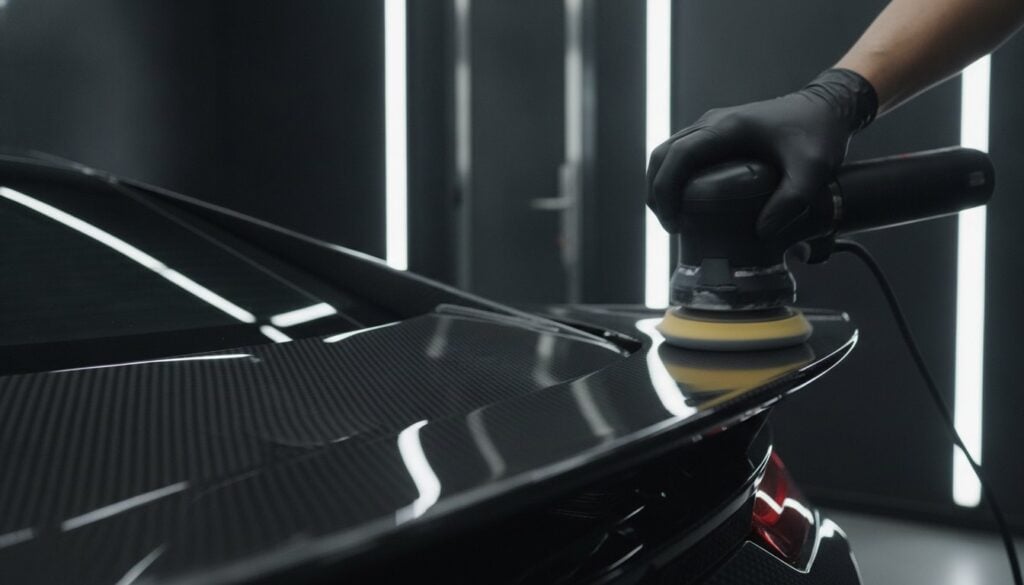
Why does a million-dollar aesthetic often fade into a milky, yellowed disappointment after just a few seasons in the sun? You invested in carbon fiber for its lightweight strength and that unmistakable high-tech weave, but seeing it turn dull, scratched, or cloudy is incredibly frustrating. It’s a common pain point for performance enthusiasts who demand perfection and refuse to settle for anything less than a showroom finish. Restoring gloss to carbon fiber parts is more than just a cosmetic fix; it’s a precise technical restoration of the resin’s clarity and visual impact.
We understand that your vehicle is a masterpiece of engineering. This 2026 guide reveals the professional techniques and scientific principles required to eliminate oxidation and return a factory-mirror finish to your vehicle’s most striking components. You’ll discover how to erase surface swirls, neutralize yellowing epoxy, and implement elite protection strategies. We’ll explore the surgical process of surface correction, the necessity of UV-resistant layers, and how to safeguard your vehicle’s resale value through meticulous, expert-level care. It’s time to bring back the depth and brilliance your supercar deserves.
Key Takeaways
- Learn how to distinguish between surface-level oxidation and structural damage using professional diagnostic techniques like the water test.
- Master the precise sequence of mechanical polishing and wet sanding required for restoring gloss to carbon fiber parts without compromising the delicate weave.
- Discover why deep cleaning and clay bar treatments are essential preparation steps for achieving a flawless, factory-mirror finish.
- Understand why immediate application of Paint Protection Film (PPF) is critical to blocking 99% of UV rays and locking in your restoration results.
- Gain the technical expertise needed to maintain your vehicle’s resale value by approaching carbon restoration as a surgical, high-precision process.
Understanding Why Carbon Fibre Parts Lose Their Lustre
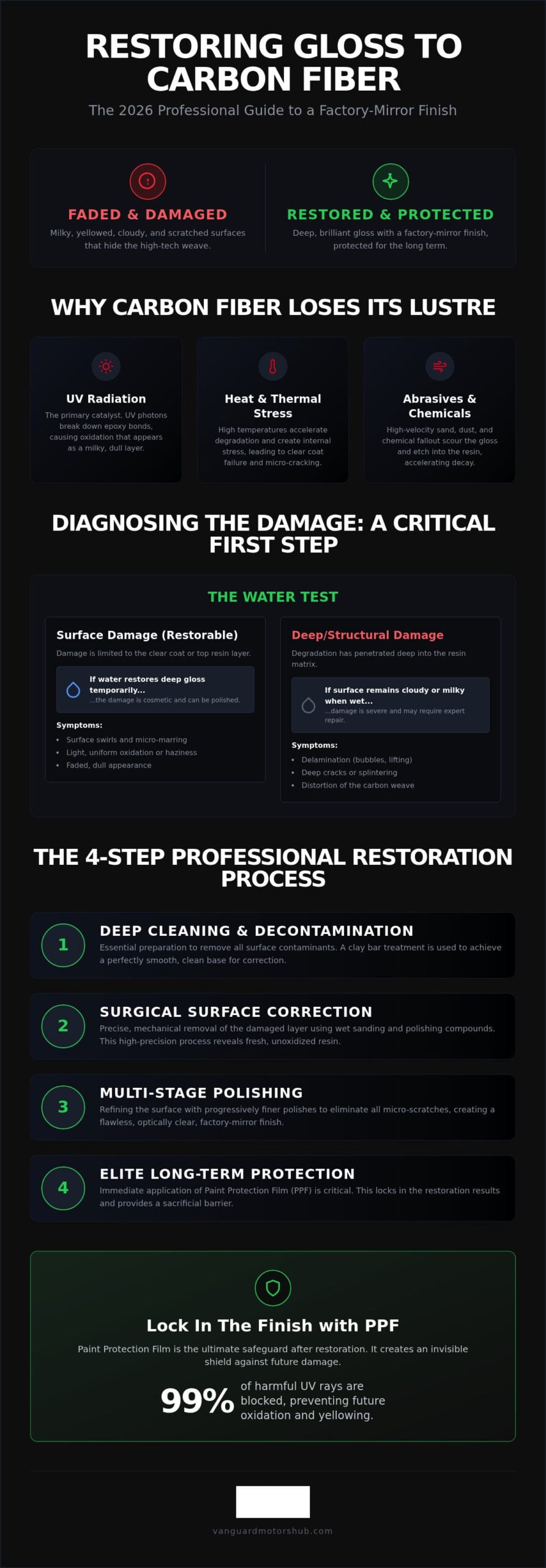
Exposure to intense ultraviolet radiation is the primary catalyst for aesthetic failure in high-performance composites. While the Carbon fiber reinforced polymer structure remains incredibly strong, the organic polymers within the resin matrix are susceptible to photo-degradation. UV photons possess enough energy to break the molecular bonds of the epoxy, leading to a phenomenon known as oxidation. This process manifests as a dull, milky, or cloudy surface layer that obscures the intricate weave beneath, making the task of restoring gloss to carbon fiber parts a priority for maintaining vehicle aesthetics.
In regions with extreme climates, high ambient temperatures accelerate this deterioration. Thermal expansion occurs at different rates for the carbon fibers and the resin. This discrepancy creates internal stress, eventually leading to clear coat failure or micro-cracking. Distinguishing between surface-level oxidation and structural delamination is vital for any owner. Surface issues are cosmetic; delamination involves the actual separation of the composite layers. You can identify surface contamination by its uniform haziness, whereas delamination often appears as distinct bubbles or lifting sections that compromise the part’s integrity.
The Chemistry of Resin Yellowing
Older carbon fibre components often lack the advanced UV stabilizers found in modern resins. When oxygen reacts with the polymer matrix under heat, it triggers a permanent transformation. Resin yellowing is a permanent chemical change in the epoxy layer. It isn’t a surface stain that can be washed away. This discoloration occurs deep within the resin’s molecular structure, often requiring professional correction to reveal fresh, untainted material. Identifying this early is key to successful restoration before the damage penetrates too deeply into the weave.
Environmental Stressors on Performance Parts
Performance vehicles face unique environmental challenges that compromise their finish. High-velocity sand and dust act as a constant abrasive, scouring the gloss and creating millions of micro-scratches. Chemical fallout and hard water spots etch into the resin, creating permanent pits if left untreated. In high-heat environments, non-UV-stable resins degrade rapidly, as the thermal energy provides the necessary activation for chemical breakdown. These stressors turn a mirror-like finish into a hazy surface that traps contaminants and accelerates further decay. Professional cosmetic repair strategies are designed to neutralize these stressors and rebuild the surface’s protective barrier.
The Science of Carbon Fibre Degradation: Surface vs. Structural
Precision restoration begins with a fundamental understanding of how performance composites are built. High-end carbon components are not a single material; they are a sophisticated three-layer system. The foundation is the structural carbon weave, which is encased in a resin matrix that provides rigidity. Finally, a sacrificial clear coat is applied to provide the mirror-like shine and UV protection. Identifying which layer has failed is the most critical step in restoring gloss to carbon fiber parts without causing irreversible damage.
You can perform a simple “water test” to diagnose the severity of the dullness. Pour a small amount of clean water over the affected area. If the part regains its deep, vibrant lustre while wet, the damage is likely limited to the clear coat or the very top of the resin. If the surface remains milky or cloudy even when wet, the degradation has likely penetrated deep into the resin matrix. This distinction determines whether you need a cosmetic polish or a more intensive Carbon Fibre Car Parts Repair process.
Extreme caution is required during the correction phase. Restoring gloss to carbon fiber parts involves removing microscopic layers of material to reveal a fresh surface. If you are too aggressive, you risk “burning through” the clear coat. Once you hit the raw resin or the weave itself, the part is no longer protected and will degrade rapidly. Always look for signs of structural failure like splintering, weave distortion, or deep cracking. These issues cannot be polished away and require structural intervention to ensure the part remains safe for high-speed use.
Surface Damage: Swirls and Light Oxidation
Micro-marring and swirl marks are frequently the result of improper washing techniques or abrasive dust. These tiny scratches scatter light, which mimics a matte finish on parts that should be high-gloss. While light oxidation can be addressed through mechanical polishing, there are limits to what buffing can achieve. If the oxidation has turned the resin brittle, simple polishing may only provide a temporary improvement before the cloudiness returns. If you are unsure about the depth of the scratches, consult with a carbon fiber specialist to avoid over-thinning the protective layers.
Deep Degradation: Delamination and Clear Coat Failure
Peeling clear coat is a common sight on carbon hoods and roofs that endure heavy UV exposure. This “shelling” occurs when the bond between the resin and the clear coat fails entirely. Deep scratches that catch a fingernail also indicate that the damage has moved past the surface. These scenarios require more than a simple buffing compound; they often necessitate a full wet-sanding and re-clearing procedure to restore the factory finish and structural protection.
Restoration Methods: Polishing, Sanding, and Reclearing
Precision restoration requires a clean slate. Before any mechanical correction begins, chemical decontamination is non-negotiable. This process involves using specialized iron removers and clay bars to extract embedded metallic particles and mineral deposits from the resin surface. Skipping this step risks dragging contaminants across the finish, which creates deeper scratches rather than removing them. Once the surface is chemically pure, the focus shifts to the physical leveling of the clear coat to achieve that signature mirror finish.
Mechanical polishing serves as the first line of defense for restoring gloss to carbon fiber parts. It utilizes diminishing abrasives to gently shave away microscopic layers of oxidized resin. If the dullness has progressed beyond the reach of a polishing pad, wet sanding becomes the necessary bridge to a total recovery. This technique uses ultra-fine grit sandpaper, typically ranging from 1500 to 3000 grit, to level the surface and remove deep-seated hazing. For components suffering from total clear coat failure or severe yellowing, professional reclearing is the definitive solution, providing a fresh, UV-stable barrier that mimics a factory-fresh appearance.
Comparing Restoration Techniques
Choosing the correct path depends on the depth of the degradation. A single-step polish is often sufficient for removing light swirl marks and refreshing the depth of the weave. In contrast, a multi-stage sanding process is a transformative undertaking designed for neglected parts. Dual-action polishers are the preferred tool for most enthusiasts because they provide a safer, heat-controlled movement. Professional restorers, however, often utilize rotary polishers for their superior cutting power on hard, high-solids resins. While polishing offers immediate results, the longevity of the restoration is only guaranteed if the remaining clear coat is thick enough to withstand future environmental stress.
When Professional Intervention is Mandatory
The complexity of modern supercar aerodynamics makes DIY restoration a high-risk gamble. Complex curves, sharp winglet edges, and intricate vent structures are incredibly easy to “burn through” with a machine polisher. Supercar-grade carbon components, particularly those found on Brabus or Mansory conversions, utilize specialized high-solids clear coats that require specific curing temperatures and application environments. If your parts show signs of peeling or structural splintering, attempting a home fix can lead to permanent damage. Seeking expert Cosmetic Car Repair ensures that your high-value investment is handled with the surgical precision required to maintain both its aesthetic brilliance and structural integrity.
Step-by-Step Guide to Restoring Carbon Fibre Gloss
Achieving a factory finish requires a surgical approach to the surface layers. Preparation is the non-negotiable foundation. You must perform a deep chemical decontamination followed by a clay bar treatment to ensure a naked surface. Any microscopic grit left behind will act as an abrasive during the correction phase, undermining the entire process. Once the surface is pure, the correction stage begins. We use diminishing abrasives that break down as they work, allowing for a controlled leveling of the clear coat. This method is critical for restoring gloss to carbon fiber parts because it manages heat generation. High friction can soften the resin matrix, leading to permanent surface distortion or “striking through” the delicate weave.
Refining the finish involves switching to ultra-fine finishing polishes. These compounds are designed to maximize light reflection and visual depth by removing the microscopic “haze” left by the correction stage. After each pass, a high-intensity lighting inspection is mandatory. We use specialized LED arrays with multiple color temperatures to reveal micro-defects that are invisible to the naked eye under standard shop lights. Only when the surface is flawless do we move to the protection phase. This final step locks in the clarity and prevents immediate re-oxidation. For owners of elite marques like Mansory or Brabus, this level of precision is the only way to maintain the vehicle’s aesthetic integrity.
Level 1: Light Gloss Enhancement
For components showing only minor haze or faint swirl marks, a Level 1 enhancement is the most efficient path. This process utilizes soft foam pads paired with fine finishing compounds. We execute low-speed passes to keep surface temperatures stable and prevent resin softening. The objective is to gently polish away the top layer of micro-marring to reveal the sharp, high-contrast weave beneath. It is an ideal maintenance step for vehicles that are frequently detailed but face light environmental wear.
Level 2: Deep Oxidation Removal
When the surface has developed a stubborn milky appearance, a more aggressive intervention is required. This level involves a precision wet-sanding process to physically level the damaged clear coat. Safety is paramount here; removing too much material will expose the raw carbon fibers. Begin with a 2000-grit wet sand to level the oxidation, followed by a 2500-grit refinement, and conclude with a 3000-grit finishing pass to minimize compounding time. After leveling, we compound the surface back to a high shine using heavy-cut pads before finishing with a high-gloss glaze. If your carbon components have reached this stage of degradation, book a professional restoration assessment to ensure the structural weave remains protected.
Beyond Restoration: Protecting Your Carbon Fibre for the Long Term
Restoring gloss to carbon fiber parts is a technical triumph, but leaving the surface unprotected is a strategic error. Freshly corrected resin is highly vulnerable to the same environmental stressors that caused the original degradation. Without a robust defensive layer, the clarity achieved through polishing or sanding will begin to fade within months. A comprehensive protection strategy is essential to lock in the factory-mirror finish and maintain the structural integrity of the composite matrix over the long term. It’s the difference between a temporary fix and a permanent transformation.
The Ultimate Shield: PPF for Carbon Fibre
Paint Protection Film (PPF) serves as the industry standard for preserving high-performance composites. High-quality films are engineered to block up to 99% of harmful UV radiation, which effectively halts the chemical process of resin yellowing. Modern films also feature self-healing properties; the top layer can absorb micro-scratches and swirl marks through heat exposure, ensuring the carbon weave remains visible and flawless. Owners can choose between high-gloss films to amplify the depth of the weave or matte finishes for a more aggressive, stealth-inspired aesthetic. You can explore why The Ultimate Shield: Why PPF is the Standard for Excellence is the preferred choice for elite automotive enthusiasts.
Vanguard Motors: Elite Carbon Preservation
Our approach to carbon care is rooted in the intersection of technical skill and creative expression. We specialize in the meticulous restoration and protection of supercar components, ensuring that every detail meets the standards of brands like Mansory and Brabus. Whether we’re performing Supercar Detailing Reference Guide level maintenance or installing bespoke car kit conversions, our focus remains on precision. We utilize premium carbon components and advanced application techniques to ensure that your vehicle’s aesthetic value is preserved against the harsh conditions of the national environment.
Ceramic coatings provide an additional layer of defense by enhancing hydrophobicity and chemical resistance. These coatings create a semi-permanent bond with the surface, making it easier to wash away contaminants like bird droppings or industrial fallout before they can etch into the resin. While home care is important for routine cleaning, professional detailing remains the cornerstone of elite maintenance. Expert technicians possess the tools and environment needed to apply these high-performance barriers correctly, ensuring that the results of restoring gloss to carbon fiber parts last for years rather than weeks. It’s about proactive preservation rather than reactive repair.
Mastering the Art of Carbon Preservation
Restoring gloss to carbon fiber parts is a precision-driven investment in your vehicle’s identity. It requires a sophisticated understanding of resin chemistry and mechanical correction to achieve a flawless result. Throughout this guide, we’ve explored how to diagnose surface oxidation and execute a surgical restoration process that respects the integrity of the carbon weave. True excellence lies in the details, from the initial chemical decontamination to the final refinement of the clear coat. However, the most critical takeaway is that restoration without professional protection is merely a temporary solution.
Our expert technicians specialize in luxury carbon fiber repair, offering specialized care for high-end Brabus and Mansory conversions. We provide premium PPF and ceramic coating options designed to shield your investment from the most aggressive environmental stressors. By choosing a technical partner who understands the intersection of form and function, you ensure your supercar remains a masterpiece of engineering and aesthetics. Restore your supercar’s carbon fibre to a factory-fresh finish with Vanguard Motors. Your vehicle deserves a finish that reflects its elite performance standards.
Frequently Asked Questions
Can yellowed carbon fibre be restored to its original clear state?
Yellowed carbon fibre can often be restored through professional sanding and reclearing if the oxidation is localized within the top resin layers. This chemical change is usually the result of UV exposure breaking down older, non-stabilized epoxy. While simple polishing might not reach the depth of the discoloration, a multi-stage restoration can reveal the fresh, untainted weave beneath. If the degradation has reached the structural fibers, a full replacement or structural repair may be necessary.
Is it safe to polish carbon fibre parts at home?
Polishing carbon fiber at home carries significant risks due to the material’s extreme sensitivity to heat. Unlike metal body panels, the resin matrix in carbon composites can soften or “strike through” with very little friction. Most DIY enthusiasts lack the specialized LED lighting and paint depth gauges required to monitor clear coat thickness accurately. For high-performance components, professional intervention is recommended to avoid irreversible damage to the delicate carbon weave and ensure a uniform, mirror-like finish.
How much clear coat is actually on a carbon fibre part?
Most factory carbon fiber parts feature a sacrificial clear coat layer measuring between 30 and 50 microns in thickness. This is remarkably thin, considering a standard human hair is approximately 70 microns wide. Because the margin for error is so slim, restoring gloss to carbon fiber parts requires a surgical touch. Aggressive sanding or high-speed polishing can easily deplete this protective barrier, leaving the raw resin exposed to rapid environmental degradation and permanent structural failure.
Will ceramic coating prevent my carbon fibre from fading again?
Ceramic coatings provide an essential secondary layer of protection by enhancing hydrophobicity and filtering out specific UV wavelengths. While they significantly slow the fading process, they don’t offer the same absolute UV blockage as high-quality Paint Protection Film. A ceramic coating acts as a chemical barrier against industrial fallout and bird droppings, which helps maintain the clarity of the resin. For the ultimate defense, we recommend applying a ceramic coating over PPF to maximize gloss and durability.
What is the difference between dry carbon and wet carbon for restoration?
Dry carbon is manufactured using pre-impregnated resins and autoclaves, resulting in a thinner, stronger part with a matte or satin finish that’s difficult to restore if damaged. Wet carbon utilizes a hand-laid resin process, which typically results in a thicker, glossier surface that’s more receptive to traditional polishing and sanding techniques. Understanding these manufacturing differences is vital, as the restoration approach for a dry carbon wing differs significantly from a wet carbon hood or interior trim.
Can I use standard car wax on restored carbon fibre?
You can use standard high-quality car wax on restored carbon surfaces, but it offers only temporary aesthetic enhancement. Wax provides minimal UV protection and can sometimes trap heat on the resin surface in high-temperature environments. For a finish that’s truly durable, modern synthetic sealants or ceramic coatings are far superior. These advanced products bond more effectively to the clear coat, providing a durable barrier that maintains the deep, high-contrast look of the carbon weave for much longer periods.
Does PPF change the look of the carbon fibre weave?
High-quality, optically clear Paint Protection Film doesn’t distort the appearance of the carbon fiber weave; instead, it often enhances the visual depth and contrast. The film fills in microscopic surface imperfections, creating a smoother plane for light reflection. If you prefer a custom look, you can opt for a matte-finish PPF, which transforms a gloss part into a sophisticated satin finish while maintaining the same 99% UV protection and self-healing properties found in standard gloss films.
How often should carbon fibre parts be professionally detailed?
We recommend a professional detailing assessment every six to twelve months, depending on your vehicle’s exposure to environmental stressors. Restoring gloss to carbon fiber parts is a proactive process that prevents minor oxidation from becoming a major structural issue. Regular professional maintenance includes deep chemical decontamination and the inspection of protective layers like PPF or ceramic coatings. This schedule ensures that high-value components, such as those from Mansory or Brabus, retain their showroom brilliance and long-term resale value.