
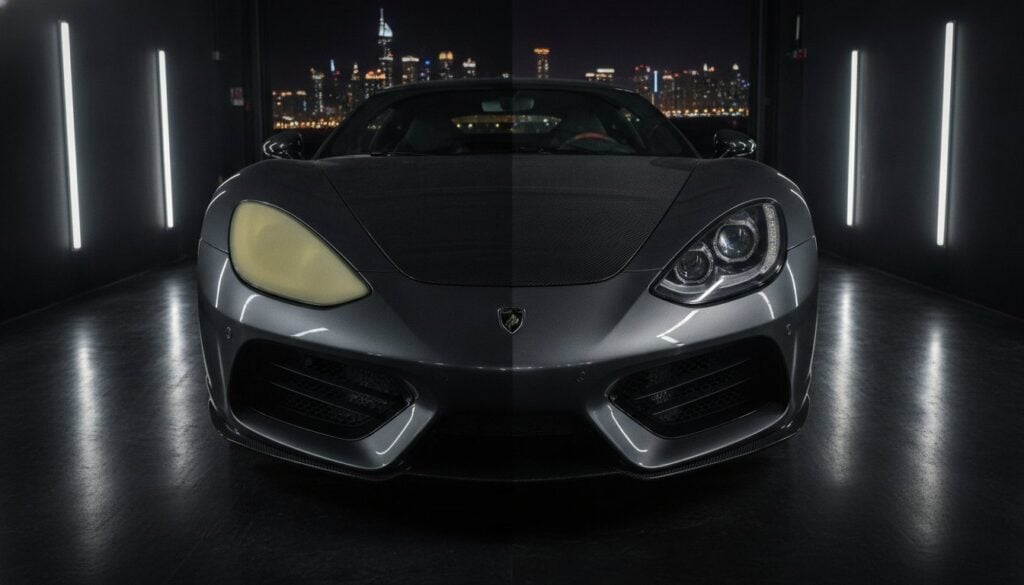
Hazed lenses can reduce light output by as much as 70 percent, effectively turning a high-performance machine into a safety hazard the moment the sun sets. You have likely noticed that unsightly amber film creeping across your lenses, dulling the sharp aesthetic of your vehicle and making night drives feel like guesswork. It is a frustrating reality for owners who demand perfection, especially when cloudy optics lead to failed safety inspections or diminished resale value.
Restoring yellowed headlights is not merely a cosmetic fix; it is a precision surgery that removes dead oxidation and grafts a new, resilient barrier onto the lens. In this 2026 guide, you will master the professional techniques required to achieve factory-level clarity and maintain that transparency for years. We will examine the essential mechanics of oxidation removal and why a standard polish is never enough without a sophisticated UV sealant. From high-tier restoration steps to the long-term protection offered by Paint Protection Film (PPF), you are about to discover how to reclaim your vehicle’s elite presence and ensure every drive is illuminated with absolute precision.
Key Takeaways
- Understand the molecular breakdown of polycarbonate lenses to identify why deep-seated oxidation requires more than just a superficial polish.
- Master a precise, multi-stage wet-sanding and refining technique to physically remove damaged layers and reveal hidden clarity.
- Learn the professional secrets to restoring yellowed headlights by following a disciplined grit progression that ensures a distortion-free finish.
- Secure your restoration against future solar damage by applying advanced barriers like Paint Protection Film (PPF) or high-performance ceramic coatings.
- Distinguish between temporary DIY myths and professional-grade solutions that offer factory-level aesthetics and long-term durability.
Understanding Headlight Oxidation: Why Polycarbonate Yellows
Polycarbonate is the engineering standard for modern automotive lighting. It’s lightweight. It’s incredibly impact-resistant. It’s also chemically sensitive. While glass lenses of the past remained clear for decades, they were heavy and hazardous in collisions. Today’s lenses offer superior design flexibility but depend on a fragile, factory-applied hardcoat for their longevity.
Mastering the art of restoring yellowed headlights requires a deep understanding of why these components fail in the first place. Solar radiation is the primary catalyst for degradation. Intense UV rays penetrate the lens surface and sever the molecular bonds of the plastic. This chemical breakdown, known as oxidation, manifests as a stubborn yellow film that compromises both form and function.
The headlight restoration process begins by acknowledging that this hazing is a structural failure of the outer layer. Beyond sunlight, environmental stressors accelerate the decay. Extreme engine heat, abrasive road debris, and harsh industrial chemicals all contribute to the erosion of the lens’s integrity. When these factors converge, the once-clear plastic transforms into an opaque barrier.
The Anatomy of a Modern Headlight
Most high-performance vehicles utilize high-grade polycarbonate for its durability. A factory UV-hardcoat, often measuring a mere 10 microns, provides the initial shield. When this microscopic barrier fails, the plastic becomes porous and begins to “chalk.” You’ll notice a rough, opaque texture that traps contaminants. It’s crucial to distinguish this from internal condensation. If moisture is trapped behind the lens, the issue is a compromised seal rather than surface oxidation.
Safety Risks of Foggy Lenses
Aesthetics are secondary to performance. Safety is the ultimate metric. Yellowed lenses can slash your lumen output by up to 70 percent, leaving you vulnerable during high-speed night maneuvers. This phenomenon, known as light scatter, occurs when the smooth surface becomes pitted at a microscopic level. Instead of passing through the lens in a coherent stream, the photons bounce off the oxidized particles in every direction.
This refraction creates a dangerous glare for oncoming drivers while significantly reducing your own sightline. restoring yellowed headlights is essential for maintaining roadworthiness and ensuring your vehicle passes stringent safety inspections. At Vanguard Motors Dubai, we view this as a precision requirement for any elite vehicle. Clear optics aren’t just about a polished look; they’re about maintaining the mechanical excellence your car was designed to deliver.
The Physics of Restoration: Sanding, Polishing, and Refining
Restoration is a mechanical recalibration of the lens surface. It is not a simple cleaning task. You are physically stripping away a layer of compromised polycarbonate to reveal the pristine material beneath. This process requires a calculated grit progression. Start too coarse, and you risk creating deep gouges that are impossible to buff out. Start too fine, and you merely polish the oxidation instead of removing it. Precision is everything.
When restoring yellowed headlights, the transition from heavy cutting to fine refining must be seamless. Each sanding stage must completely replace the scratch pattern of the previous one. This creates a surface that is structurally prepared for optical refinement. Heat management is a critical variable during this phase. High-speed polishing can easily reach temperatures that melt the polycarbonate surface, leading to permanent “plastic burn” that ruins the lens clarity.
The ultimate goal is to restore the refractive index of the lens. Smooth surfaces allow light to pass through without scattering or losing intensity. According to IIHS research on headlight safety, poor illumination is a primary factor in nighttime accidents. By refining the lens to a perfectly smooth state, you ensure the beam pattern remains focused and powerful, exactly as the engineers intended. This meticulous care is a core component of the Vanguard Motors Dubai approach to vehicle maintenance.
Wet-Sanding vs. Dry-Sanding
Lubrication is non-negotiable for professional results. Water acts as both a cooling agent and a transport for removed debris. Without it, friction creates heat that can warp the plastic. We recommend a cross-hatch pattern: sand horizontally with one grit, then vertically with the next. This allows you to visually verify when the previous scratches are gone. Watch for the “slurry.” This milky, often yellow-tinted runoff is the physical evidence of oxidation leaving the lens. Once the slurry turns pure white, you have reached fresh polycarbonate.
Compound Selection and Polishing
Once the lens reaches a uniform, frosted appearance, it is time for chemical correction. We utilize heavy cutting compounds to level the final sanding marks, typically from a 3000-grit finish. This is followed by a finishing polish to achieve mirror-like clarity. A dual-action polisher is the preferred tool for this stage. It provides the necessary oscillation to refine the surface while minimizing the risk of holograms or excessive heat. If you prefer a master technician to handle this delicate calibration, you can consult with our detailing team to ensure a factory-perfect result.
DIY vs. Professional Restoration: Evaluating Your Options
The internet is saturated with “hacks” for restoring yellowed headlights, ranging from baking soda pastes to the infamous toothpaste myth. While these household abrasives might provide a momentary improvement in clarity, they fail to address the underlying chemical degradation. You are essentially buffing the surface of a dead hardcoat without replacing the vital UV barrier. The result is a lens that yellows again within weeks, often returning in a worse state than before because the raw plastic is now completely exposed to the elements.
Off-the-shelf kits offer a middle ground but frequently fall short of professional standards. These retail products often include thin, solvent-based sealants that lack the durability of industrial-grade coatings. In contrast, a professional restoration utilizes high-torque machinery and high-solids UV inhibitors that bond at a molecular level. Maintaining this level of clarity is not just about vanity. It is a matter of meeting global safety benchmarks, such as those outlined in the Federal Motor Vehicle Safety Standards, which dictate strict performance parameters for illumination and beam pattern. Professional equipment ensures these standards are met with every pass.
Common DIY Pitfalls
Precision is the primary barrier to entry. Many enthusiasts leave behind “islands” of old oxidation because they fear the aggressive initial cut required to reach fresh material. This leads to a blotchy, uneven finish that distorts light. Conversely, excessive heat from improper machine use can thin the polycarbonate or cause “crazing,” which are micro-cracks that compromise the structural integrity of the lens housing. Without professional-grade masking tape and multi-layer shielding, a simple restoration can quickly escalate into an expensive paint repair job on the surrounding fenders.
When to Call an Expert
High-value assets require a higher standard of care. If you are managing a supercar with intricate carbon fiber surrounds or integrated aerodynamic ducts, the risk of a DIY error is simply too great. Professional technicians can also identify internal condensation or electrical faults that a surface polish cannot fix. For those seeking a total aesthetic transformation, integrating this service into a broader cosmetic car repair plan ensures every inch of your vehicle reflects elite quality. Vanguard Motors Dubai offers this level of meticulous care through our Vanguard Premium Package or our convenient mobile detailing van, bringing factory-grade precision directly to your location.
How to Restore Headlights: A Precision 5-Step Process
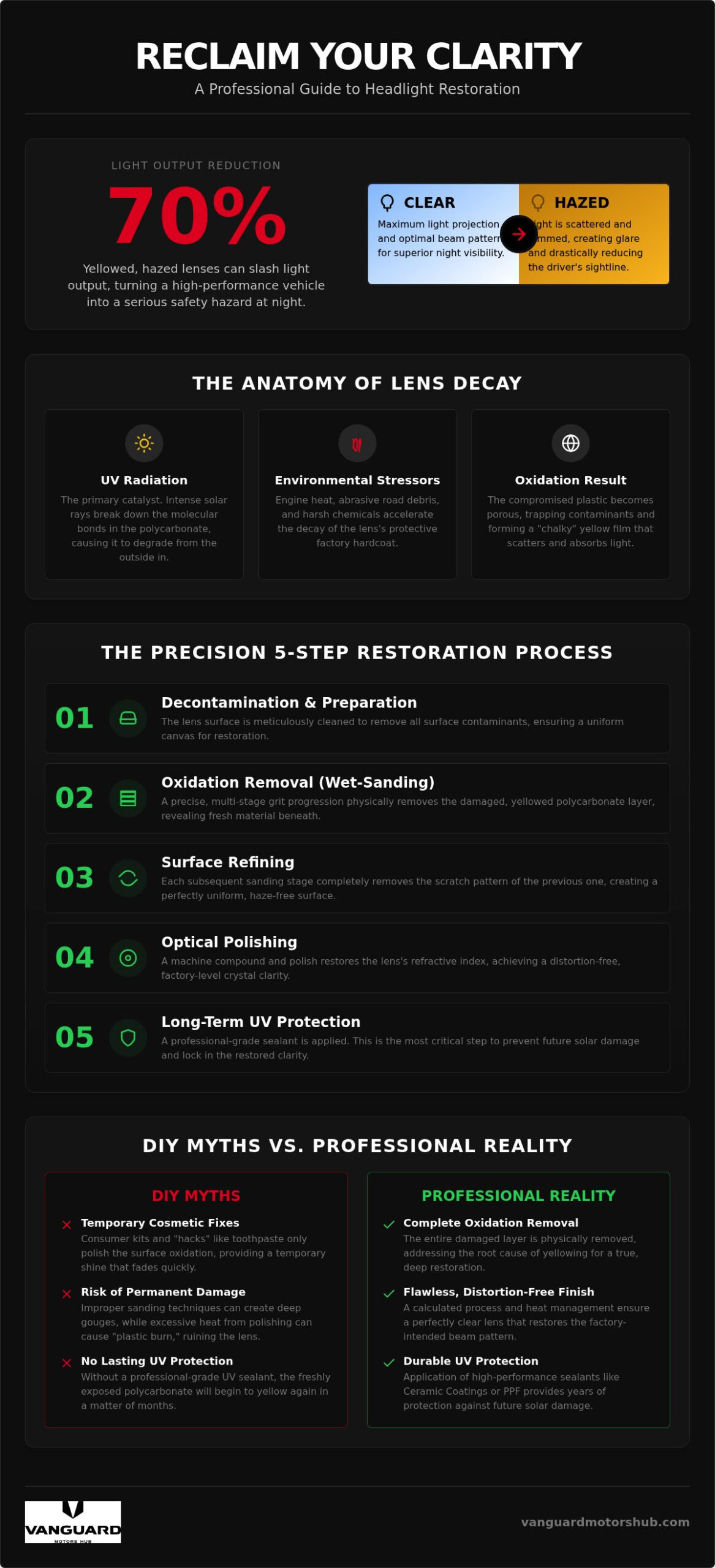
Achieving factory-level clarity is a disciplined progression of surface calibration. It is a linear journey from aggressive correction to microscopic refinement. When restoring yellowed headlights, skipping a single stage or rushing the grit progression will result in optical distortion. Follow this professional workflow to ensure your vehicle’s optics perform with absolute precision.
Step 1: Preparation and Masking
Meticulous preparation is the non-negotiable foundation of every professional restoration. Begin by decontaminating the lens with a high-concentration Isopropyl Alcohol (IPA) solution to strip away waxes, oils, and road film. This ensures the abrasives bite directly into the oxidized layer rather than sliding over surface contaminants.
Protection is equally critical. Use multiple layers of automotive-grade masking tape to shield the surrounding bodywork. This is vital when working near delicate carbon fiber car parts or custom paint finishes where a single slip of the sandpaper could cause permanent damage. Double-mask the edges to provide a safety buffer for the machine polishing phase.
Steps 2 and 3: The Cut and Refinement
The second step is the initial cut. Use an 800-grit to 1000-grit wet-sand to aggressively remove the failing factory hardcoat. You must sand until the lens has a uniform, frosted appearance and the yellow slurry ceases. Once the heavy oxidation is gone, move to the refinement phase. Progress through 1500, 2000, and finally 3000-grit sandpaper. Each stage must completely replace the scratch pattern of the previous grit to ensure the final surface is smooth enough for optical clarity.
Step 4: Machine Polishing Techniques
Polishing transforms the frosted polycarbonate into a transparent lens. Speed control is paramount here. Set your dual-action polisher to a moderate RPM, typically between 1200 and 1500, to generate enough friction for correction without reaching the melting point of the plastic. Use a high-quality cutting compound followed by a finishing polish.
- Maintain constant movement to prevent localized heat buildup.
- Apply light, even pressure to ensure the pad stays flat against the lens contour.
- Conduct a final inspection using a high-intensity light source to identify any remaining micro-haze or pigtail scratches.
Step 5: The UV Sealant Barrier
The final, most critical step is sealing the fresh polycarbonate. Raw plastic will yellow within weeks if left unprotected. Avoid standard car waxes, as the heat generated by headlight bulbs can melt these temporary layers. Instead, apply a dedicated UV-resistant hardcoat or a semi-permanent ceramic coating. This chemically bonds to the surface, providing a durable shield against solar radiation and environmental contaminants. For those who demand the highest tier of protection, you can book a professional restoration session to have our technicians apply an elite-grade UV barrier.
Beyond the Polish: Long-Term Protection with PPF and Ceramic
Polishing is a transformative act, but it leaves the lens vulnerable. Raw polycarbonate is chemically unstable when exposed to the sun. Restoring yellowed headlights without applying a high-performance barrier is a temporary victory. Within weeks, the oxidation will return, often more aggressively than before. You must transition from correction to preservation to ensure long-term clarity. This final stage is what separates a standard detail from a professional restoration.
Traditional car waxes are insufficient for this task. The thermal energy generated by modern headlight bulbs easily exceeds the melting point of standard carnauba waxes, causing the protection to evaporate. Ceramic coatings offer a superior alternative. They create a semi-permanent, chemically bonded UV shield that repels water and environmental contaminants while remaining stable under high temperatures. This molecular bond ensures that the lens remains clear through hundreds of heat cycles.
The PPF Advantage for Headlights
For those seeking the absolute pinnacle of preservation, paint protection film (PPF) is the definitive solution. Unlike liquid coatings, PPF provides a physical sacrificial layer. It absorbs the impact of high-velocity road debris, preventing the microscopic pitting that often precedes oxidation. Modern films feature advanced UV inhibitors that block the specific wavelengths responsible for yellowing.
The self-healing properties of premium PPF ensure that minor surface abrasions disappear with the application of heat, maintaining a flawless finish. This is the gold standard for maintaining optics on vehicles that see frequent highway use or extreme environmental exposure. It effectively freezes the lens in its restored state, providing a level of durability that no liquid sealant can match.
Integrating with Luxury Detailing
Headlight restoration is rarely an isolated task for the discerning owner. It is a vital component of a comprehensive supercar detailing regimen. Ensuring your optics match the pristine condition of your paintwork is essential for maintaining the vehicle’s elite aesthetic and resale value. While professional-grade ceramic sealants are excellent for daily commuters, luxury assets deserve the multi-layer protection of a Vanguard Premium Package.
Prolonging the life of your restoration requires disciplined maintenance. Avoid abrasive automated car washes that can mar the protective film or coating. A simple routine of pH-neutral soap and a clean microfiber towel is usually sufficient. By removing bird droppings and industrial fallout promptly, you prevent chemical etching. This proactive approach ensures that the clarity achieved during the process of restoring yellowed headlights remains a permanent feature of your vehicle’s profile.
Reclaim Your Vehicle’s Elite Presence
Achieving factory-level clarity is a multi-stage discipline that balances aggressive correction with microscopic refinement. You have learned that restoring yellowed headlights requires more than a temporary polish; it demands a permanent UV barrier to prevent the cycle of degradation from restarting. Whether you choose a high-solids ceramic coating or the physical shield of Paint Protection Film (PPF), your goal is to preserve the mechanical excellence and safety of your machine.
Vanguard Motors specializes in this level of meticulous care for supercars and luxury vehicles. Our technicians utilize industrial-grade equipment to ensure your optics meet the highest performance standards. For those with demanding schedules, our mobile detailing van brings this elite precision directly to your driveway, ensuring convenience without compromising on quality. It’s time to secure your vehicle’s aesthetic and functional longevity through professional expertise.
Restore your vehicle’s clarity with Vanguard Motors’ expert detailing services. Elevate your driving experience and ensure every night journey is illuminated with absolute precision.
Frequently Asked Questions
Is toothpaste a permanent solution for yellowed headlights?
Toothpaste is not a permanent solution. It acts as a mild abrasive that removes surface level oxidation but fails to address the underlying chemical breakdown of the polycarbonate. Most importantly, toothpaste lacks the UV inhibitors required to shield the raw plastic from solar radiation. Without a professional sealant, the lens will likely re-yellow within weeks. For lasting results, the process of restoring yellowed headlights must conclude with a high solids UV hardcoat or a ceramic barrier.
How long does a professional headlight restoration last?
A professional restoration typically lasts between two and five years depending on the protective layer applied. Standard clear coats usually offer two years of clarity, while high tier ceramic coatings can extend this duration. If you choose to apply Paint Protection Film (PPF), the protection can last for the life of the film itself. Environmental factors like intense sun exposure and harsh chemical cleaners will eventually influence the longevity of the results on your vehicle.
Can I restore headlights that have fogging on the inside?
Internal fogging cannot be corrected through surface restoration. This condition indicates a compromised seal or a crack in the headlight housing that allows moisture to enter the assembly. While restoring yellowed headlights addresses external oxidation and pitting, internal condensation requires the housing to be professionally resealed or replaced entirely. If you notice persistent water droplets or a mist behind the lens, a cosmetic surface treatment will not resolve the underlying structural failure.
Will restoring my headlights improve my night-time visibility?
Restoring your headlights will dramatically improve night-time visibility. Oxidized lenses can block up to 70 percent of a bulb’s light output, creating a dangerous situation during high speed maneuvers. By removing the opaque layer of dead plastic, you allow the light to pass through the lens with its intended intensity. This ensures a sharper beam pattern and a significantly longer throw, which are critical for safety and meeting national roadworthiness standards.
Why do headlights turn yellow again so quickly after cleaning?
Headlights yellow quickly after cleaning because the factory UV protection has been completely eroded. When you polish the lens without applying a new sealant, you expose the raw polycarbonate to oxygen and ultraviolet rays. This plastic is highly reactive and will begin to oxidize almost immediately. Professional restoration prevents this by grafting a new, chemically bonded UV barrier onto the surface, effectively replacing the microscopic shield that was lost to environmental decay over time.
Is it better to restore or replace oxidized headlights?
Restoration is almost always the superior choice for luxury and supercars. Replacing a modern LED or HID headlight assembly can cost thousands of dollars per unit. Unless the lens is physically cracked, deeply pitted, or suffering from internal component failure, professional restoration can return the optics to factory level clarity. It is a cost effective way to maintain your vehicle’s resale value and aesthetic appeal without the heavy expense of purchasing new hardware.
Can Paint Protection Film (PPF) be applied to headlights?
Paint Protection Film (PPF) is the definitive solution for headlight preservation. It provides a thick, sacrificial layer that absorbs the impact of road debris while blocking harmful UV rays. Unlike liquid sealants, PPF offers physical protection against stone chips and pitting. We highly recommend PPF as a core component of any high end detailing package to ensure that your restored lenses remain crystal clear through years of high performance driving.
Does headlight restoration affect the beam pattern of the lights?
Headlight restoration actually corrects and improves the beam pattern. When a lens is oxidized, the rough surface causes light photons to scatter in every direction, which creates glare for oncoming traffic and reduces your own sightline. By refining the surface to a perfectly smooth state, the light can travel in a coherent, focused beam. This restores the original engineering specifications of the lamp, ensuring maximum safety and optimal road illumination during night drives.