

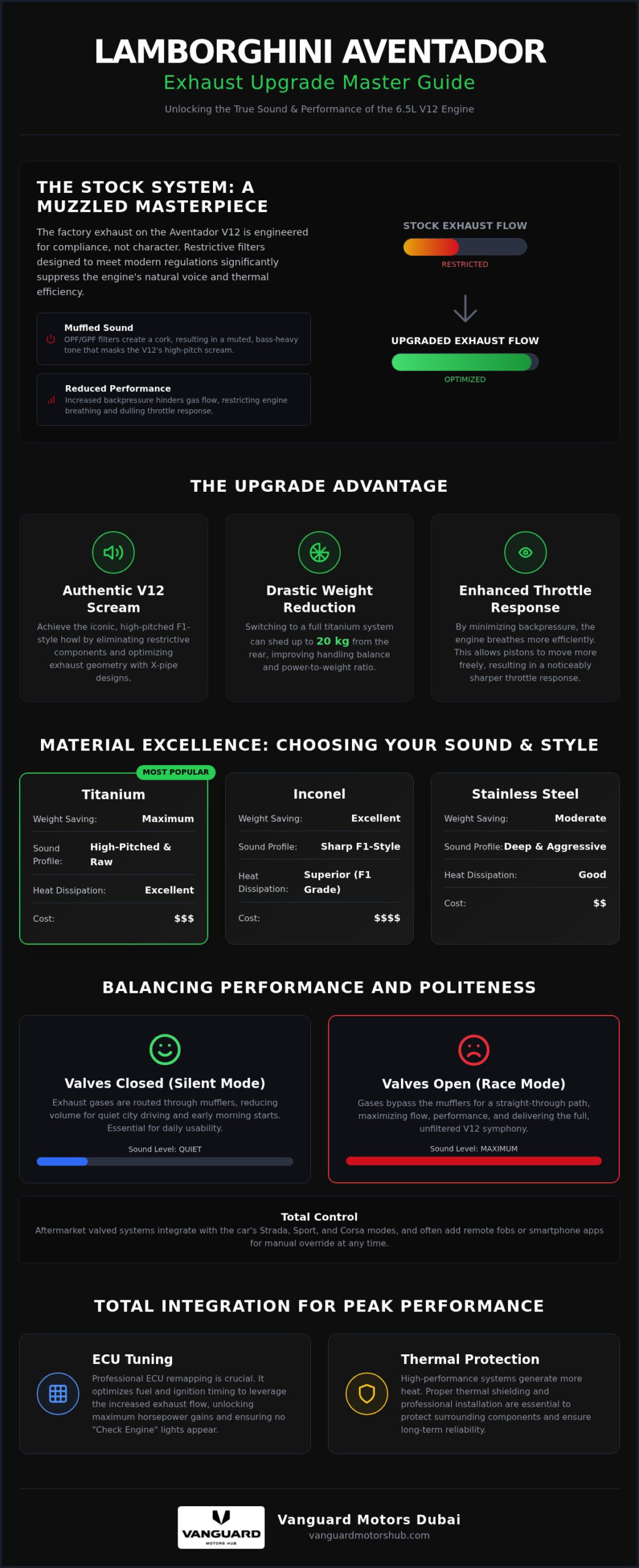
The factory exhaust on your Lamborghini Aventador is effectively a muzzle on a masterpiece. While the 6.5-liter V12 is an engineering marvel, modern regulations and restrictive OPF filters often stifle the raw, visceral soundtrack you expect from a Sant’Agata flagship. You aren’t alone in feeling that the stock setup lacks the soul and thermal efficiency required for peak performance. Investing in a Lamborghini Aventador exhaust upgrade is the most impactful way to reclaim that lost character and ensure your engine breathes as freely as it was designed to.
At Vanguard Motors Dubai, we understand that a bespoke conversion is about more than just volume; it’s about acoustic precision and heat management. This 2026 guide masters the technical nuances of aftermarket systems to help you achieve that elusive, high-pitched V12 scream while avoiding the irritation of cabin drone. You’ll learn how advanced materials like titanium can reduce weight by up to 20 kg and how custom carbon or ceramic tips provide the ultimate visual finish. We’ll break down the latest valved technology and ECU tuning options to ensure your upgrade delivers both a transformative sound and measurable performance gains.
Key Takeaways
- Unlock the authentic, high-pitched V12 scream by navigating the restrictions of modern factory OPF filters.
- Master the balance between aggressive track performance and refined street driving with advanced valved exhaust technology.
- Identify the ideal material for your Lamborghini Aventador exhaust upgrade by weighing the acoustic and weight-saving benefits of Titanium versus Inconel.
- Ensure long-term reliability and peak power gains through integrated ECU tuning and professional thermal protection.
- Learn the precision required to align high-performance exhaust tips with bespoke Mansory or Brabus body kit conversions.
The V12 Symphony: Why the Aventador Demands an Exhaust Upgrade
The 6.5-liter naturally aspirated V12 is the heart of the Raging Bull’s legacy. From the initial release of the LP700-4 to the final, refined Ultimae, the Lamborghini Aventador’s V12 engine has defined the supercar era. However, as global emissions standards became more stringent toward 2026, the factory soundtrack began to lose its edge. Modern iterations are equipped with Gasoline Particulate Filters (GPF) and Otto Particulate Filters (OPF). These components act as a physical cork, muffling the high-frequency notes that owners crave. A Lamborghini Aventador exhaust upgrade isn’t just about volume; it’s about restoring the mechanical purity that modern regulations have suppressed.
The relationship between backpressure and performance is critical here. While the factory setup is designed for global compliance, it often creates a muffled, bass-heavy tone that masks the engine’s true character. Enthusiasts generally fall into two camps: those seeking a deep, muscle-car-like rumble and those pursuing the iconic “F1-style” high-pitch scream. Achieving the latter requires a complete rethink of how exhaust gases are routed and managed.
Unlocking the 6.5L V12 Potential
The stock manifold and catalytic converter setup create significant bottlenecks for exhaust gases. By replacing these restrictive factory components, you allow the engine to breathe with far greater efficiency. One of the most immediate benefits is the drastic reduction in mass. Switching to a titanium Lamborghini Aventador exhaust upgrade can shed up to 20kg of weight from the rear of the car, which directly improves handling balance and power-to-weight ratios.
Exhaust backpressure is the resistance encountered by gases as they exit the engine; reducing this resistance allows the pistons to move more freely, which significantly sharpens throttle response.
Acoustic Engineering: Sound as an Art Form
Achieving a specific sound profile requires meticulous engineering of the exhaust geometry. Most enthusiasts seek the high-frequency howl that builds in intensity as you approach the 8,500 RPM redline. This is primarily achieved through X-pipe designs, where exhaust pulses from both cylinder banks merge and create a higher tonal pitch. In contrast, traditional H-pipes tend to produce a lower frequency that doesn’t quite suit the Aventador’s exotic persona.
Tonal quality is far more important than raw decibels. High-end systems utilize specialized resonators to cancel out low-frequency “booming” or drone, ensuring that the cockpit remains a place of sophisticated power rather than annoying vibration. It’s the difference between a loud car and a precision-tuned instrument. When you choose an elite system, you’re investing in a curated acoustic experience that matches the car’s visual drama.
Valved vs. Non-Valved Systems: Balancing Performance and Politeness
Selecting the right architecture for your Lamborghini Aventador exhaust upgrade involves a critical decision between raw, unfiltered volume and daily versatility. The V12 engine is naturally boisterous, but how you manage that sound determines whether your car is a refined grand tourer or a dedicated track weapon. Most owners opt for vacuum-actuated valves. These components allow the car to operate in a “Silent Mode,” which is essential for navigating residential areas or early morning departures without disturbing the peace. While the factory system manages these valves based on your selected drive mode, aftermarket solutions often provide much more granular control.
Integrating these systems with the Aventador’s Strada, Sport, and Corsa modes is a hallmark of elite engineering. In Strada, the valves remain closed to keep the cabin quiet and comfortable. In Corsa, they stay wide open to maximize flow. However, many enthusiasts prefer aftermarket valve controllers that allow for a manual override. This means you can enjoy the full V12 scream even at low speeds in Strada mode. Whether you’re evaluating Inconel, titanium, and stainless steel exhausts, the valved mechanism is the most sophisticated way to enjoy your car in the UAE’s diverse driving environments.
The Versatility of Valved Exhausts
Valved systems offer a “best of both worlds” scenario by maintaining necessary backpressure at low RPMs to preserve torque while opening up for maximum horsepower at the redline. Modern technology has expanded control options beyond the dashboard. You can now manage your exhaust note via smartphone apps, dedicated physical fobs, or even integrated steering wheel buttons. This level of customization is particularly useful for managing the “cold start” challenge. A V12 cold start is notoriously aggressive; having the ability to force the valves shut before you hit the ignition button is a courtesy your neighbors will appreciate. If you’re looking for the perfect balance of sound and control, you can consult with our specialists to find the right valved setup for your build.
Track-Ready Performance: The Non-Valved Route
Non-valved systems, often referred to as “Race Pipes,” are designed for the purist who demands the most visceral experience possible. By removing the heavy valve actuators and associated plumbing, these systems offer the absolute maximum weight savings. They provide a raw, uninterrupted path for exhaust gases, resulting in a consistent and piercing high-pitched note. However, this choice comes with a caveat: the risk of cabin drone. Without the ability to baffle the sound, long highway drives can become fatiguing as certain frequencies resonate through the chassis. These setups are ideal for dedicated track cars like the SVJ or show-stopping builds where social politeness is not a priority.
Material Excellence: Inconel, Titanium, and Stainless Steel
Selecting the right alloy for your Lamborghini Aventador exhaust upgrade is as much a performance decision as it is an acoustic one. While the factory system relies on heavy, mass-produced components, the aftermarket offers a hierarchy of materials designed to survive the intense thermal environment of the 6.5L V12. Each material brings a distinct personality to the car, influencing everything from the curb weight to the specific frequency of the exhaust note. Choosing between them requires an understanding of how metallurgy affects both the longevity of your investment and the visceral experience behind the wheel.
T304 stainless steel serves as the industry standard for durability and corrosion resistance. It’s a robust, cost-effective entry point for owners looking to replace restrictive factory mufflers. While it doesn’t offer the extreme weight-saving properties of exotic alloys, high-quality stainless systems provide a significant upgrade over OEM parts in both flow and longevity. It’s a reliable choice for a daily-driven Aventador, offering a deeper, more resonant tone than its lighter counterparts.
The Case for Inconel in the UAE
In the UAE, where ambient temperatures often exceed 40°C, thermal management is paramount for any high-performance build. Inconel is a nickel-chromium superalloy originally developed for aerospace and Formula 1 applications. It possesses incredible tensile strength at high temperatures, allowing manufacturers to use much thinner tubing, often just 0.6mm to 0.9mm, without risking structural failure. This “thin-wall” construction results in a system that is nearly as light as titanium but far more resilient to the intense heat cycles of a mid-engine V12. Inconel is the preferred material for Aventador manifolds because it maintains structural integrity at temperatures that would cause stainless steel to fatigue or crack.
Titanium: The Lightweight Champion
Titanium remains the gold standard for pure weight reduction. A full titanium Lamborghini Aventador exhaust upgrade can drastically alter the car’s center of gravity by removing substantial mass from behind the rear axle. Beyond the physical benefits, titanium has unique acoustic properties; it produces a crisper, sharper, and more “metallic” sound compared to the deeper resonance of steel. This material is particularly favored for its high-frequency “scream” at the top of the rev range.
Owners also value the aesthetic transformation associated with this metal. Over several heat cycles, titanium naturally oxidizes to a vibrant blue or purple hue, creating a visual signature that’s impossible to replicate with other materials. While it has different heat-soak properties than Inconel, its performance-to-weight ratio makes it the ultimate choice for those prioritizing agility and a piercing, exotic soundtrack.
Total Integration: ECU Tuning and Thermal Protection
A Lamborghini Aventador exhaust upgrade is a transformative mechanical change that demands a digital and thermal response. High-flow systems significantly alter the pressure and flow dynamics of the 6.5L engine. Without proper integration, the vehicle’s sophisticated sensor network may trigger “Check Engine” lights or enter a restricted performance mode. This happens because the stock ECU is calibrated for the backpressure of factory mufflers and OPF filters. Professional remapping is essential to synchronize the engine’s fueling map with the increased exhaust velocity, ensuring the V12 remains both reliable and responsive.
Thermal management is the second, equally critical half of the integration equation. The Aventador’s mid-engine layout creates an incredibly tight and hot environment. Upgrading your exhaust can actually help reduce engine bay temperatures, but only if the system is properly insulated. Without high-grade thermal blankets or ceramic coatings, the intense heat from the headers can damage sensitive electronics or warp nearby bodywork. Protecting your investment requires a holistic approach that pairs hardware with protective engineering.
Performance Software and Tuning
Optimizing the ECU isn’t just about clearing error codes; it’s about unlocking the true character of the car. A custom calibration can yield power gains typically ranging from 20 to 40hp by refining the ignition timing and air-fuel ratios. Many owners also request software adjustments to enhance the “pop and bang” overrun, providing a more aggressive acoustic profile during downshifts. This level of supercar exhaust modification ensures that the software perfectly complements the hardware. It’s a delicate balance that prioritizes peak performance without compromising the long-term health of the V12 powertrain.
Heat Management Strategies
The sheer volume of heat generated by a high-revving V12 can be destructive to aesthetic components. Rear bumpers and expensive carbon fiber diffusers are particularly vulnerable to the “flame-throwing” nature of high-flow exhausts. We utilize gold heat foil and advanced ceramic heat shields to create a thermal barrier between the exhaust piping and the chassis. This is also vital for protecting your Paint Protection Film from the extreme heat exiting the tips. High-quality thermal blankets can reduce surface temperatures by hundreds of degrees, preserving the integrity of your paint and carbon fiber. If you’re ready to integrate these elite performance and protection standards into your build, contact our technical specialists for a consultation.
The Vanguard Precision: Professional Installation for Elite Cars
Executing a Lamborghini Aventador exhaust upgrade requires a surgical level of precision that goes far beyond simple bolt-on mechanics. The mid-engine architecture of the Aventador is notoriously compact; this necessitates the complete removal of the rear bumper and various heat shields to access the primary exhaust components. This process demands specialist tools and a deep understanding of Lamborghini’s intricate fastening systems. At Vanguard Motors Dubai, we treat every installation as a component of a larger bespoke conversion, ensuring that the new hardware integrates seamlessly with the car’s existing systems.
Precision fitment is especially critical when the vehicle is equipped with Mansory or Brabus body kits. These high-end aerodynamic packages often feature aggressive carbon fiber diffusers with tight tolerances. Even a millimeter of misalignment can result in the exhaust tips touching the carbon, which leads to unwanted vibrations or thermal damage. Our technicians prioritize the exact centering of the exit pipes to ensure that the visual impact matches the acoustic performance.
Aesthetic Synergy: Carbon and Cosmetic Finishing
Choosing the right finish for your exhaust tips is the final step in personalizing your Lamborghini Aventador exhaust upgrade. These options include:
- Matte Carbon: A subtle, high-tech finish that complements traditional carbon weaves.
- Forged Carbon: A modern, marble-like aesthetic for a truly unique look.
- Ceramic Black: A stealthy, heat-resistant coating for a minimalist appearance.
Because the area surrounding the exhaust is subject to extreme stress, we also specialize in Carbon Fibre Car Parts Repair. This ensures that any existing heat damage to the diffuser is corrected before the new system is fitted. We don’t just install parts; we restore and enhance the structural and aesthetic integrity of your vehicle’s rear assembly.
Final Quality Assurance and Testing
Rigorous testing is the hallmark of a professional installation. Once the system is secured, we perform comprehensive leak testing and verify the operation of the vacuum-actuated valves. It’s vital that the valve controllers respond instantly to drive-mode changes or remote commands. After the mechanical checks, the car undergoes road testing to ensure there’s zero cabin drone at cruising speeds and that the tonal quality is perfect across the entire RPM range.
Maintaining a clean, professional workshop environment is essential for supercar care. We protect every surface of your vehicle during the installation process, from the paintwork to the interior leather. This meticulous attention to detail ensures that your Aventador leaves our facility in better condition than it arrived, ready to deliver a world-class driving experience.
Reclaiming the V12 Legacy
Transforming your vehicle into an acoustic masterpiece requires more than just a simple part swap. A successful Lamborghini Aventador exhaust upgrade balances the visceral power of the 6.5L engine with sophisticated thermal management and digital integration. By selecting elite materials like Inconel or Titanium, you don’t just enhance the sound; you improve the car’s agility and heat dissipation. This process ensures your supercar performs as aggressively as it looks on the UAE’s open roads.
At Vanguard Motors Dubai, we specialize in the meticulous care required for such elite customizations. As official installers for Mansory and Brabus kits, our team combines mechanical excellence with aesthetic preservation, including specialized carbon fiber and PPF integration. We provide national coverage for owners who demand the highest standards of precision and performance. Elevate your Aventador V12 sound with Vanguard Motors Dubai and experience the thrill of a truly unrestricted engine today.
Frequently Asked Questions
Will an exhaust upgrade void my Lamborghini Aventador warranty?
Modifying your car with a Lamborghini Aventador exhaust upgrade may affect specific parts of your manufacturer warranty related to the engine and exhaust system. While the entire vehicle warranty isn’t automatically voided, any failure directly attributed to the aftermarket component won’t be covered under the standard terms. We recommend consulting with your local service center to understand their specific stance. Many owners find that the benefits of improved sound and thermal efficiency outweigh these limited risks.
What is the best exhaust material for high-heat environments like the UAE?
Inconel is the superior choice for the extreme ambient temperatures found throughout the UAE. This nickel-chromium superalloy maintains its structural integrity at temperatures that cause stainless steel to weaken or crack. Its ability to dissipate heat rapidly protects the engine bay during intense summer drives. While titanium is excellent for weight reduction, Inconel’s resilience to high-heat cycles makes it the preferred material for bespoke conversions in desert climates.
Do I need to tune my ECU after installing a new exhaust system?
Yes, an ECU tune is strongly recommended after a Lamborghini Aventador exhaust upgrade to ensure the engine operates within safe parameters. Removing restrictive factory filters changes the air-fuel ratio, which can trigger warning lights or cause the engine to run lean. A professional remap optimizes performance, clears diagnostic errors, and unlocks the full horsepower potential of your new high-flow system. It’s an essential step for maintaining long-term reliability and performance.
How much weight can I save with a titanium exhaust upgrade?
Switching from a heavy factory setup to a high-grade titanium system can save up to 20kg of mass. This reduction is significant because it removes weight from the very rear of the chassis, which improves the overall weight distribution and handling agility. For track-focused models like the SVJ, this weight saving directly translates to faster lap times and sharper turn-in response. It’s one of the most effective ways to improve the car’s power-to-weight ratio.
What is the difference between an X-pipe and a straight pipe for the V12?
An X-pipe design merges the exhaust pulses from both cylinder banks, creating a higher-pitched, F1-inspired scream that enthusiasts crave. In contrast, straight pipes or H-pipes keep the banks separate, resulting in a deeper, more traditional V12 rumble that lacks the exotic tonal quality of an X-pipe. For the Aventador, the X-pipe is almost always the preferred choice for those seeking that iconic, high-frequency howl as the engine approaches its 8,500 RPM redline.
Can I control the exhaust valves using the factory Lamborghini buttons?
Most high-end valved exhaust systems are designed to integrate perfectly with the factory Lamborghini drive mode buttons. In Strada mode, the valves remain closed for a refined experience. Switching to Corsa or Sport opens the valves to unleash the full V12 soundtrack. Some aftermarket systems also include a dedicated remote or smartphone app, giving you manual control over the volume regardless of which drive mode you’ve selected on the steering wheel.
How do I prevent my rear bumper from melting with a high-flow exhaust?
Preventing thermal damage to your rear bumper requires a combination of ceramic coatings and high-quality thermal blankets. These barriers reflect the intense radiant heat away from the carbon fiber and paintwork. We also utilize gold heat foil on the inner surfaces of the bumper to provide an extra layer of protection. These steps are vital for cars that produce aggressive overrun flames, as they ensure your aesthetic components remain pristine despite the extreme temperatures.
What is the best exhaust for the Aventador SVJ specifically?
The SVJ demands a system that respects its active aerodynamics and high-output engine characteristics. A valved Inconel system is the gold standard for this model, as it provides the necessary heat management for the top-exit exhaust design. It preserves the high-pitched signature of the SVJ while shedding weight and improving throttle response. Pairing this with a bespoke ECU tune ensures that the ALA system and powertrain work in perfect harmony for maximum performance.